Orny
In the late 15th century Orny's church of Notre-Dame was given a bell tower with a stone spire, a design borrowed from the Rhône valley and the Chablais.
Entry based on 7 sources · Our method · Reusable text (CC BY-SA)
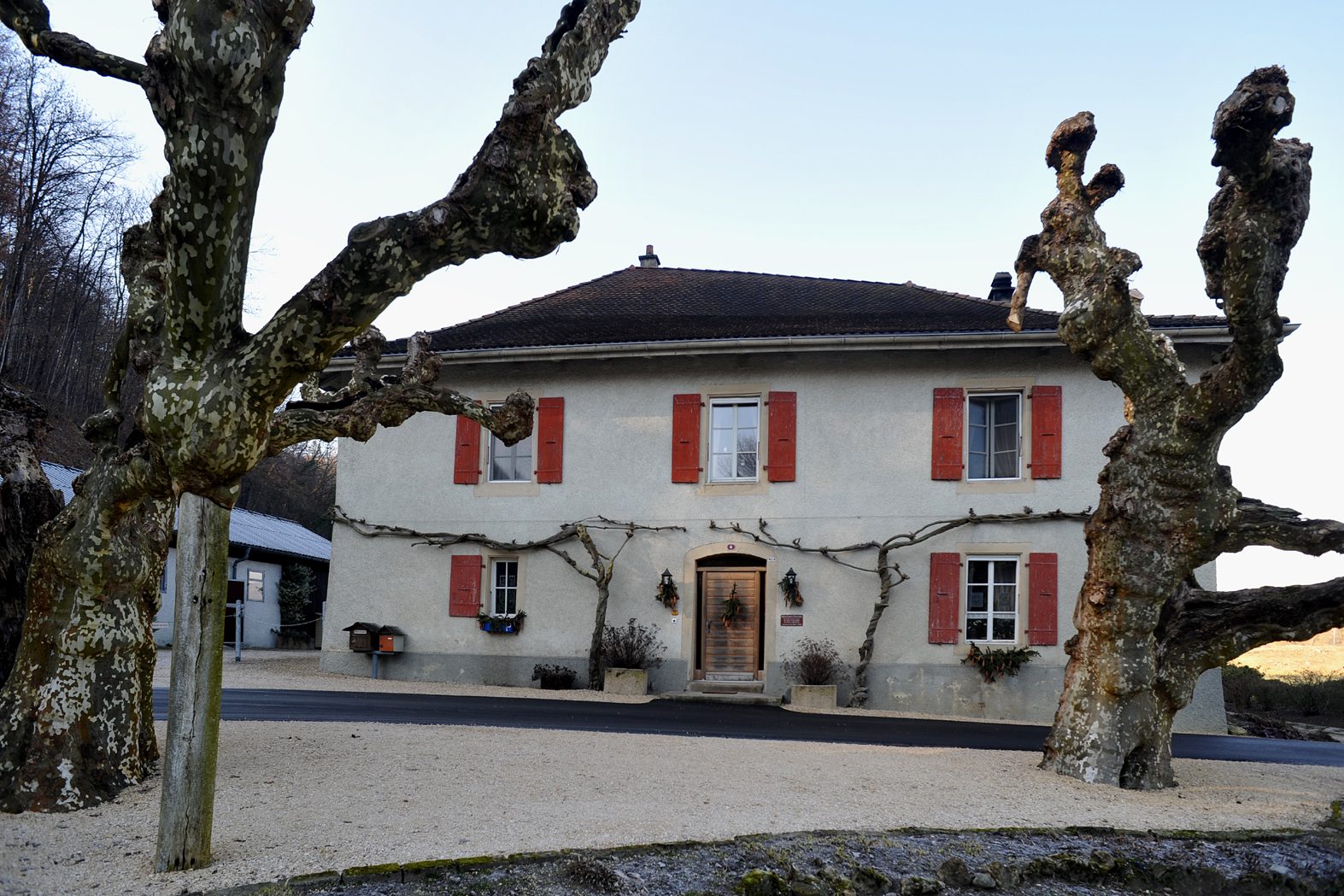
Origin of the name Orny
The place is mentioned in 1011 as «in Orne». The forms «Orniaco», «Ornei», «Ornie» and «Ornier» are also given before «Orny», but this series is uncertain. The name «Orny» still awaits an explanation.[1][2]
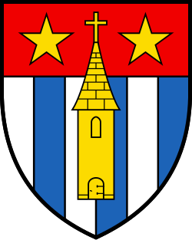
Coat of arms of Orny
Paly argent and azure, on a chief gules two mullets or, a bell tower of the same overall. The shield is covered with vertical stripes, alternately white and blue. The top is red and bears two yellow stars. A yellow bell tower lies over the whole. Adopted in 1926, the arms take up those borne by the barons of La Sarraz from the 14th century.[6][2]
Founding of Orny
The site was inhabited long before the first written records. A protohistoric level and many Roman remains have been identified there: a road, a 2nd-century milestone, a settlement with a mosaic and a Gallo-Roman cremation cemetery. In the Middle Ages Orny was a fief of the Grandson family and belonged to the great barony of La Sarraz. Its lords gave the church, already a parish church, to the abbey of the Lac de Joux before 1177. The fief later passed to the Gingins and, when the barony was broken up, the lordship of Orny became the appanage of a cadet branch of that family. The municipality includes the village and the locality of Entreroches.[1][2]
History of Orny
Protohistory. Occupation attested by a protohistoric level, beneath a later cemetery.[1]
Roman period. Road, 2nd-century milestone, tiles, settlement with a mosaic and Gallo-Roman cremation cemetery.[1]
1011. First written mention, in the form «in Orne».[1]
1177. The church of Notre-Dame is attested. The lords of La Sarraz had given it to the abbey of the Lac de Joux.[1][2]
1228. The church is a parish church by this date at the latest.[1]
1453. Orny has 45 hearths.[1]
late 15th century. The church is given a bell tower with a stone spire, borrowed from the architecture of the Rhône valley and the Chablais.[1]
1536-1798. Orny belongs to the bailiwick of Romainmôtier. After the Reformation the parish becomes an annex of La Sarraz.[1]
1542. The fief passes to the Gingins.[1]
1626. Break-up of the barony of La Sarraz. The lordship of Orny becomes the appanage of a cadet branch of the Gingins.[1]
1645. Pompaples is detached from the lordship of Orny.[1]
18th century. Victor de Gingins (1690-1758) has the present castle built.[1]
1795. Construction of a building housing a schoolroom, a wine press and a bread oven.[1]
1798-2007. Orny belongs to the district of Cossonay.[1]
1871. The castle is bequeathed to the cantonal institution for the sick, the incurable and infirm elderly. It becomes the EMS Cottier-Boys care home, named after the donor.[1]
1926. Adoption of the coat of arms, taking up that of the barons of La Sarraz with the church tower.[2]
2002. Restoration of the bread oven of 1795.[1]
2005. Agriculture still provides 38% of jobs.[1]
2008. With the new territorial organisation of Vaud, Orny joins the district of Morges.[1][3]
Population of Orny
Sources and references: [1][4]
| 1453 | 45 hearths (households) |
| 1764 | 180 |
| 1798 | 214 |
| 1850 | 301 |
| 1900 | 302 |
| 1950 | 306 |
| 2000 | 334 |
| 2025 | 525 |
Families of Orny
Citizen families before 1800. Michaud, Pavillard, Tissot and Vannod, with no precise date. The Potterat family, from Chavannes-le-Chêne VD, was admitted in 1766.[7]
In the 19th century. Chauffard, Jaquinet, Juvet and Messeiller, as well as the Favre family of Château-d'Oex VD, with no precise date.[7]
From 1901 to 1962. In 1950 the Canola family, from Italy, and the Ghica family were registered. They were followed by the Romanens of Sorens FR (1956), the Bürki of Brenzikofen BE (1957) and the Majola, from Italy (1959).[7]
Notable people of Orny
Ernest Correvon. A painter and restorer, he renovated the church of Orny in the early 20th century.[2]
Economy of Orny, past and present
Fields and market gardens. In 2005 farming still provided 38% of jobs in Orny. About ten farms and market gardens are still at work there, and the village shop sells their produce.[1][2]
The Cottier-Boys care home. Housed in the castle, the Cottier-Boys care home has 29 beds. It is the last state-run care home still in operation. The Altage Foundation took over its management on 1 January 2025.[1][2]
Historic sites in Orny
Church of Notre-Dame. Attested in 1177 and a parish church by 1228 at the latest, the church received towards the end of the 15th century a bell tower with a stone spire, inspired by the architecture of the Rhône valley and the Chablais. It keeps a Gothic chapel from before the Reformation. Its wall paintings are said to be among the oldest in the canton of Vaud.[1]
Orny castle. Built in the 18th century for Victor de Gingins (1690-1758), the castle was bequeathed in 1871 to the cantonal institution for the sick, the incurable and infirm elderly and now houses the EMS Cottier-Boys care home.[1]
Building of 1795 and bread oven. This municipal building combined a schoolroom, a wine press and a bread oven, restored in 2002.[1]
Village listed in the ISOS. The whole village of Orny is reportedly listed in the Federal Inventory of Swiss Heritage Sites of national importance (ISOS).
Remains in Orny
Roman remains. The area has yielded numerous Roman remains: a road alignment, a 2nd-century milestone, tiles, a settlement decorated with a mosaic, and a Gallo-Roman cremation cemetery set on a protohistoric level.[1]
Protected heritage in Orny
Cultural property of national significance (A objects in the PCP inventory)[5]
- Ancien canal d'Entreroches - Époque moderne (cf. également Eclépens)
- Le Mormont / Pévraz / Tilérie, sites du Néolithique - Époque romaine (cf. Eclépens & La Sarraz)
Cultural property of regional significance (B objects)[5]
- Château (act. asile) avec ancien rural et fontaine
- Eglise réformée Notre-Dame
- Maison de l'éclusier du canal d'Entreroches
Legends of Orny
The «Rupiants». The inhabitants of Orny are nicknamed «les Rupiants». According to tradition, they earned this nickname at a gargantuan feast paid for, long ago, by the sale of a piece of forest in the Risoux.[2]
Traditions and festivals in Orny
Saturday bread and the press. On Saturdays the villagers bake their bread together in the village oven, looked after by the Société du four à pain. In autumn Orny still runs one of the last traditional apple presses.[2]
The ten-yearly festival. Every ten years the Rupiants hold a village festival.[2]
Sources
- Dictionnaire historique de la Suisse, « Orny » (Patrick-R. Monbaron, version du 13.08.2009)
- Feuille des avis officiels du canton de Vaud, « Alphabet des communes vaudoises : Orny »
- État de Vaud, communiqué du 12.07.2007, « Organisation des préfectures et adaptation au nouveau découpage territorial »
- Statistique Vaud, « Population résidante permanente au 31 décembre 2025 »
- Federal Office for Civil Protection (FOCP), Swiss Inventory of Cultural Property (PCP), list for the canton of Vaud (as of 1.1.2026)
- IPI, Swissreg, emblems database: coat of arms of Orny (no. 101406)
- Register of Swiss Surnames, 3rd edition (1989), search Commune "Orny", Canton VD
Published by Sébastien Jörg ·
Other villages near Orny
Missing information, or do you have a source? Suggest a correction or addition. Every submission is checked before it's published.
Suggest a change