Bavois
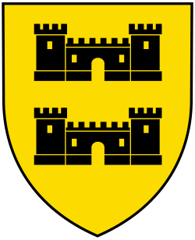
Château-Dessus and Château-Dessous, perhaps born of the divisions of the lords of Joux's lordship, both appear on the coat of arms of this village on the Orbe plain.
Entry based on 15 sources · Our method · Reusable text (CC BY-SA)
Origin of the name Bavois
The name appears around 1200 as « Bavoies », then « Bavoës » and, in 1536, « Bavoy ». Also reported are « Baoies » (« Albertus de Baoies ») around 1200, « Bavoes » in 1225, « Bayoies » in 1269, « Bayoes » in 1454 and, as early as 1182, « ecclesia de Baises ». The origin and meaning of the name reportedly have not yet found a satisfactory explanation.[1][3]
Coat of arms of Bavois
Or, two castles sable, the gates and windows of the field. On a yellow field stand two black castles, whose gates and windows show the yellow background. Adopted in 1924, the arms depict the two castles that overlooked the village under the Ancien Régime. The black and yellow come from the arms of the lords of Joux, the earliest known lords of Bavois.[9][2]
Founding of Bavois
Who founded Bavois is not known. The site was inhabited from the Bell Beaker culture to the Late Bronze Age (2400-1200 BC). Two Roman roads crossed the territory, and an Early Medieval cemetery, Burgundian or Merovingian, has been found here. In the Middle Ages Bavois became the seat of a lordship of the lords of Joux, who founded a small fortified town there. The successive divisions of the lordship through inheritance reportedly explain the existence of two castles, Château-Dessus and Château-Dessous, but this is not established. The municipality includes the village, Les Bordes (Bavois-Dessus) and the hamlet of Le Coudray. The inhabitants are nicknamed «lè z'Agasse», the magpies.[1][2][3]
History of Bavois
2400-1200 BC. Prehistoric settlement from the Bell Beaker culture to the Late Bronze Age.[1]
Roman period. Two Roman roads cross the territory, one linking Entreroches to Yverdon, the other Pontarlier to Moudon.[1][3]
Early Middle Ages. A cemetery is laid out. Whether it is Burgundian or Merovingian remains open. It is discovered in the mid-20th century, and further graves are uncovered in 2020.[3]
12th century. The lordship of Bavois belongs to the lords of Joux. The church of Saint-Léger is mentioned.[1]
1263. The lords of Joux, lords of Bavois, are vassals of Peter II of Savoy.[1]
1358. End of the lordship of the lords of Joux over Bavois.[1]
1386. Mention of the small fortified town founded at Bavois.[1]
1403. Last mention of the town, in decline from this date.[1]
1416. Bavois has 85 hearths.[1]
15th century. Enlargement of the church choir and construction of a chapel.[1][2]
1525. Château-Dessous is known from this date.[2]
1536. With the Bernese conquest, Bavois is attached to the bailiwick of Yverdon. With the Reformation the church becomes a dependency of Chavornay. The commune is run by a Council of Twelve and has a local court of justice.[1][3]
1798. Bavois joins the district of Orbe.[1]
1836. Construction of the village school.[2]
1914-1918. During and after the First World War, the company Laminoirs et Câblerie de Cossonay reportedly extracts peat from the Marais des Puits using Decauville railways.
1924. Adoption of the coat of arms: Or, two castles Sable, recalling the two castles that dominated the village.[2]
1972. Partial land consolidation.[1]
1981. Start of drainage works in the Orbe plain, with protection of the peat bogs.[1]
2008. With the new districts coming into force on 1 January, the municipality joins the district of Jura-Nord vaudois.[5][6]
Population of Bavois
Sources and references: [1][7]
| 1416 | 85 hearths (households) |
| 1681 | 38 houses |
| 1764 | 317 |
| 1850 | 492 |
| 1900 | 566 |
| 1970 | 407 |
| 1990 | 496 |
| 2025 | 1'055 |
Families of Bavois
De Joux. A noble family named after the castle of Joux, near Pontarlier, between Vaud and Franche-Comté. Lords of Bavois, Corcelles-sur-Chavornay and Suchy, in the 13th century they sold their support dearly to both the Chalon and the Savoy. After the death of Henri III in 1326, the Blonay took over the Joux lordships.[10][1]
Pillichody. A family from Yverdon. In 1782 Jean Georges Pillichody inherited the lordship of Bavois-Dessus from his uncle François-Barthélemy. He also succeeded him as bailiff's lieutenant and castellan of Yverdon.[11]
Burgher families before 1800. Agasse, Agassis, Agassiz, de Palézieux dit Falconnet, Monnay, Oulevay and Rochat, with no precise date.[15]
Show more families (2)
In the 19th century. Aubertet, Carel, Carrel, Chalet, Clerc, Crausaz, Favre and Hermin, as well as the Jean-Mairet, from La Sagne NE, all with no precise date.[15]
From 1901 to 1962. Thirteen entries. The Dondon, from France, opened the series in 1932, followed by the Zutter in 1936. The year 1956 counts five: Lehmann of Hindelbank BE, Montandon of Travers NE (registered a second time in 1959), Oppliger of Sigriswil BE, Roulin of Pont-la-Ville FR and Schmid of Köniz BE. In 1957 came the Brunisholz of Praroman FR, the Hug of Ferenbalm BE and the Kohli of Saanen BE, then the Matthey in 1958. Two families came from Sweden: the Silfverberg in 1954 and the Silferberg, the last entry, in 1962.[15]
Notable people of Bavois
Jean Georges Pillichody (Bern 1715 - Lausanne 1783). Jurist, lord of Bavois-Dessus from 1782. He was one of the leading figures of the French-Swiss school of natural law and co-founded the Yverdon library in 1761.[11]
Louis Agassiz (Môtier 1807 - Cambridge, Massachusetts, 1873). Naturalist and citizen of Bavois. After his research in Neuchâtel on fossil fish and glaciers, he taught zoology and geology at Harvard from 1847 and founded its Museum of Comparative Zoology in 1859. He was also the leading theorist of polygenism in the United States, and the Federal Council condemned his racist theories in 2007 and 2015.[12]
Alexandre Agassiz (Neuchâtel 1835 - Atlantic Ocean 1910). Son of Louis and likewise a citizen of Bavois. Made wealthy by copper mines on Lake Superior, he funded his own research as a zoologist and oceanographer and in turn directed Harvard's Museum of Comparative Zoology.[13]
Alfred Oulevay (Bavois 1868 - Pompaples 1927). The son of a Bavois farmer. A travelling salesman, he founded a biscuit and wafer business in Morges in 1899, which became Switzerland's leading biscuit maker after the war.[14]
Economy of Bavois, past and present
A shop and a motorway service area. In 2018 young people from the village set up the Petite Épicerie, where residents can shop at any hour. Beside the motorway, the Bavois-Nature service area looks out over the Orbe plain.[3]
Historic sites in Bavois
Church of Saint-Léger. Romanesque and Gothic church mentioned from the 12th century and dedicated to Saint Leodegar (saint Léger). Its origins are said to go back to the 11th century. Its 12th-century choir was enlarged in the 15th century, and a chapel was added in the 15th century, before the Reformation. It preserves wall paintings from the 14th and 16th centuries. Cultural property of regional importance.[1][2][4]
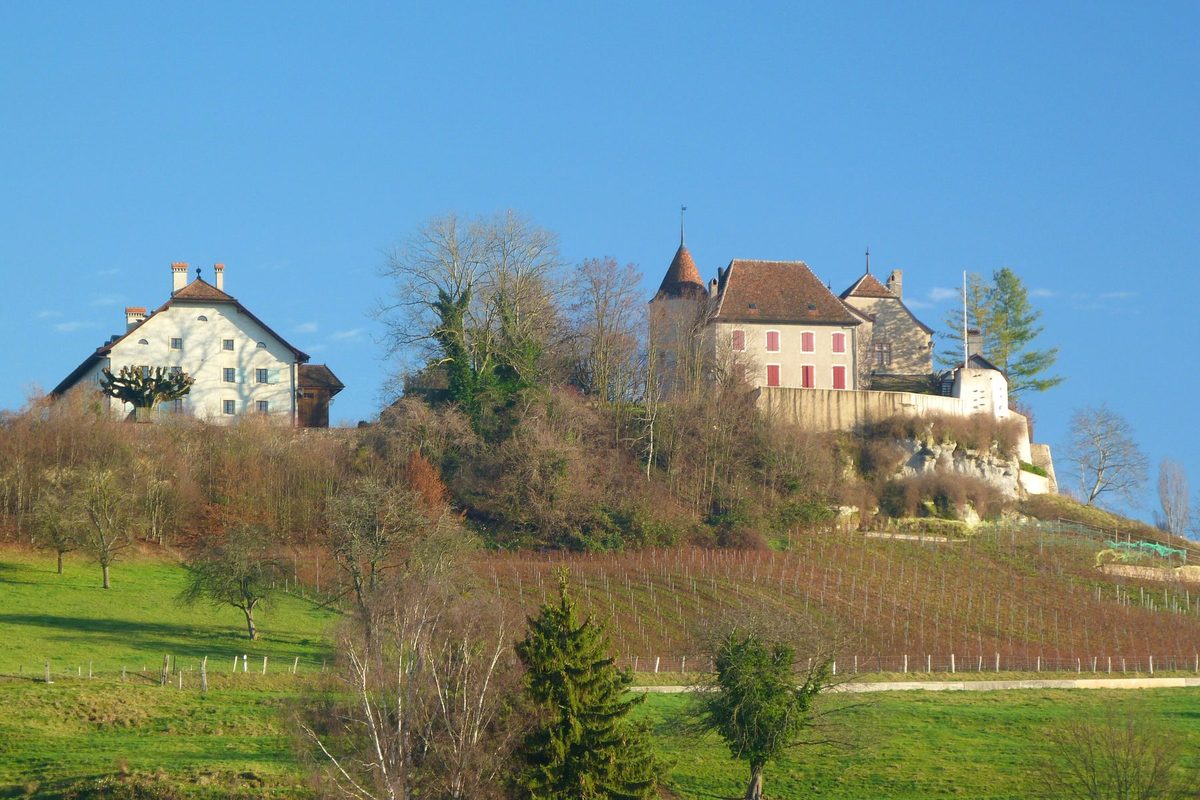
Château-Dessus. The fortress overlooking the village dates from the 14th-15th centuries. A first building probably goes back to the 13th century, though this is not established. It was restored in the 1960s.[2]
Château-Dessous. Built beside the road to Chavornay, it looks like a manor house with an agricultural purpose. It is known since 1525 and has been entirely renovated.[2]
Former school. School building of 1836, converted in 1992 into a childcare facility for schoolchildren and flats.[2]
Remains in Bavois
Prehistoric, Roman and Early Medieval traces. The territory has yielded traces of settlement from the Bell Beaker culture to the Late Bronze Age, remains of two Roman roads and an Early Medieval cemetery, discovered during construction work in the mid-20th century. Excavations by the cantonal archaeology service uncovered further graves in 2020.[1][3]
Protected heritage in Bavois
Cultural property of regional significance (B objects)[8]
- Château avec four et fontaine
- Eglise réformée Saint-Léger
Traditions and festivals in Bavois
The Abbaye. The Bavois Abbaye festival is held every other year.[3]
Bread oven bakes. The village has a bread oven society, which holds bakes among the communal events.[3]
Sources
- Dictionnaire historique de la Suisse, « Bavois »
- Commune de Bavois, « Présentation de la commune »
- Feuille des avis officiels du canton de Vaud, « Alphabet des communes vaudoises : Bavois »
- Office fédéral de la protection de la population, Inventaire PBC, liste cantonale VD (état au 1.1.2026)
- Canton de Vaud, Loi sur le découpage territorial (LDecTer, RSV 132.15) du 30 mai 2006
- État de Vaud, communiqué du 12.07.2007, « Les préfètes et les préfets sont attribués aux nouveaux districts »
- Statistique Vaud, « Population résidante permanente au 31 décembre 2025 »
- Federal Office for Civil Protection (FOCP), Swiss Inventory of Cultural Property (PCP), list for the canton of Vaud (as of 1.1.2026)
- IPI, Swissreg, emblems database: coat of arms of Bavois (no. 101885)
- Historical Dictionary of Switzerland (HDS), article "Joux, de"
- Historical Dictionary of Switzerland (HDS), article "Pillichody, Jean Georges"
- Historical Dictionary of Switzerland (HDS), article "Agassiz, Louis"
- Historical Dictionary of Switzerland (HDS), article "Agassiz, Alexandre"
- Historical Dictionary of Switzerland (HDS), article "Oulevay, Alfred"
- Register of Swiss Surnames, 3rd edition (1989), search Commune "Bavois", Canton VD
Published by Sébastien Jörg ·
Other villages near Bavois
Missing information, or do you have a source? Suggest a correction or addition. Every submission is checked before it's published.
Suggest a change