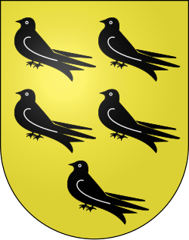
Corcelles-sur-Chavornay
In 888 a vassal named Vodelgise gives the bishop of Lausanne lands at Corcelles that he had received three years earlier from Emperor Charles the Fat.
Entry based on 5 sources · Our method · Reusable text (CC BY-SA)
Origin of the name Corcelles-sur-Chavornay
The village appears in 885 (or 887) as «Corceles». Like other places of the same name in French-speaking Switzerland, it reportedly takes its name from the Latin «curticella», a diminutive of «curtis» (rural estate, farmyard). For Corcelles-sur-Chavornay in particular, this explanation is uncertain.[1][2]
Founding of Corcelles-sur-Chavornay
Remains found on its territory show that the site was occupied in Roman times. At the end of the 9th century, lands at Corcelles passed to the bishop of Lausanne. The village then developed as a feudal dependency of the lordship of Bavois. In the 16th century it became the seat of an independent lordship.[1][2]
History of Corcelles-sur-Chavornay
885 (or 887). First written mention of the village under the name «Corceles».[1][2]
888. A vassal of Count Rudolph, Vodelgise, gives lands of Corcelles to the bishop of Lausanne. He had received them three years earlier from Emperor Charles the Fat.[1]
1228. A parish is recorded at Corcelles for the first time. The church was reportedly an annex of the parish of Suchy at that time.[1]
12th century. Corcelles is dependent on the lordship of Bavois, held by the lords of Joux.[1]
1263. The lords of Joux, lords of Bavois on whom Corcelles depends, pay homage to Peter II of Savoy.[1]
around 1520 (or 1507). By hereditary succession, Corcelles separates from the lordship of Bavois. Bernard de Gléresse becomes its first independent lord and establishes his seat in a château.[1][2]
1536. Under Bernese administration, Corcelles is attached to the bailiwick of Yverdon and the local church becomes a Protestant church following the Reformation.
1644. César Lentulus acquires the lordship of Corcelles, enlarges the château and brings together most of the land and seigneurial rights.[1]
mid-18th century to 1909. A tile works operates on the village's territory.[1]
1754. The architect Gabriel Delagrange rebuilds the present church and gives it a monumental façade. The walls are reportedly of molasse and the foundations of Mormont limestone. The mason David Reymond, of Vaulion, reportedly directed the work.[1][2]
1798. The village has 232 inhabitants. The municipality is attached to the district of Orbe, of which it will remain part until the end of 2007.[1]
around 1870. A modest home-based watchmaking industry develops in the village.[1]
1884 to 1963. The former seigneurial château is used as a health establishment.[1]
around 1924. The Pré-Carré health institution is built in the village.[1]
1913, 1951, 1985. The church was reportedly restored several times: the interior in 1913, a modernisation by the architect Oscar Magnin in 1951, then the exterior in 1985.
1 January 2008. The new Vaud districts come into force: the district of Orbe disappears and Corcelles-sur-Chavornay is attached to the district of Jura-Nord vaudois.[2][3]
13 September 2015. The inhabitants of Corcelles-sur-Chavornay, Chavornay and Essert-Pittet approve the merger of their three municipalities in a vote. In Corcelles the yes vote wins by 113 to 28.[2]
1 January 2017. The merger takes effect: Corcelles-sur-Chavornay loses its status as an independent municipality and becomes a locality of the new municipality of Chavornay, alongside Chavornay (the capital) and Essert-Pittet.[1][2]
Population of Corcelles-sur-Chavornay
Sources and references: [1][2]
| 1414 | 14 hearths (households) |
| 1699 | 48 hearths, that is about 215 inhabitants |
| 1764 | 207 inhabitants |
| 1798 | 232 inhabitants |
| 1850 | 336 inhabitants |
| 1900 | 307 inhabitants |
| 1950 | 353 inhabitants |
| 1970 | 233 inhabitants |
| 2000 | 305 inhabitants |
| 2015 | 330 inhabitants |
Families of Corcelles-sur-Chavornay
Citizen families before 1800. Charles, Girard, Gorin, Grenay, Léonnard and Magnin, without a precise date.[5]
In the 19th century. Favre, Perret, Verly and Vuarraz, without a precise date.[5]
From 1901 to 1962. Several families come from abroad: from Italy (Pellegrinelli in 1953 and Vallin in 1959). From Switzerland come the Burri family from Wahlern BE, the Ramseier family from Trub BE and the Stoller family from Lütschental BE (1956) and the Leuenberger family from Dürrenroth BE (1960). The last family registered, in 1960, is the Leuenberger family.[5]
Economy of Corcelles-sur-Chavornay, past and present
Tiles, watches and fields. The tile works closed in 1909, and home watchmaking, which appeared around 1870, stayed modest. Farming kept its place: in 2000 it still provided a third of the village's jobs.[1]
Disasters and major events in Corcelles-sur-Chavornay
The Bourla-Papey in 1802. The men of Corcelles joined the Bourla-Papey. On 8 May 1802 they went to Orbe to demand the tax registers, which they found hidden at the miller's. The municipality was then formed and elected Abram Charles as its first mayor.[2]
Historic sites in Corcelles-sur-Chavornay
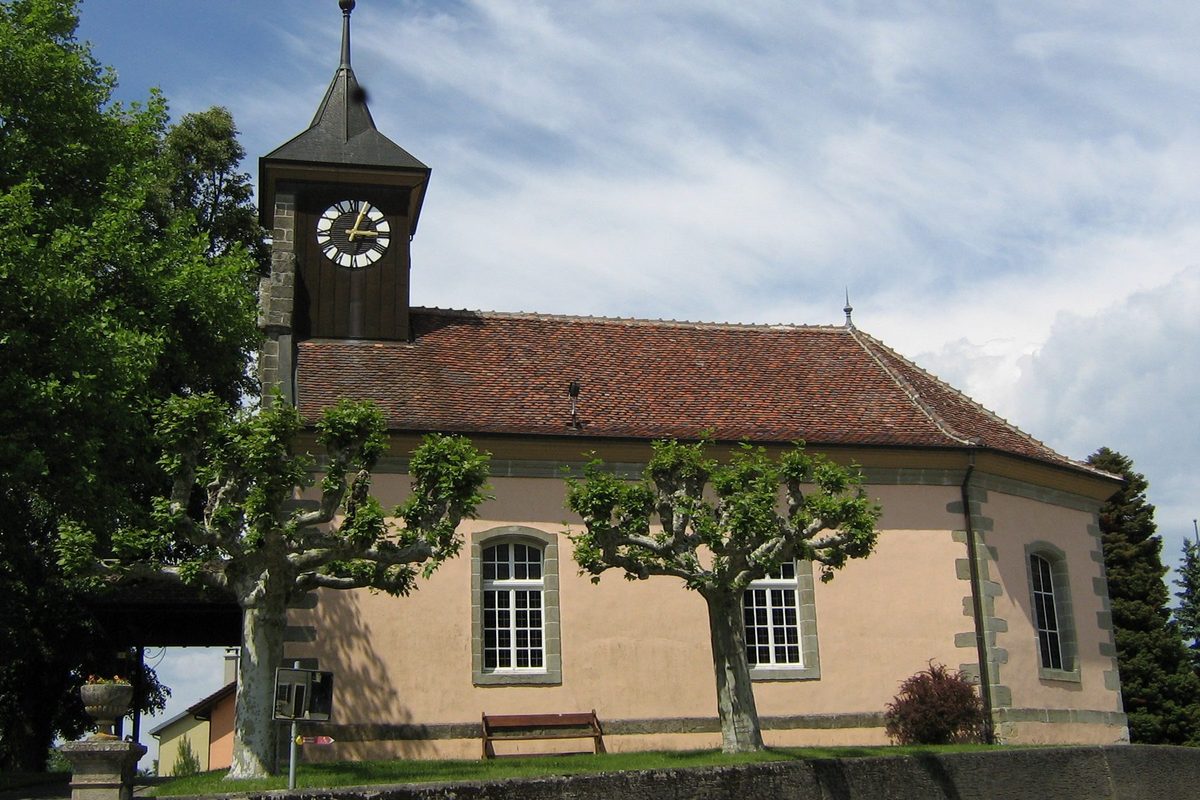
Corcelles-sur-Chavornay church. Rebuilt in 1754 by the architect Gabriel Delagrange, who gave it a monumental façade, this Protestant church has a light bell tower projecting above the entrance door dated 1754, and a clock face set in a semicircular recess on the upper floor. Several details are uncertain: the molasse walls, the Mormont limestone foundations, the direction of the work by the mason David Reymond, of Vaulion, and the restorations of 1913, 1951 (architect Oscar Magnin) and 1985. A parish has been recorded at Corcelles since 1228. The church became a Protestant church with the Reformation of 1536.[1][2]
Corcelles Castle. Bernard de Gléresse established the seat of the lordship of Corcelles here around 1520 (or 1507, date uncertain), when the village separated from the lordship of Bavois. César Lentulus enlarged the château in 1644 and brought together most of the land and seigneurial rights there. Later converted, the building served as a health establishment from 1884 to 1963.[1][2]
Le Pré-Carré. Health-oriented institution built around 1924 in the village, continuing the health function previously served by the château.[1]
Remains in Corcelles-sur-Chavornay
Remains from the Roman period. Roman-period remains have been uncovered on the territory of Corcelles-sur-Chavornay. Their precise nature and the exact location of the finds are not known.[1]
Traditions and festivals in Corcelles-sur-Chavornay
The Swallows. The people of Corcelles are nicknamed the "Hirondelles" (Swallows).[4]
The village festival and the youth society. The village has kept its own village festival and youth society, both listed among the local societies of the commune of Chavornay.[4]
Sources
- Anne Rochat-Morel, « Corcelles-sur-Chavornay », Dictionnaire historique de la Suisse (DHS), version du 11.01.2017
- Conseil d'État du canton de Vaud, Exposé des motifs et projet de décret sur la fusion des Communes de Chavornay, Corcelles-sur-Chavornay et Essert-Pittet, novembre 2015
- État de Vaud, communiqué du 12.07.2007, « Organisation des préfectures et adaptation au nouveau découpage territorial »
- Feuille des avis officiels du canton de Vaud (Official Gazette of the Canton of Vaud), "Alphabet des communes vaudoises: Chavornay"
- Register of Swiss Surnames, 3rd edition (1989), search Commune "Corcelles-sur-Chavornay", Canton VD
Published by Sébastien Jörg ·
Other villages near Corcelles-sur-Chavornay
Missing information, or do you have a source? Suggest a correction or addition. Every submission is checked before it's published.
Suggest a change