Essertines-sur-Yverdon
In 1315, at war with the Lausanne chapter, the prior of Saint-Maire besieged the castle of Essertines, laid waste to the village and took 37 horses from its people.
Entry based on 7 sources · Our method · Reusable text (CC BY-SA)
Origin of the name Essertines-sur-Yverdon
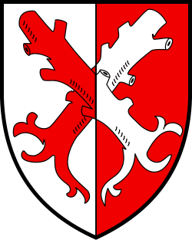
The village is recorded from 1180 in the form «Essertines». The name comes from the verb «essarter» or «esserter», to clear land: an «essart» or «essert» is a clearing won from the forest for cultivation. The municipal coat of arms, adopted in 1927, shows two uprooted tree trunks symbolising this «cleared» land.[1][2]
Coat of arms of Essertines-sur-Yverdon
Per pale argent and gules, two tree trunks couped of their branches and eradicated in saltire, counterchanged. The shield is split vertically, white on the left and red on the right. Two trunks with lopped branches and visible roots cross in an X, red on the white and white on the red. Adopted in 1927, the arms recall the clearing of the land. Their colours are those of the chapter of Lausanne.[6][2]
Founding of Essertines-sur-Yverdon
The name says it all: the village arose from forest clearance. Who founded it, on the other hand, is not known. The area was inhabited long before: two protohistoric settlement sites and two Roman establishments were identified in the trench of the Orbe gas pipeline, and an early medieval cemetery lies at the place called En Etannaz. In the Middle Ages, Essertines was one of the oldest and most important prebends of the Lausanne cathedral chapter. The chapter gradually bought up the rights of other owners there, but never obtained those of the priory of Saint-Maire.[1][2]
History of Essertines-sur-Yverdon
Prehistory. Two protohistoric settlement sites, identified in 1979 when the Orbe gas pipeline was laid.[1]
Roman period. Two Roman establishments, identified during the same works. Roman ruins had already been discovered at the Bois des Tours in 1828.[1][2]
Early Middle Ages. Cemetery at the place called En Etannaz.[1]
1180. First written mention: «Essertines».[1]
1219. Dispute between the Lausanne chapter and the lord Jordan de Belmont over the building of a castle on the site of the present church.[2]
1228. The parish and its church of Saint-André are mentioned.[1]
1315. At war with the chapter, the prior of Saint-Maire besieges the castle, lays waste to the village and takes 37 horses from the inhabitants.[2]
1536. Bernese conquest: the Bernese, who take over the church property, make Essertines a castellany attached to the bailiwick of Yverdon.
1702. The new temple is built within the walls of the former castle.[1]
1803. The municipality belongs to the district of Echallens.[1]
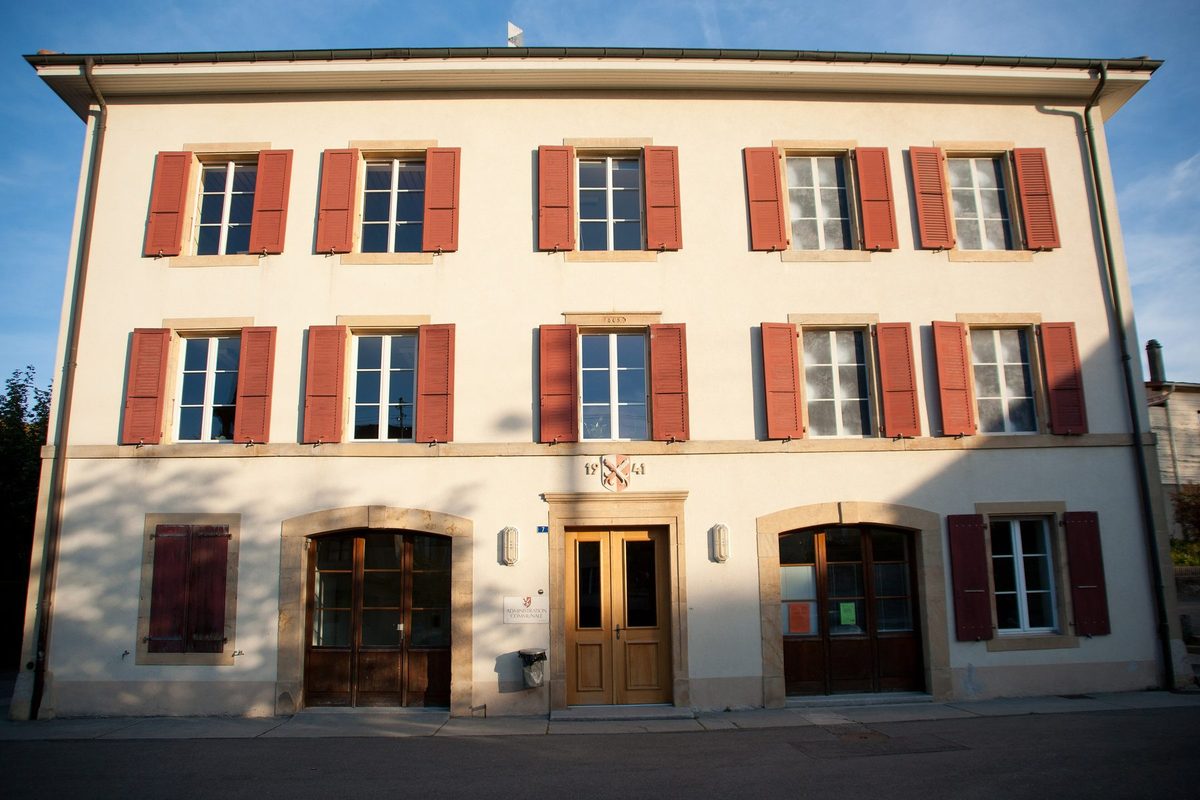
1869. The school building is constructed, with a room for the council.[1]
1963. A drilling on the heights towards Pailly reportedly strikes good-quality oil at a depth of 2'300 m, a first in Switzerland. The quantities are not enough for profitable extraction.
since 1970. The hamlet of Epautheyres develops into a residential area, while the rest of the municipality remains agricultural.[1]
1979. The trench of the Orbe gas pipeline reveals protohistoric and Roman sites.[1]
2008. On 1 January 2008, with the new territorial division of Vaud, the municipality joins the district of Gros-de-Vaud.[3][4]
Population of Essertines-sur-Yverdon
Sources and references: [1][5]
| 1764 | 354 inhabitants |
| 1798 | 431 inhabitants |
| 1850 | 648 inhabitants |
| 1900 | 672 inhabitants |
| 1950 | 607 inhabitants |
| 1970 | 451 inhabitants |
| 2000 | 663 inhabitants |
| 2025 | 1'183 inhabitants (31 December) |
Families of Essertines-sur-Yverdon
Citizen families before 1800. Auberson, Barraud, Brochet, Ducret, Gonin, Miéville, Moulin, Perret and Roux, without a precise date.[7]
In the 19th century. The David family, without a precise date. Then the Weber family obtains citizenship in 1893.[7]
From 1901 to 1962. 15 registrations. Several families come from abroad: from Italy (Mollia in 1941, Laurenti in 1951, Zoni in 1953, Perolini in 1954 and Santucci in 1960), from France (Pineau in 1909), from Germany (Mau in 1940) and from Austria (Reinhofer in 1946). From Switzerland come the Gerber family from Röthenbach im Emmental BE (1952), the Fawer family from Münchenwiler BE and the Schumacher family from Zweisimmen BE (1956) and the Emery family from Vuissens FR (1958). They are joined by the Johnson family (1943), the Chaussat family (1947) and the Braun family (1957). The last family registered, in 1960, is the Santucci family.[7]
Economy of Essertines-sur-Yverdon, past and present
A farming municipality. Outside the hamlet of Epautheyres, which has become residential, the municipality has remained agricultural. About a dozen farmers work here, roughly half of them with dairy cows.[1][2]
Shops and road. The village has several businesses, among them the restaurant La Balance, a grocery and two garages. It lies on the Lausanne-Yverdon-les-Bains road, and a PostBus links Epautheyres to the town.[2][1]
Historic sites in Essertines-sur-Yverdon
The temple. Former parish church of Saint-André, mentioned from 1228. The present temple, rebuilt in 1702, was erected within the walls of the former castle.[1]
The village, ISOS site. The village is reportedly listed in the Federal Inventory of Swiss Heritage Sites (ISOS).
The school building. Built in 1869, it also housed a room for the municipal council.[1]
The hamlets. The municipality includes the hamlet of Epautheyres, on the Lausanne-Yverdon-les-Bains road, as well as Nonfoux and La Robellaz, which was called «Villars Luezon» in the Middle Ages.[1]
Remains in Essertines-sur-Yverdon
The former castle. The medieval castle, linked to the lordship of the Lausanne chapter, has disappeared. The temple of 1702 stands within its former walls. In 1315 it was besieged by the prior of Saint-Maire.[1][2]
Protohistoric and Roman sites. Two protohistoric settlements and two Roman establishments were identified in 1979 in the trench of the Orbe gas pipeline.[1]
Cemetery of En Etannaz. Early medieval cemetery at the place called En Etannaz.[1]
Traditions and festivals in Essertines-sur-Yverdon
The egg race and the village fête. At Easter Essertines-sur-Yverdon holds an egg race. The bread oven is lit for 1 August, and a village fête takes place every two years. The Jeunesse d'Essertines also puts on theatre evenings.[2]
Lè Patâi. In patois the inhabitants bear the nickname « Lè Patâi ».[2]
Sources
- Philippe Heubi, « Essertines-sur-Yverdon », Dictionnaire historique de la Suisse, version du 23.08.2004
- Feuille des avis officiels du canton de Vaud, « Alphabet des communes vaudoises : Essertines-sur-Yverdon »
- Canton de Vaud, Loi sur le découpage territorial (LDecTer, RSV 132.15) du 30 mai 2006
- État de Vaud, communiqué du 12.07.2007, « Les préfètes et les préfets sont attribués aux nouveaux districts »
- Statistique Vaud, « Population résidante permanente au 31 décembre 2025 »
- IPI, Swissreg, emblems database: coat of arms of Essertines-sur-Yverdon (no. 102086)
- Register of Swiss Surnames, 3rd edition (1989), search Commune "Essertines-sur-Yverdon", Canton VD
Published by Sébastien Jörg ·
Localities of the municipality with a page
Other villages near Essertines-sur-Yverdon
Missing information, or do you have a source? Suggest a correction or addition. Every submission is checked before it's published.
Suggest a change