Penthéréaz
Village of the common bailiwick of Orbe-Echallens, which adopted the Reformation in 1619 and whose Catholics were forced to leave in 1675.
Entry based on 8 sources · Our method · Reusable text (CC BY-SA)
Origin of the name Penthéréaz
The village is first mentioned in 1141 as «Panterea». Later forms are «Pantheroia» (1154), «Pantereya» (1184) and «Panthereaz» (1453). The etymology of «Penthéréaz» has yet to be found.[1][2]
Coat of arms of Penthéréaz
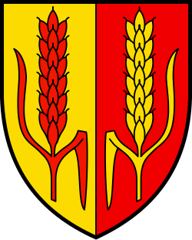
Per pale Or and gules, two ears of wheat counterchanged. The shield is yellow on the left and red on the right, with two ears of wheat in reversed colours, red on the yellow and yellow on the red. Adopted in 1926, these arms take up the colours of the Montfaucon, a noble family present in the Echallens area from the 12th century. The ears recall cereal growing.[6][7][2]
Founding of Penthéréaz
It is not known who founded the village or how it came into being. It appears in 1141 with its church of Saint-Etienne. In the Middle Ages Penthéréaz belonged to the lordship of Echallens, held by the Montfaucon, a family established in the region since the 12th century. The church was a daughter church of Goumoens-la-Ville, and the right to present its priest belonged to the abbey of Montbenoît in Burgundy (diocese of Besançon).[1][2]
History of Penthéréaz
1141. First mention of «Panterea» and of the church of Saint-Etienne, a daughter church of Goumoens-la-Ville.[1]
Middle Ages. Penthéréaz belongs to the lordship of Echallens. The right of presentation to the church belongs to the abbey of Montbenoît in Burgundy.[1]
1416. The village has 14 hearths (households).[1]
1484. Incorporated into the common bailiwick of Orbe-Echallens, administered by Bern and Fribourg.[1]
1619. Adoption of the Reformation; Penthéréaz henceforth belongs to the parish of Goumoens-la-Ville.[1][2]
1675. Initially tolerated thanks to an intervention by the Federal Diet, the Catholics are forced to leave the municipality.[1][2]
1798. Incorporated into the district of Echallens (until 31 December 2007). The village has 275 inhabitants.[1]
1926. Adoption of the municipal coat of arms: two ears of wheat in the colours of the Montfaucon.[2]
1981. Opening of the A1 motorway with the Chavornay exit; the population grows again.[1][2]
2006. Start of a merger project with Goumoens-la-Ville, Goumoens-le-Jux and Eclagnens.[1]
2008. Penthéréaz withdraws from the merger project. The new Vaud districts come into force and the municipality joins the district of Gros-de-Vaud.[1][3]
Population of Penthéréaz
Sources and references: [1][4]
| 1416 | 14 hearths (households) |
| 1453 | 12 hearths (households) |
| 1798 | 275 |
| 1850 | 369 |
| 1900 | 279 |
| 1950 | 262 |
| 1980 | 212 |
| 2000 | 342 |
| 2025 | 446 |
Families of Penthéréaz
Citizen families before 1800. Burdet, Dupuis, Mercier and Millioud, with no precise date. The Favez, from Servion VD, are admitted in 1665.[8]
In the 19th century. The Collet, with no precise date.[8]
1901 to 1962. Six families: the Sartoretti in 1923, the Mayor in 1936, the Fiechter in 1941, the Haenni of Salvenach FR in 1957, and in 1959 the Capiferri and the Miglio, both from Italy.[8]
Economy of Penthéréaz, past and present
Cereals, beet and chicory. Long almost entirely devoted to crops and livestock, the village still grows a lot of cereals and sugar beet. Local firms offer farm work and threshing. One farmer has specialised in producing chicory.[7][2]
Milk and Gruyère. The village dairy was built in 1906. Penthéréaz no longer has any milk producer, but producers from the surrounding area deliver their milk to the cheesemaker. Built in 2002, a fully automated cellar can ripen up to 3'500 wheels of Gruyère AOP.[7][2]
Horses, crafts and services. A family trains horses there for harness trotting races, in Switzerland and abroad. Fiduciary firms, wood and construction companies and consulting services are also based in the village. A growing share of the working population works in the large centres around Lake Geneva.[7]
Historic sites in Penthéréaz
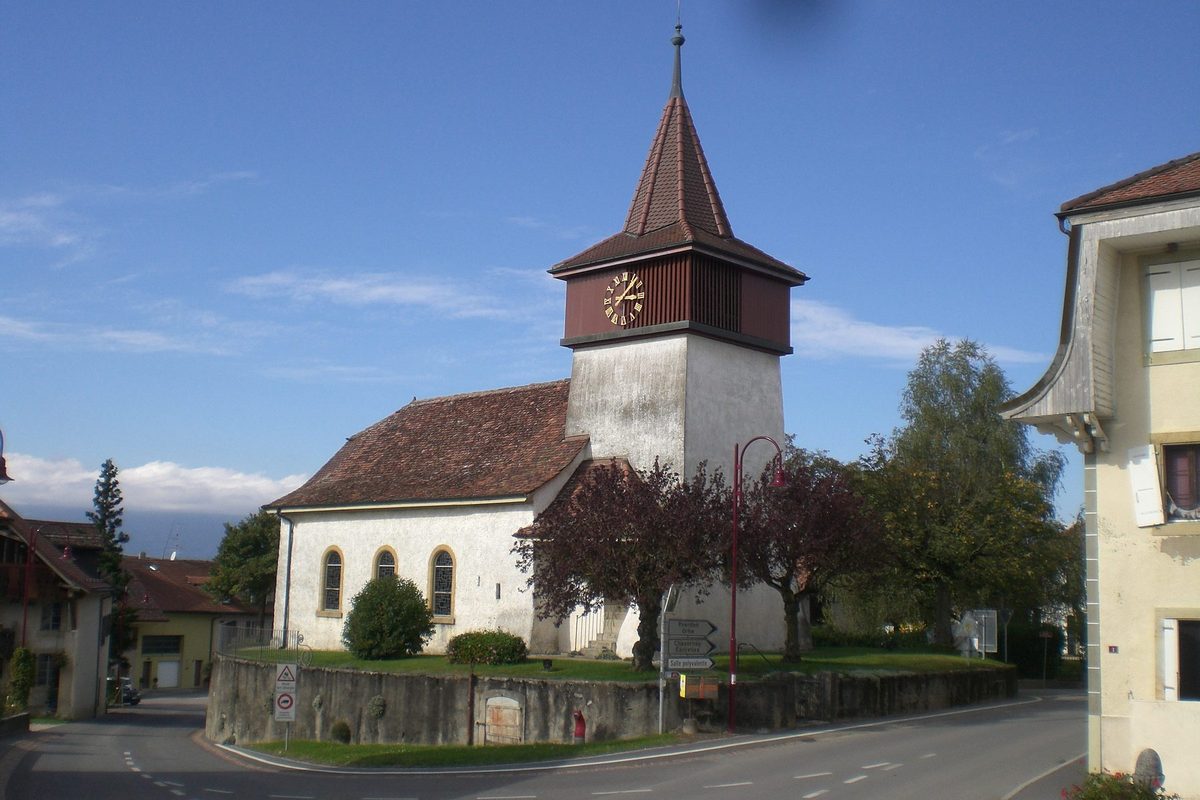
Church of Saint-Etienne. Church mentioned from 1141, a daughter church of Goumoens-la-Ville, whose right of presentation belonged to the abbey of Montbenoît in Burgundy. Since the Reformation of 1619 Penthéréaz has belonged to the parish of Goumoens-la-Ville.[1]
Bernese house (tithe house). Building used to collect the tithe for the bailiffs. The municipality describes it as a listed historic monument.[2]
Market gardening. The village has remained agricultural and has specialised in market gardening, especially endives.[1][2]
Protected heritage in Penthéréaz
Cultural property of regional significance (B objects)[5]
- Maison bernoise
Legends of Penthéréaz
The «Buïa-Tsa» and the «Matous». The inhabitants are nicknamed «Lè Buïa-Tsa» (in patois, «cat-washers») and «Les Matous». According to a popular anecdote, a woman is said to have put a cat in a washtub, deliberately or by accident.[2]
Traditions and festivals in Penthéréaz
The village societies. The men's choir, the shooting society, the Amicale de la pétanque and the youth society keep village life going. Each year there is a summer pétanque tournament and a lotto.[7][2]
Sources
- Historisches Lexikon der Schweiz, Paola Crivelli, « Penthéréaz », version du 06.01.2011
- Commune de Penthéréaz, « Historique »
- État de Vaud, communiqué du 12.07.2007, « Organisation des préfectures et adaptation au nouveau découpage territorial »
- Statistique Vaud, « Population résidante permanente au 31 décembre 2025 »
- Federal Office for Civil Protection (FOCP), Swiss Inventory of Cultural Property (PCP), list for the canton of Vaud (as of 1.1.2026)
- IPI, Swissreg, emblems database: coat of arms of Penthéréaz (no. 101860)
- Official Gazette of the Canton of Vaud (FAO), "Alphabet des communes vaudoises: Penthéréaz"
- Register of Swiss Surnames, 3rd edition (1989), search Commune "Penthéréaz", Canton VD
Published by Sébastien Jörg ·
Other villages near Penthéréaz
Missing information, or do you have a source? Suggest a correction or addition. Every submission is checked before it's published.
Suggest a change