Mormont
Around 100 BC, Helvetii laid out a sanctuary of more than 200 pits on the summit of the Mormont, discovered in 2006 ahead of the quarry's extension.
Entry based on 9 sources · Our method · Reusable text (CC BY-SA)
Origin of the name Mormont
The name first appears in writing in 814 as « Mauromonte ». It reportedly derives from the Roman-era personal name Maurus, but this is not certain.
Founding of Mormont
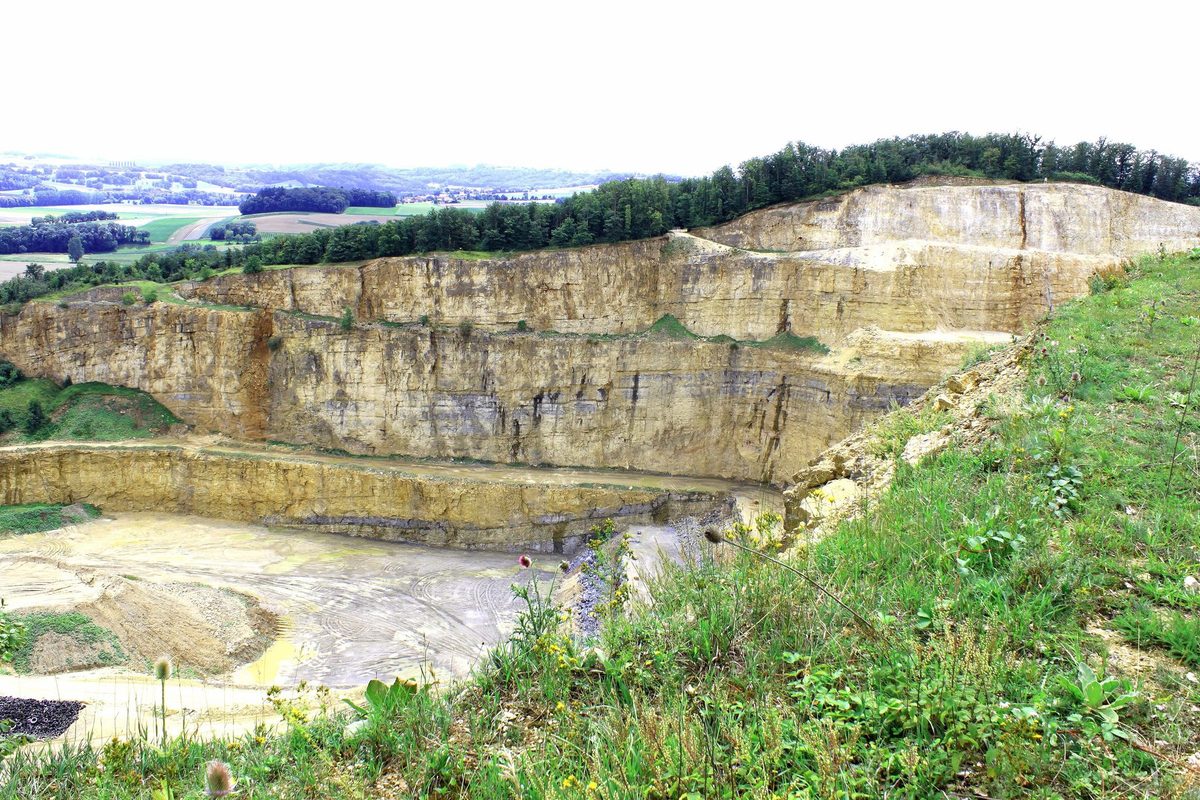
The Mormont is not a village but a small wooded limestone massif overlooking Eclépens and La Sarraz. This tectonic horst, linked to the folding of the Jura and unique in Switzerland, formed as it rose a natural barrier that diverted an ancient river from the Rhine basin to the Rhône basin. The massif, listed in the Federal Inventory of Landscapes (IFP 1023, « Massif boisé du Mormont », 299 hectares in the municipalities of Bavois, Eclépens, La Sarraz and Orny), bears on its summit a Helvetian sanctuary dating from around 100 BC, discovered in 2006. Its limestone, quarried industrially since the mid-20th century, supplies the Eclépens cement works.[1][5]
History of Mormont
around 100 BC. Helvetians lay out on the summit of the Mormont a site with more than 200 pits containing various deposits, post holes and a few hearths. The main occupation seems to have been brief, perhaps a generation or a few years.[1]
Roman period. The Roman road from Lausanne to Orbe crosses the Mormont. A milestone has been found on the northern slope.[5][6]
1638. Digging begins on the Entreroches canal, a waterway between Yverdon and the Cossonay area.[5]
1648. The canal opens to navigation. It runs through the Mormont gorge known as Entreroches.[5]
1829. Goods traffic on the Entreroches canal comes to an end.[5]
1850-1855. Construction of the Mormont railway tunnels, begun in 1850 and opened in 1855: they are the two oldest tunnels in Switzerland.[5]
1953. Opening of the Eclépens cement works, supplied from the mid-20th century by industrial quarrying of the Mormont limestone.[5][6]
1992. The cement works now belongs to Holderbank Ciments et Bétons.[6]
2006. Discovery of the Helvetian sanctuary during archaeological investigations preceding the extension of the quarry; excavations begin.[1][2]
2012. Excavation campaign from April to mid-October led by Archeodunum SA: six new offering pits, a two-handled iron cauldron, a whole cow and the partial skeleton of a child aged about 5 are uncovered.[2]
2015. Excavations resume over about 20'000 m² before limestone extraction restarts: 45 new features, coins, ornaments and a new section of the Roman road identified in 2006.[3]
2020. In October, environmental activists occupy part of the hill to oppose the extension of the quarry (ZAD du Mormont).[4]
2021. On 30 March, the police clear the ZAD, set up on plots in La Sarraz owned by Holcim, which had about 150 occupants.[4]
Economy of Mormont, past and present
Stone, lime and cement. Mormont limestone supplied building stone and then lime burnt in kilns. From the mid-20th century it was quarried industrially for the Eclépens cement works. The quarry and the cement works occupy the south of the Haut de Mormont.[5]
Meadows, vines and coppice. Meadows, pastures and crops cover the central part and western slopes of the hill. Vines once covered the southern flank, and only a few plots remain. In the late 19th century coppice woods covered the eastern part and supplied firewood.[5]
Historic sites in Mormont
The Haut de Mormont and its sanctuary. The summit of the hill where a Celtic site of international importance, dated to around 100 BC, was discovered in 2006. Nearly 11 hectares have been explored without reaching its limits. The Mormont, Pévraz and Tilérie sites, from the Neolithic to the Roman period, are cultural properties of national importance (PCP inventory).[1][7]
Entreroches gorge. A gorge cutting through the Mormont, through which the Entreroches canal ran, opened in 1648 and used until 1829. The former canal is a cultural property of national importance (PCP inventory).[5][7]
Mormont railway tunnels. Opened in 1855 on the Lausanne-Yverdon line after works begun in 1850, they are the two oldest tunnels in Switzerland.[5]
Eclépens quarry and cement works. South of the massif, the quarry extracts Mormont limestone for the Eclépens cement works, in operation since 1953. The successive archaeological excavations were carried out ahead of its extension.[5][6]
Wooded massif of the Mormont. Landscape listed in the Federal Inventory of Landscapes (IFP 1023), a mosaic of thermophilous forests and open spaces with a sub-Mediterranean character, in the municipalities of Bavois, Eclépens, La Sarraz and Orny.[5]
Remains in Mormont
Helvetian sanctuary. More than 200 pits, many postholes and a few hearths have yielded unusual deposits: human remains given special treatment (crouched individuals, decapitation), animals sacrificed or deposited whole, an iron cauldron, vessels, coins, ornaments and small tools. A ritual interpretation is preferred, but everyday activities (drinking, meat eating, storage) also took place, and the site's function is still debated.[1][2]
Remains of the Entreroches canal. Dug from 1638 and used until 1829, the canal left remains in the Mormont gorge, notably retaining walls 2 to 3 metres high. At Orny the lock-keeper's house is a cultural property of regional importance.[5][7]
Roman road and milestone. The Roman road Lausanne-Orbe crossed the Mormont. A milestone was found on the northern slope and sections of roadway were identified during the excavations of 2006, 2012 and 2015.[2][3][5]
Protected heritage in Mormont
Cultural property of national significance (A objects in the PCP inventory)[9]
- Le Mormont / Pévraz / Tilérie, sites du Néolithique - Époque romaine (cf. Eclépens & La Sarraz)
- Le Mormont / Pévraz / Tilérie, sites du Néolithique - Époque romaine (cf. Eclépens & Orny)
- Le Mormont / Pévraz / Tilérie, sites du Néolithique - Époque romaine (cf. La Sarraz & Orny)
Sources
- État de Vaud, Archéologie cantonale, « Sites fouillés : une sélection »
- État de Vaud, communiqué du 28 septembre 2012, « Les fouilles archéologiques se poursuivent sur le sanctuaire helvète de la colline du Mormont »
- État de Vaud, communiqué du 30 juillet 2015, « Les fouilles archéologiques ont repris au sommet de la colline du Mormont »
- État de Vaud, actualité du 30 mars 2021, « La police procède à l'évacuation du squat de la ZAD du Mormont »
- Office fédéral de l'environnement, Inventaire fédéral des paysages, objet IFP 1023 « Massif boisé du Mormont »
- Dictionnaire historique de la Suisse, « Eclépens » (Jean-Jacques Bouquet, version du 28.07.2004)
- Office fédéral de la protection de la population, Inventaire PBC, liste du canton de Vaud (état au 1.1.2026)
- Statistique Vaud, « Population résidante permanente au 31 décembre 2025 »
- Federal Office for Civil Protection (FOCP), Swiss Inventory of Cultural Property (PCP), list for the canton of Vaud (as of 1.1.2026)
Published by Sébastien Jörg ·
Other villages near Mormont
Missing information, or do you have a source? Suggest a correction or addition. Every submission is checked before it's published.
Suggest a change