Collex-Bossy
Origin of the name Collex-Bossy
Collex and Bossy appear in 1258 as « Coliacum » and « Bocium ». Other early forms are reported but unconfirmed: « Cholay » (1258) and « Colay » (1278) for Collex, « Bossie » (1236) for Bossy. Collex is said to come from a personal name of the type « Colus ». Bossy remains unexplained; a Celtic personal name « Bussus » has been suggested, Bossy then being the estate of « Bussius », though this is not established.[1]
Founding of Collex-Bossy
At Bossy, people settled from the end of the early Middle Ages around a parish church that has since vanished: excavations there revealed timber buildings and numerous grain storage pits. Collex appears with its own parish church. The village then belonged to the lordship of La Bâtie-Beauregard, granted in turn as a fief to the Compey, the Menthon, the Champion, the Crose, the Gillier and the Vasserot. It comprised three fortified places: La Bâtie-Beauregard (La Bâtie), the fortified house of Collex and that of Le Vengeron. Collex then followed the fate of the Pays de Gex, occupied by Bern, returned to Savoy, occupied by Genève and finally passed to France. Today's municipality brings together the villages of Collex and Bossy. For over half a century it also included Bellevue.[1][2][8]
History of Collex-Bossy
End of the early Middle Ages. In the centre of Bossy, near the former parish church, timber buildings stand alongside numerous grain storage pits, uncovered by the excavations of 2014-2015.[8]
1258. First mentions of Collex (« Coliacum ») and Bossy (« Bocium »). The parish church of Collex is mentioned. There are two chapels, one at Colovrex (Saint-Éloi), the other at Bossy.[1]
1270. Founding of the lordship of La Bâtie-Beauregard, which includes Collex.[1]
1299. The castle of La Bâtie-Beauregard, also called Bâtie-Champion or Bâtie sur Versoix, is recorded. It belongs to the lords of Gex and defends the northern part of their territory.[2]
1369-1641. The noble Champion family holds the fief of La Bâtie-Beauregard.[5]
1536. Bern occupies the Pays de Gex and attaches Collex to the bailiwick of Gex.[1]
1547. Bern raises the lordship to a barony.[1]
1567. The Pays de Gex is returned to Savoy.
1589-1590. The Genevans take the castle of La Bâtie-Beauregard in 1589 and destroy it in 1590.[2]
1601. With the Pays de Gex, Collex passes to France.[1]
1612. Collex having adopted the Reformation, the Protestants must return the church to Catholic worship. A Protestant temple is built.[1]
1662. The temple of 1612 is destroyed and Protestant worship is banned.[1]
1790. Creation of the municipality, which also includes Bellevue. It succeeds the former lordship and barony of La Bâtie-Beauregard.[1][3][4]
1815. France cedes the municipality to Genève. It becomes Genevan and Swiss on 20 November 1815, under the Treaty of Paris.[1][4]
1855. Bellevue is created as a municipality, for political and religious reasons, after its split from Collex-Bossy.[3][4]
1859. The church of Saint-Georges is demolished.[1]
1869-1871. Construction of the church of Saint-Clément, assigned to the Old Catholics from 1873 to 1896.[1]
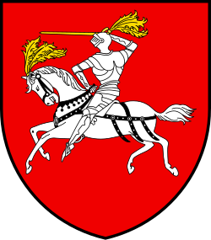
1924. The municipal council adopts the municipal coat of arms, showing a tournament champion in tribute to the Champion family.[5]
1980. Residential development grows, but the municipality remains rural. At the end of the 20th century farmland covers about 60% of its territory.[1]
2000. The primary sector still provides a quarter of the jobs. Three quarters of the working population work outside the municipality.[1]
Population of Collex-Bossy
Sources and references: [1][6]
| 1850 | 740 |
| 1860 | 509 |
| 1900 | 444 |
| 1950 | 512 |
| 1980 | 524 |
| 1990 | 952 |
| 2000 | 1'279 |
| 2025 | 1'710 |
Historic sites in Collex-Bossy
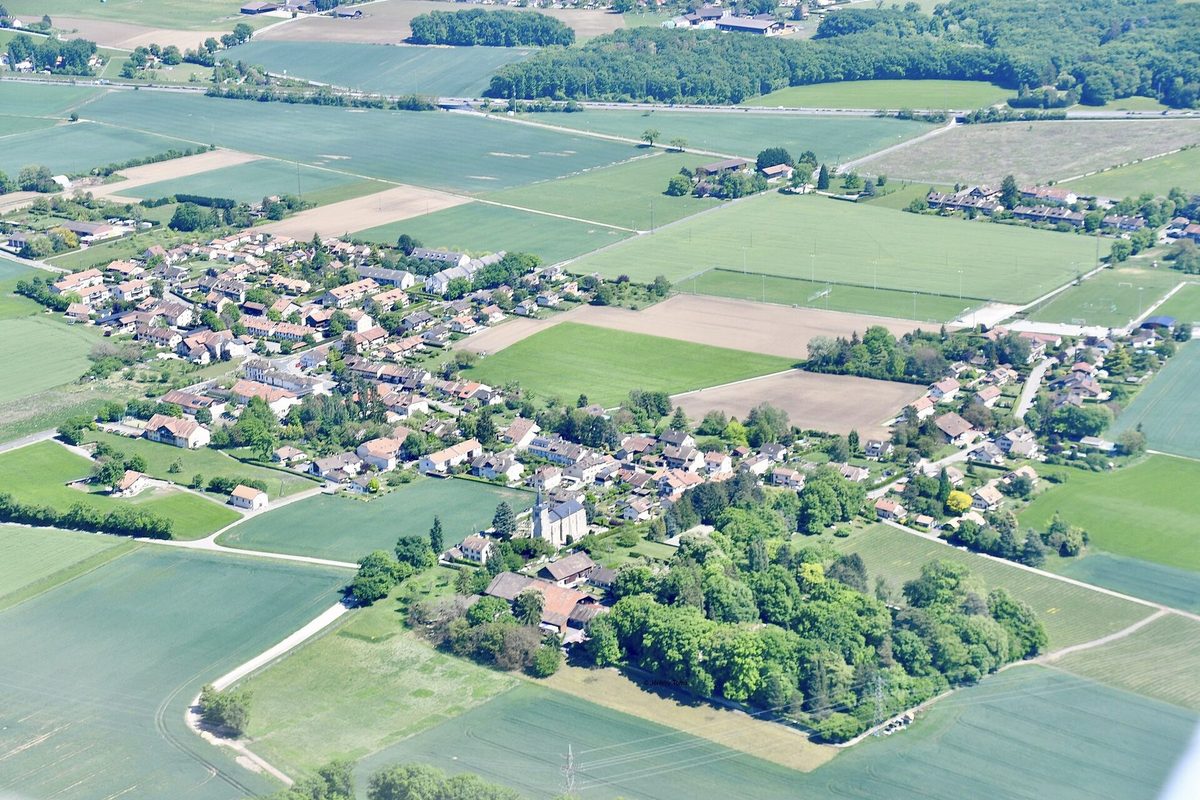
Collex and Bossy. The two villages of the municipality are mentioned from 1258. There was a chapel at Bossy. The inhabitants of Collex are reportedly called Collésiens, those of Bossy Bossiotes.[1]
La Vieille-Bâtie. Place on the bank of the Versoix where the ruins of the castle of La Bâtie-Beauregard survive, centre of the lordship founded in 1270 and raised to a barony in 1547.[1][2]
Church of Saint-Clément. Church built in 1869-1871, after the demolition of the church of Saint-Georges in 1859. It was assigned to the Old Catholics from 1873 to 1896.[1]
Municipal coat of arms. Adopted in 1924, it shows a tournament champion and recalls the Champion family, who held the fief of La Bâtie-Beauregard from 1369 to 1641.[5]
Remains in Collex-Bossy
Ruins of La Bâtie-Beauregard. Recorded in 1299, the castle of the lords of Gex defended the north of their territory. Taken by the Genevans in 1589 and destroyed in 1590, only ruins remain at the place called La Vieille-Bâtie.[2]
Medieval settlement of Bossy. Excavations of 2014-2015 in the village centre: traces of timber buildings and numerous pits for storing grain, near the now vanished former parish church, the focus of settlement from the end of the early Middle Ages.[8]
Sources
- Dictionnaire historique de la Suisse, « Collex-Bossy » (Jacques Barrelet)
- Dictionnaire historique de la Suisse, « Bâtie, La » (Dominique Zumkeller), version allemande
- Dictionnaire historique de la Suisse, « Bellevue » (Martine Piguet)
- Commune de Collex-Bossy, « La commune en bref »
- Commune de Collex-Bossy, « Les armoiries »
- Office cantonal de la statistique (OCSTAT), Mémento statistique du canton de Genève 2026, tableau Population résidante par commune, en 2025
- geo.admin.ch, service de recherche de swisstopo (coordonnées)
- Service cantonal d'archéologie de Genève, Archéologie genevoise 2014-2015 (Patrimoine et architecture, série archéologie n° 3), préface de Jean Terrier
Localities of the municipality with a page
Other villages near Collex-Bossy
Missing information, or do you have a source? Suggest a correction or addition. Every submission is checked before it's published.
Suggest a change