Versoix
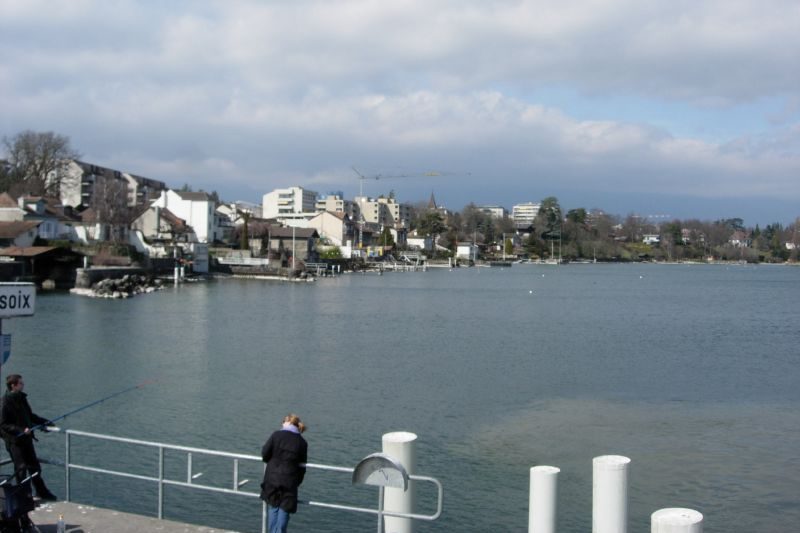
Origin of the name Versoix
The name first appears in 1022, in the form « Versoi ». Where does the name come from? That is still unknown.[1]
Founding of Versoix
The shores of Versoix were inhabited long before the village. The Bronze Age site of Versoix-Bourg is one of the Swiss lakeside settlements on the Unesco World Heritage list. A tumulus and a curved ditch date from the early Iron Age, while a large Roman villa and two aqueducts point to significant settlement in Roman times. In 1022 a castle on the slope of Saint-Loup and the estate of Ecogia are mentioned. The borough itself is the work of Peter II of Savoy: after receiving in 1257 the possessions of the abbey of Saint-Maurice at Commugny, with their dependencies of Saint-Loup and Versoix, he had a new castle built from 1258 to 1268, surrounded by a borough.[1]
History of Versoix
Bronze Age. Lakeside settlement of Versoix-Bourg, about 170 m from today's shore, now on the Unesco World Heritage list among the Swiss lakeside settlements.[1]
800-480 BC. A tumulus and a curved ditch (vallum) date from the early Iron Age.[1]
1022. First mention of the name, in the form « Versoi ». A castle on the slope of Saint-Loup and the estate of Ecogia (« Adesgogia ») are mentioned.[1]
1177. Pope Alexander III confirms the ownership of the parish church of Saint-Loup by the provostry of the Great Saint Bernard.[1]
1257. The abbey of Saint-Maurice cedes its possessions at Commugny, with the dependencies of Saint-Loup and Versoix, to Peter II of Savoy.[1]
1258-1268. Peter II of Savoy has a new castle built, surrounded by a borough. In 1265 he also receives the right of patronage over the church.[1]
1268. His widow, Agnes of Faucigny, bequeaths Versoix to Simon de Joinville, lord of Gex. The chapel of Saint-Théodule dates from this year.[1]
1353. Versoix becomes Savoyard again when Amadeus VI takes the Pays de Gex.[1]
1457. Paper making begins, for a long time the most important industry of Versoix.[1]
1536. Bern occupies the Pays de Gex. The chapel of Saint-Théodule becomes the parish church. The territory is returned to Savoy in 1567, under the Treaty of Lausanne of 1564.[1]
1589. In November, during the war between Genève and Savoy, the castle and borough of Versoix are razed by Genevan troops.[1]
1601. The Treaty of Lyon assigns the Pays de Gex to the King of France. Catholicism is reintroduced, imposed in 1662, and the temple demolished.[1]
1766. The French embargo on Genève gives rise to Choiseul's project of a fortified port town, Versoix-la-Ville.[1]
1770. In February more than 1'200 people settle on the building site around the future Port-Choiseul. In December Choiseul's fall from favour deprives the town of its main supporter.[1]
1787. Ami Argand founds in Versoix a royal factory for the lamps he invented.[1]
1794. The borough, rebuilt after 1589, and the town merge into Versoix-la-Raison.[1]
1816. Versoix becomes definitively part of Genève under the Treaty of Paris of 20 November 1815.[1]
1856. Opening of the Lausanne-Genève railway line. In 1875 the Favarger chocolate factory settles in Versoix.[1]
1886-1888. Stones from Port-Choiseul are used to build the quays of Versoix and Cologny.[1]
1980. The François-Alphonse Forel university institute settles here. In 2000 the last paper mill closes, and in 2001 Ecogia welcomes the ICRC training centre.[1]
Population of Versoix
Sources and references: [1][2]
| 1481 | 250 (approx.) |
| 1601 | 100 (approx.) |
| 1791 | 1'165 |
| 1800 | 750 |
| 1850 | 937 |
| 1900 | 1'531 |
| 1950 | 2'471 |
| 2000 | 10'309 |
| 2010 | 12'947 |
| 2025 | 14'035 |
Historic sites in Versoix
Port-Choiseul. Harbour of Choiseul's town project, around which more than 1'200 people settled in 1770. Its stones were used in 1886-1888 for the quays of Versoix and Cologny, and it was rebuilt as a marina in 1962-1963.[1]
Church of Saint-Loup. Second church of Saint-Loup, built in 1839, used by the Old Catholics from 1876 to 1908, then returned to the Roman Catholic parish.[1]
Temple and chapel of persecution. The new temple dates from 1858. A « chapelle de la persécution » was built in 1878.[1]
Richelien. The Richelien mill was replaced in 1892 by a hydroelectric plant.[1]
Ecogia. Estate mentioned from 1022 (« Adesgogia »), home since 2001 to the ICRC training centre.[1]
Remains in Versoix
Lakeside settlement of Versoix-Bourg. Bronze Age settlement, about 170 m from today's shore, on the Unesco World Heritage list among the Swiss lakeside settlements.[1]
Tumulus and vallum. Tumulus and curved ditch from the early Iron Age (800-480 BC).[1]
Roman villa and aqueducts. A large Roman villa and two aqueducts show significant settlement in Roman times.[1]
Castle and borough of Peter II of Savoy. Castle built from 1258 to 1268, razed together with the borough by Genevan troops in November 1589.[1]
Chapel of Saint-Théodule. Chapel of 1268, which became the parish church after the Bernese Reformation. Its last remains were demolished in 1948.[1]
Sources
- Dictionnaire historique de la Suisse, « Versoix » (Françoise Dubosson)
- Office cantonal de la statistique (OCSTAT), Mémento statistique du canton de Genève 2026, tableau Population résidante par commune, en 2025
Localities of the municipality with a page
Other villages near Versoix
Missing information, or do you have a source? Suggest a correction or addition. Every submission is checked before it's published.
Suggest a change