Tannay
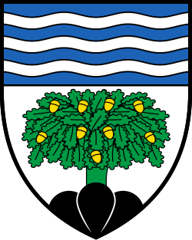
The oak in the coat of arms recalls the probable origin of the name, a place where oaks abound. The village castle, recorded in 1649, is now a municipal building.
Entry based on 6 sources · Our method · Reusable text (CC BY-SA)
Origin of the name Tannay
The place is mentioned in 1390 in the form « Taney ». The name was later written Thanay, then Tanay in the 17th century, and Tannay since the early 19th century. It is thought to come from a Lower Breton root meaning oak and to denote a place where oaks abound, hence the oak in the coat of arms.[2]
Coat of arms of Tannay
Argent, an oak tree vert fructed or issuing from a mount of three hillocks sable, on a chief azure three bars wavy argent. On a white field, a green oak with yellow acorns grows from a black hill with three peaks. The horizontal band at the top is blue and bears three wavy white lines. The FAO links the village's name to a root meaning oak, and so explains the tree in the arms.[4][2]
Founding of Tannay
Tannay has no known founder. Remains of a Gallo-Roman settlement show, however, that the site has long been occupied. In the Middle Ages Tannay belonged to the lordship of Coppet. The village is clustered on a terrace overlooking Lake Geneva, between the roads from Geneva to Saint-Cergue and from Geneva to Lausanne, and long lived from farming and wine-growing. It also took in Huguenot refugees, particularly from the Pays de Gex.[2]
History of Tannay
Roman period. A Gallo-Roman settlement occupies the site. Remains of it have been found.[2]
Middle Ages. Tannay belongs to the lordship of Coppet. The village is part of the parish of Commugny.[2]
1390. First known mention, in the form « Taney ».
1536-1798. Tannay is part of the Bernese bailiwick of Nyon.
1649. First mention of the castle: its owner has a square tower built there. Long owned by the Duvillard family, the castle was sold to the municipality in 1984.[2]
1666. A dispute over land at Veytay, on the boundary with Mies, sets the inhabitants against the baron of Coppet.
1798. Tannay is assigned to the district of Nyon.
1849. End of the school shared with Mies.
1858. Opening of a halt on the Geneva-Lausanne railway line.
19th century. The descendants of Jean Delor, a Huguenot refugee taken in by the municipality, found a prosperous watchmaking factory.
1883. Founding of the Mies-Tannay dairy and cheese-making society.
1950. Until then Tannay remains a traditionally farming and wine-growing village.
2000. The municipality has 1'227 inhabitants.
early 21st century. Tannay becomes a residential municipality for a well-off population working in Geneva; boatyard and marina.
2025. The municipality has 1'732 inhabitants on 31 December.[3]
Population of Tannay
Sources and references: [3]
| 1764 | 113 |
| 1850 | 160 |
| 1900 | 135 |
| 1950 | 251 |
| 2000 | 1'227 |
| 2025 | 1'732 |
Families of Tannay
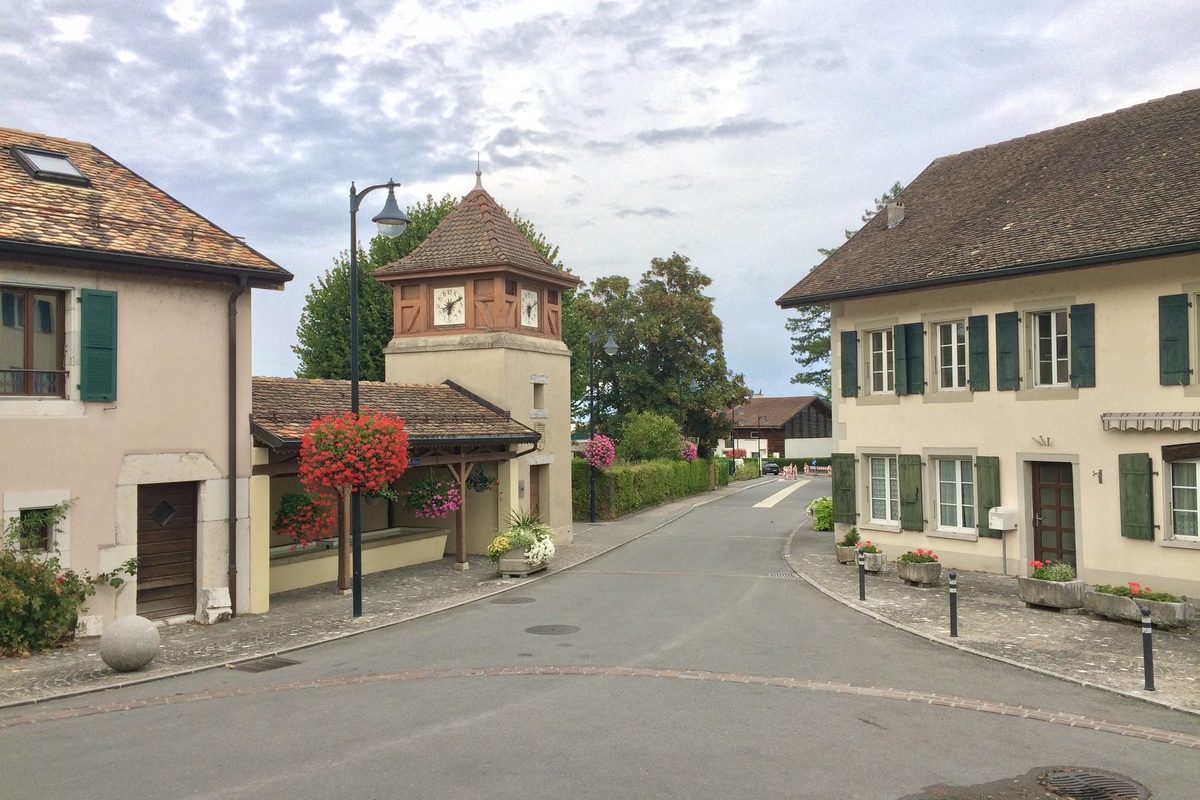
Duvillard. Long the owner of the castle, which the municipality bought in 1984, the family gave the municipality, which has no church, a tower with a three-faced clock in 1922.[2][1]
Burgher families before 1800. Berthod, Delor and Plojoux, with no precise date. Four families were received at the end of the 18th century: the Bourgue, from Saint-Sulpice VD, and the Longchamp in 1774, the Semoroz, from Les Cullayes VD, in 1775, and the Duvillard in 1784.[5]
From 1901 to 1962. Eight entries. The Hutin, from France, opened the list in 1922, and the Bertola, from Italy, were received in 1955. Three families followed in 1956: the Kaltenrieder from Kerzers FR, the Olivet from Jussy GE and the Spori from Boltigen BE. In 1959 came the Eibel, from Austria, and the Putallaz, from Versoix GE. The last registered were the Ritter, from Münchenstein BL, in 1960.[5]
Notable people of Tannay
François Louis Duvillard (1748-1836). A notary in Nyon (1774-1833), he was governor of Tannay in 1786 and 1795 and then syndic of the commune from 1815 to 1832. A member of the Grand Council and of the Vaud Small Council, he played an important part in setting up the land register. In 1806 he had the first mechanical threshing machine in Switzerland built in Tannay.[6]
Economy of Tannay, past and present
From farmland to Geneva. Agricultural and wine-growing until 1950, Tannay becomes at the start of the 21st century a residential municipality for a well-off population working in Geneva. According to the FAO, many residents work in Nyon or Geneva, notably in finance and international organisations.[1][2]
The lake. Tannay has a boatyard and a marina. The FAO reports a project, led jointly by Mies and Tannay, to develop a lakeside area and build a new harbour at Tannay.[1][2]
Historic sites in Tannay
Tannay Castle. Castle first mentioned in 1649, when its owner had a square tower built there. Long owned by the Duvillard family, it was sold to the municipality in 1984 and now serves as a municipal building.[2]
Harbour and boatyard. Tannay has a marina and a boatyard on the shore of Lake Geneva.
Railway halt. Halt opened in 1858 on the Geneva-Lausanne line.
Remains in Tannay
Gallo-Roman settlement. The foundations of a Roman house and some tiles of the period were found at Tannay in the 20th century. They attest to the occupation of the site since Roman times.[2]
Sources
- Dictionnaire historique de la Suisse (DHS), « Tannay »
- Feuille des avis officiels du canton de Vaud, « Alphabet des communes vaudoises : Tannay »
- Statistique Vaud, « Population résidante permanente au 31 décembre 2025 »
- IPI, Swissreg, emblems database: coat of arms of Tannay (no. 101769)
- Register of Swiss Surnames, 3rd edition (1989), search Commune "Tannay", Canton VD
- Dictionnaire historique de la Suisse, « Duvillard, François Louis », version du 03.02.2003
Published by Sébastien Jörg ·
Other villages near Tannay
Missing information, or do you have a source? Suggest a correction or addition. Every submission is checked before it's published.
Suggest a change