Coppet
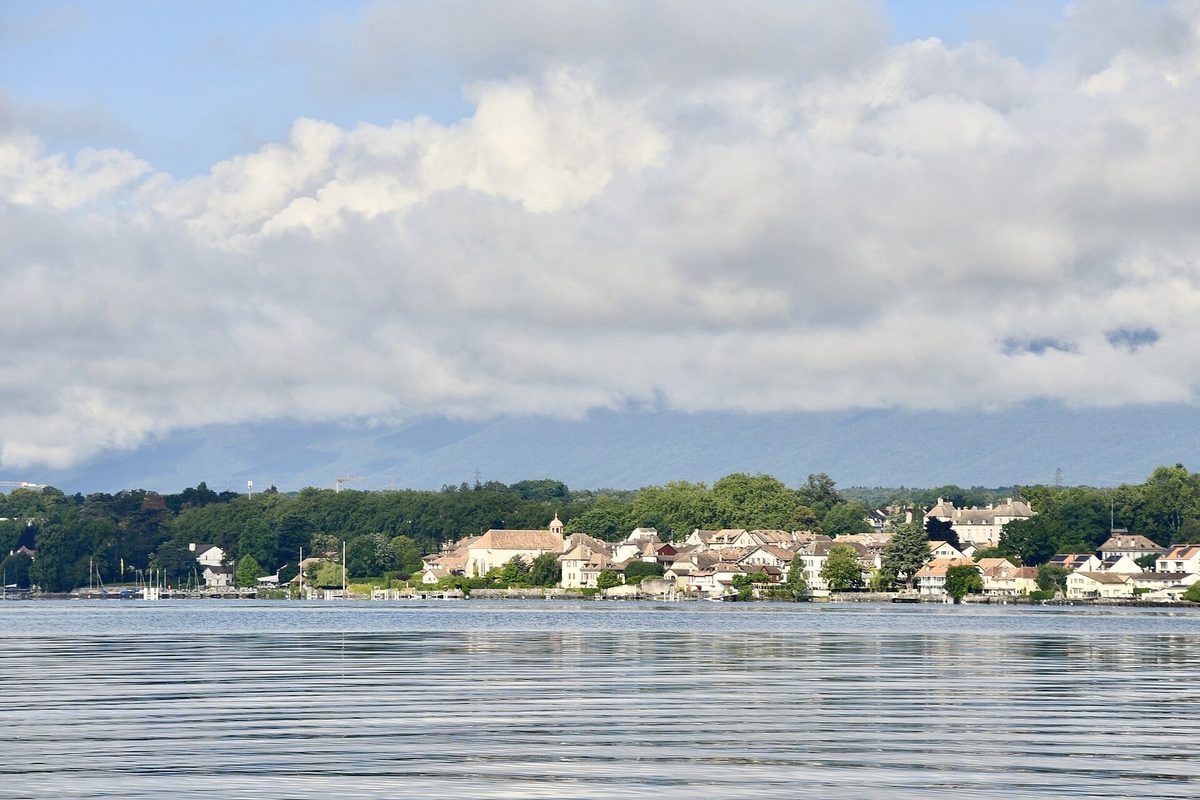
Laid out as a new town at the end of the 13th century by the lords of Thoire et Villars, Coppet owes its European reach to Necker's château and Madame de Staël's «Coppet group».
Entry based on 9 sources · Our method · Reusable text (CC BY-SA)
Origin of the name Coppet
The name appears in 1294 in the form «Copetum», then in 1347 in the form «Copet». The place probably takes its name from the wheel of the mills built along the Greny, called «Copé» in the local patois.[1][2][3]
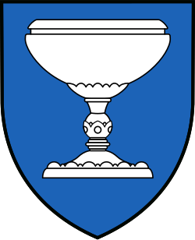
Coat of arms of Coppet
Azure, a cup argent. A white cup stands out on a blue field.[8]
Founding of Coppet
Coppet is a 13th-century new town, one of the last founded in the region. In 1271 the lords of Thoire et Villars, lords of the Haut-Bugey, bought from the House of Savoy a piece of land of the seigneury of Commugny in order to build a borough and a castle there. Humbert IV of Thoire et Villars founded the castle around 1280, then planned the borough at the end of the century. The Allamand family, who held the seigneury from 1314, granted Coppet a charter of franchises, and it thus became a town, later administered by a Council of Twelve and two syndics. As a border town between the Pays de Vaud and the Pays de Gex, on the Lausanne-Genève road, it prospered through transit trade.[1][2][3][4]
History of Coppet
Bronze Age. A pile-dwelling village occupies the lakeshore.[1][3]
Roman period. Remains of a villa, a funerary stele and a milestone of Emperor Antoninus.[1]
1271. The lords of Thoire et Villars acquire from the House of Savoy a piece of land of the seigneury of Commugny to found a borough and a castle there.[1][3]
around 1280. Humbert IV of Thoire et Villars founds the castle and plans the new town.[4]
1284. The Thoire et Villars own a «bâtie» in Coppet, a rectangular castle with a circular keep.[2]
1294. First written mention, in the form «Copetum».[1][3]
1299. Fortified buildings protected by ditches are attested.[2]
around 1300. The borough, the castle and the chapel of Notre-Dame are attested.[1][3]
1314. The seigneury passes to the Allamand family.[1]
1349. The Allamand grant franchises to the town of Coppet.[1]
15th century. The burghers found a hospital, to which the chapel of Notre-Dame is joined.[1]
1484. The Duke of Savoy creates the barony of Coppet for Amédée de Viry.[1][3]
1490. Foundation of a Dominican convent. Its church, in the Flamboyant Gothic style, is built around 1500-1510.[1][3]
1536. Bernese conquest: the castle is set on fire and the convent church becomes the Reformed temple. Coppet belongs to the bailiwick of Nyon until 1798.[1][3][4]
around 1665. The Count of Dohna completes the transformation of the medieval castle into an open residence.[1]
1784. Jacques Necker, finance minister of Louis XVI, buys the château and embellishes its interiors.[1][2][3][4]
1803. Coppet becomes the chief town of a circle.[1]
1804. On Necker's death, his daughter Germaine de Staël inherits the château. Under the Empire she gathers there the «Coppet group», which gives the small town a European reach.[1][2][4]
1946. Opening of the Musée du Vieux-Coppet.[1]
1948. The d'Haussonville family, descendants of Madame de Staël, open the château to the public.[1]
1991. Opening of the Terre-Sainte secondary school.[1]
Population of Coppet
Sources and references: [1][6]
| 1764 | 450 |
| 1850 | 471 |
| 1900 | 561 |
| 1950 | 616 |
| 1970 | 1'097 |
| 2000 | 2'360 |
| 2025 | 3'233 |
Families of Coppet
Dohna. Frederick, Burgrave of Dohna, bought the castle in 1657. With his son Alexander he gave it its classic U-shaped plan.[4]
D'Haussonville. Descendants of Madame de Staël, they received the castle through Louise de Broglie, Countess d'Haussonville, granddaughter of Germaine de Staël and niece of Adélaïde de Staël. Mathilde d'Haussonville had a Gothic Revival chapel built there in 1880. The family still owns it and lives there.[4][1]
Citizen families before 1800. Bory, Brüderlein, Guichoud, Mercier, Michel, Munier, Natural, Paitard and Poitry, as well as the Odelet family (from France), without a precise date. The Duvillard family (from France) obtains citizenship in 1760.[9]
Show more families (2)
In the 19th century. Bordier, Bristlen and Vanier, without a precise date. Then the Baierlé family (from Germany) obtains citizenship in 1878, the Débois family (from France) in 1892 and the Perrier family (from France) in 1897.[9]
From 1901 to 1962. 11 registrations. Several families come from abroad: from Italy (Antonietti in 1917 and 1955, Dura in 1946 and Masi in 1951) and from Germany (Natural in 1925). From Switzerland come the Séquin family from Lichtensteig SG and the Tillmann family from Niederried bei Kallnach BE (1956), the Dietrich family from Gampelen BE, the Frioud family from Rossens FR and the Widmer family from Othmarsingen AG (1957) and the Widmer family from Hasle bei Burgdorf BE (1959). They are joined by the Girardet family (1937). The last family registered, in 1959, is the Widmer family.[9]
Notable people of Coppet
Jacques Necker and Suzanne Curchod. The Genevan banker bought the castle in 1784 as a summer residence. He spent his last years there with his wife, born Suzanne Curchod, and both lie in the family mausoleum built in 1793-1794.[4]
Jean-Jacques Hogguer. A Genevan banker. Apart from a few later additions, the castle owes its present appearance to him.[4]
Gaspard de Smeth. Owner from 1767 to 1771, he had work carried out on the castle.[1]
Auguste de Staël. Germaine de Staël's son, he inherited the castle. He turned the French garden into an English-style park and had the library built in 1819. After his early death in 1827, his widow Adélaïde, born Vernet, lived there for nearly 50 years.[4]
Louis-Auguste Brun. In 1791 he painted a watercolour of the castle and its grounds, now held by the Bibliothèque de Genève.[1]
Economy of Coppet, past and present
Fishing, mills and molasse. For a long time Coppet drew its resources from the water, through fishing and water power. In 1347 several mills were built along the Greny. From the 14th to the 19th century, molasse quarries were worked on the shore, and the green stone was shipped by boat. A new port was laid out at the Place des Ormes in 1809.[1][2][3]
Inns and transit. Set on the road from Geneva to Lausanne, the small town grew rich on transit trade. Inns are recorded near the gates from the 15th century. There were four of them in the 18th century.[1][3]
Watchmaking. In the early 18th century, prompted by Geneva, Coppet became for a time a fairly important watchmaking centre.[1][3]
Rail, motorway and commuters. The Geneva-Lausanne line and the station opened in 1858. That same year the Compagnie des chemins de fer de l'Ouest suisse had a quay added to the port. Later the motorway and the pull of Geneva made the population grow. In 2012 the ISOS inventory noted that most residents worked in Geneva or Nyon.[1][3]
Disasters and major events in Coppet
The mill rebuilt in 1851. The town's old mill, at the end of the Rue des Moulins, was rebuilt in 1851 after a fire.[3]
Historic sites in Coppet
Château de Coppet. Castle of the lords of Thoire et Villars mentioned from 1284, set on fire in 1536 during the Bernese conquest, then transformed into a classical residence in the 17th and 18th centuries. Acquired in 1784 by Jacques Necker, it was the residence of Madame de Staël and the home of the «Coppet group». Open to the public since 1948, it is listed as a cultural property of national significance.[1][4][5]
Temple de Coppet. Former church of the Dominican convent founded in 1490, in the Flamboyant Gothic style (around 1500-1510), which became a Reformed temple at the Reformation. Octagonal bell turret in 1723, consolidation work on the bell tower in 1774, restoration in 1925-1927. Cultural property of national significance.[1][3][5]
Medieval borough. The urban fabric of the new town, built fairly quickly at the end of the 13th century along the Lausanne-Genève road, remains clearly legible. The small town is listed in the Federal Inventory of Swiss Heritage Sites (ISOS).[3]
Musée du Vieux-Coppet. Local museum founded in 1946. Cultural property of regional importance (federal PBC inventory).[1][5]
Remains in Coppet
Bronze Age pile dwelling. Remains of a Bronze Age lake village have been identified on the lakeshore.[1][3]
Roman remains. Remains of a villa, a funerary stele and a milestone of Antoninus attest to the occupation of the site in the Roman period, along the ancient lakeshore road.[1]
Protected heritage in Coppet
Cultural property of national significance (A objects in the PCP inventory)[7]
- Château avec maison d’habitation et dépendance, dépendance rurale (ancien pressoir), bûcher et deux fontaines
- Temple (ancienne église des Dominicains)
Cultural property of regional significance (B objects)[7]
- Maison de Mézières
- Musée de Coppet-Maison Michel
- Musée du château
Sources
- Dictionnaire historique de la Suisse, « Coppet »
- Commune de Coppet, « Bref descriptif historique »
- Office fédéral de la culture, Inventaire fédéral des sites construits d'importance nationale à protéger en Suisse (ISOS), fiche n° 4593 : Coppet, petite ville/bourg (2e version, février 2012)
- Fondation Othenin d'Haussonville, « History - Le Château de Coppet »
- Office fédéral de la protection de la population, Inventaire suisse des biens culturels d'importance nationale et régionale, liste du canton de Vaud (état au 1.1.2026)
- Statistique Vaud, « Population résidante permanente au 31 décembre 2025 »
- Federal Office for Civil Protection (FOCP), Swiss Inventory of Cultural Property (PCP), list for the canton of Vaud (as of 1.1.2026)
- IPI, Swissreg, emblems database: coat of arms of Coppet (no. 101508)
- Register of Swiss Surnames, 3rd edition (1989), search Commune "Coppet", Canton VD
Published by Sébastien Jörg ·
Other villages near Coppet
Missing information, or do you have a source? Suggest a correction or addition. Every submission is checked before it's published.
Suggest a change