Commugny
Beneath the church of Saint-Christophe and the cemetery lie the remains of a 1st-century Roman villa whose wall paintings are unique in Switzerland for their quality.
Entry based on 10 sources · Our method · Reusable text (CC BY-SA)
Origin of the name Commugny
The place is recorded in 1018 as « Communiacum ». No etymology is known for « Commugny ».[1]
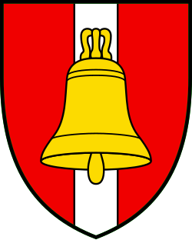
Coat of arms of Commugny
Gules, a pale argent, overall a bell Or. On a red field, a white vertical band runs down the middle of the shield, with a large yellow bell laid over it. The arms first appeared on a flag given to the municipality in 1898. In 1924 the bell, small until then and placed on the white band, was enlarged so that it spreads over the red.[8][9]
Founding of Commugny
The site first held a wealthy Roman villa with a portico, decorated with exceptional wall paintings, in the 1st century AD. A first church rose on its remains from the 6th-7th century, and the village grew up around it. Commugny has no known founder. The land of Commugny later belonged to the abbey of Saint-Maurice, which recovered it in 1018 from King Rudolph III of Burgundy.[1][4]
History of Commugny
1st century. A Roman villa with a portico, adorned with wall paintings, is built.[1]
6th-7th century. First church built on the site of the villa.[1]
515. According to tradition, Sigismund, King of Burgundy, gave Commugny to the abbey of Saint-Maurice. The donation actually seems to date from the 9th century.[1]
8th-9th century. Second church, completed by a square choir in the 11th century.[1]
1018. Rudolph III returns the land of « Communiacum » to the abbey of Saint-Maurice.[1]
1026. First mention of the parish church, dedicated to Saint Christopher.[1]
12th century. A troubled period: Commugny, an advocacy of the Blonay family, is pledged to the Count of Geneva.[1]
1180 and 1199. The abbey of Saint-Maurice buys back from the Count of Geneva the pledge he held on the advocacy.[1]
1257. Peter of Savoy acquires Commugny.[1]
1271. Commugny becomes part of the lordship, later barony, of Coppet.[1]
1536-1798. The barony of Coppet belongs to the Bernese bailiwick of Nyon. After the Reformation Commugny becomes the centre of a parish that today includes the municipalities of Terre-Sainte.
1788-1789. The parsonage is remodelled.[1]
1798. Commugny becomes part of the district of Nyon.[1]
1905. On 28 August a man kills his wife and two daughters in Commugny. The case, blamed on absinthe, strengthens opposition to the drink, banned in Switzerland in 1908.[6]
1959. On 19 April women take part in elections in the municipality for the first time, after women's suffrage was introduced in the canton of Vaud.[5]
around 1960. Until then a farming and wine-growing municipality, Commugny becomes residential with the construction of the A1 motorway.
2000. 75% of the working population works outside the municipality, mainly in Geneva. Over a third of the inhabitants are foreigners, many of them international civil servants.[1]
Population of Commugny
Sources and references: [1][2]
| 1764 | 249 |
| 1798 | 282 |
| 1850 | 249 |
| 1900 | 308 |
| 1950 | 337 |
| 1960 | 439 |
| 2000 | 2'603 |
| 2025 | 2'968 |
Families of Commugny
Citizen families before 1800. Decré, Dussoix, Gay, Guichoud, Pellegrin, Plojoux, Polencent, Vulliet and Vulliet-Prince, without a precise date.[10]
In the 19th century. The Bischoff family (from Germany) obtains citizenship in 1808, the Girard family (from Savagnier NE) in 1829, the Fuster family (from Spain) in 1865 and the Rapp family (from Germany) in 1880.[10]
From 1901 to 1962. The Michard family comes from France (1918). From Switzerland come the Jacquier family from Vernayaz VS (1956), the Thomann family from Meiringen BE (1957), the Rytz family from Ferenbalm BE (1958), the Mingot family from Genève GE (1959) and the Blatter family from Zimmerwald BE and the Wälti family from Rüderswil BE (1961). The last registrations date from 1961 (Blatter and Wälti).[10]
Notable people of Commugny
George de Mestral. An engineer from Commugny, he invented Velcro, a quick fastening system patented in 1952. A 700 m avenue through the communal forest, from the Route de la Branvaude to the Chemin du Stand, bears his name.[9]
Economy of Commugny, past and present
Farms and a wine estate. Commugny changed with the motorway, but several farms remain. They raise cattle and grow cereals. The territory also has a fruit farm and a 19th-century wine estate.[1][9]
Shops and craftsmen. The village keeps a few shops and craftsmen, listed by the municipality: a tea room, a restaurant, a garage, a wrought-iron smith, a tinsmith, a farm shop and a grocery.[9]
Historic sites in Commugny
Church of Saint-Christophe. Built on the site of the Roman villa, it succeeds a first church of the 6th-7th century and a second building of the 8th-9th century, to which a square choir was added in the 11th century and seven chapels in the 14th-16th centuries. Mentioned in 1026, it is listed as a cultural property of regional importance (federal PBC inventory).[1][3]
The parsonage. Altered in 1788-1789, the parsonage is listed as a cultural property of regional importance (federal PBC inventory).[1][3]
Remains in Commugny
Roman villa of Commugny. Portico villa of the 1st century AD. Its wall paintings are unique in Switzerland for their quality. Part of them is displayed at the Roman Museum of Nyon. Its remains lie beneath the parish church and the cemetery. The site is listed as a cultural property of regional importance (federal PBC inventory).[1][3][4]
Protected heritage in Commugny
Cultural property of regional significance (B objects)[7]
- Commugny, villa gallo-romaine
- Cure
- Eglise réformée Saint-Christophe
- Maison gothique (maison Jean-Pierre Steffen)
Sources
- Dictionnaire historique de la Suisse, « Commugny »
- Statistique Vaud, « Population résidante permanente au 31 décembre 2025 »
- Office fédéral de la protection de la population, Inventaire suisse des biens culturels d'importance nationale et régionale, liste du canton de Vaud (état au 1.1.2026)
- Musée romain de Nyon, Michel Fuchs et Evelyne Ramjoué, « Commugny - Mural splendors of a Roman villa » (catalogue, 1994), page de présentation
- Dictionnaire historique de la Suisse, « Suffrage féminin » (Yvonne Voegeli, Werner Seitz, version du 04.04.2023)
- Nina S. Studer, « Absinthe: From Green Fairy to Moral Panic », History Today
- Federal Office for Civil Protection (FOCP), Swiss Inventory of Cultural Property (PCP), list for the canton of Vaud (as of 1.1.2026)
- IPI, Swissreg, emblems database: coat of arms of Commugny (no. 101974)
- Official Gazette of the Canton of Vaud (FAO), "Alphabet des communes vaudoises: Commugny"
- Register of Swiss Surnames, 3rd edition (1989), search Commune "Commugny", Canton VD
Published by Sébastien Jörg ·
Other villages near Commugny
Missing information, or do you have a source? Suggest a correction or addition. Every submission is checked before it's published.
Suggest a change