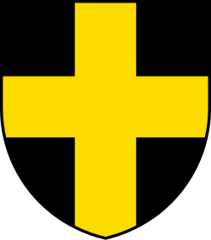
Confignon
Origin of the name Confignon
The name appears in 1153 as « Cofiniacum ». No explanation has yet been found for this name.[1]
Founding of Confignon
Nobody knows who founded the village. The site was occupied from Roman times: a cemetery, used until the first Christian centuries, has been found at Les Boules. The church of Saints-Pierre-et-Paul, mentioned from 1153, belonged to the Benedictine monastery of Saint-Jean in Genève, and the parish came under the deanery of Vuillonnex. The local lords, vassals of the counts of Genève and then of the counts and dukes of Savoy, owned a fortified castle. Their lordship later became a barony. Apart from a Bernese interlude, Confignon remained Savoyard until it joined the canton of Genève with the Communes réunies. It stayed rural and mainly wine-growing until the 1960s.[1]
History of Confignon
Roman period. A cemetery is laid out at Les Boules and used until the first Christian centuries.[1]
1153. First mention of the name, as « Cofiniacum ». The church of Saints-Pierre-et-Paul, mentioned the same year, belongs to the Benedictine monastery of Saint-Jean in Genève.[1]
1332. The local lords found a chapel.[1]
1536. Bern, ally of Genève, occupies part of the county of Genève. The locality is attached to the Bernese bailiwick of Ternier and the church adopts the Reformation.[1]
1567. The bailiwick of Ternier returns to Savoy.[1]
1589. Catholic worship is restored.[1]
1590. The Genevans destroy the castle of the lords of Confignon.[1]
1598. The lordship is raised to the rank of barony.[1]
1691. Benoît de Pontverre becomes parish priest. He converts many Genevans to Catholicism.[1]
1714. Father de Pontverre has the chapel founded in 1332 decorated.[1]
1728. Father de Pontverre gives dinner to the fifteen-year-old Jean-Jacques Rousseau and sends him to Madame de Warens in Annecy, whom he reaches on Palm Sunday.[4]
1732. The site of the destroyed castle still appears on a cadastral map.[1]
1793. After France annexes Savoy, Bernex, Onex and Confignon form a single political municipality.[1]
1816. The Treaty of Turin joins the municipality to the canton of Genève as part of the Communes réunies.[1]
1850. Confignon separates from Bernex, then from Onex.[1]
1851. Confignon becomes an independent municipality.[1]
1884. About thirty graves of the Les Boules cemetery are reportedly uncovered during construction of the road to Lully.
1960s. In the municipality, until then rural and mainly wine-growing, farmland is rezoned as building land for low-rise buildings.[1]
2000. More than 80 % of the working population works outside the municipality, which is part of the Genève agglomeration, and about three quarters of jobs are in the service sector.[1]
Population of Confignon
Sources and references: [1][2]
| 1860 | 334 |
| 1888 | 276 |
| 1900 | 282 |
| 1950 | 541 |
| 1970 | 1'635 |
| 2000 | 3'033 |
| 2010 | 4'097 |
| 2020 | 4'491 |
| 2025 | 4'570 |
Historic sites in Confignon
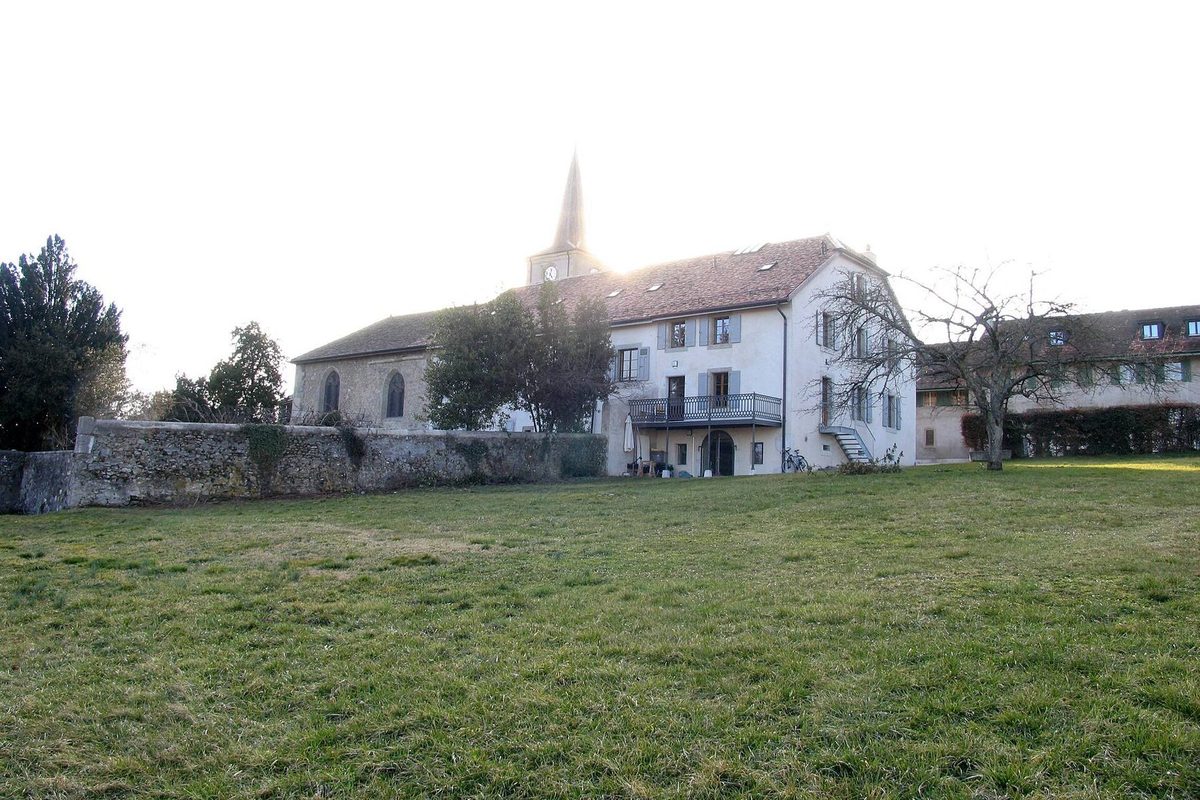
Church of Saints-Pierre-et-Paul. Church mentioned from 1153, which belonged to the Benedictine monastery of Saint-Jean in Genève. It became Protestant under Bernese administration and returned to Catholic worship from 1589. Father Benoît de Pontverre served here from 1691.[1]
Seigneurial chapel. Chapel founded in 1332 by the local lords and decorated in 1714 at the initiative of Father de Pontverre.[1]
Cressy. Locality of the municipality of Confignon. The name also refers to neighbouring districts in the municipalities of Onex and Bernex.[5]
Remains in Confignon
Les Boules cemetery. Cemetery from the Roman period and the first Christian centuries at the place called Les Boules. About thirty graves, with fragments of tile, marble, pottery and mosaic, are said to have been found there in 1884.[1]
Castle of Confignon. Castle of the lords of Confignon, destroyed by the Genevans in 1590. Its site still appears on a cadastral map of 1732.[1]
Sources
- Dictionnaire historique de la Suisse, « Confignon » (Jacques Barrelet), version du 10.08.2005
- Office cantonal de la statistique (OCSTAT), Mémento statistique du canton de Genève 2026, tableau Population résidante par commune, en 2025
- geo.admin.ch, service de recherche de swisstopo (coordonnées)
- Jean-Jacques Rousseau, Les Confessions, livre second (Collection complète des œuvres, Genève, 1780-1789, vol. 10), édition Rousseau Online
- geo.admin.ch, service de recherche de swisstopo (Cressy)
Other villages near Confignon
Missing information, or do you have a source? Suggest a correction or addition. Every submission is checked before it's published.
Suggest a change