Corbeyrier
In 1584 a landslide from the Luan cirque swept down as far as Yvorne and destroyed many buildings.
Entry based on 11 sources · Our method · Reusable text (CC BY-SA)
Origin of the name Corbeyrier
The name is recorded in 1261 as « de Cubiriaco », also transcribed « Curbiriaco ». « Curbirie » follows at the end of the 13th century, then « Corberier » in 1577 on a map of the Republic of Bern. It reportedly comes from a Latin personal name followed by the suffix of Celtic origin « -acum », « estate of », though this explanation is not certain.[1][2][3]
Coat of arms of Corbeyrier
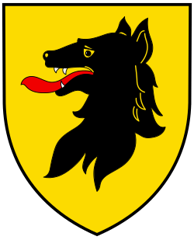
Or, a wolf's head erased sable, langued gules. On a yellow field, a black wolf's head with a ragged neck shows a red tongue. It recalls a local legend: the village hunters tracked down the last wolf in the region to claim the bounty, which earned the inhabitants the nickname "Robaleux", the wolf thieves.[7][8]
Founding of Corbeyrier
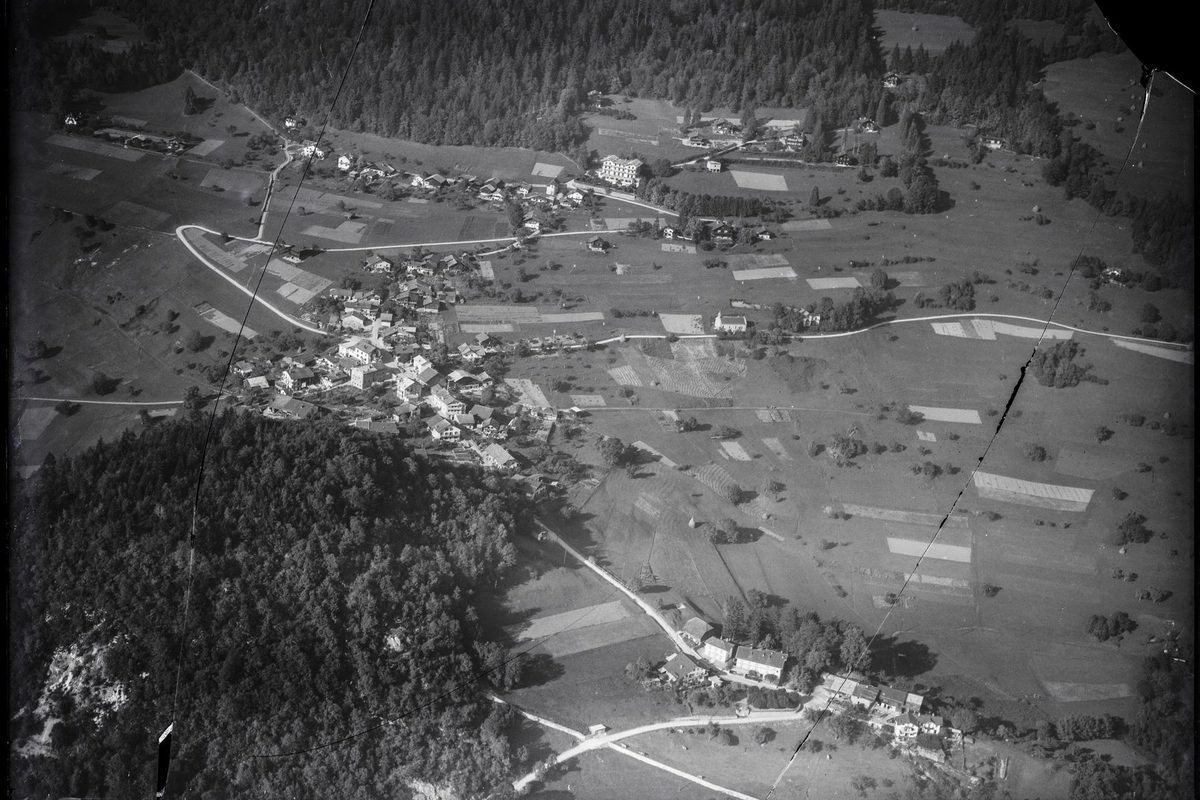
Who founded Corbeyrier, or when, is not known. Corbeyrier extends along the right bank of the Rhône, from the upper edge of the Yvorne vineyards to the large mountain pastures of the Eau-Froide and Petit-Hongrin valleys, with the hamlets of Boveau, Luan, Le Crettex and Vers Cort. A Savoyard possession in the Middle Ages, it passes to Bern with the mandement of Aigle. It becomes an autonomous municipality in 1828, and two years later divides its jointly held property with Aigle and Yvorne.[1][2]
History of Corbeyrier
1261. First reliable mention of the name, as « de Cubiriaco ».[1][2][3]
1475. Bern conquers the Savoyard lands on the right bank of the Rhône. Corbeyrier belongs to the mandement of Aigle until 1798.[1][2]
1584. A landslide starting from the Luan cirque sweeps down to Yvorne and destroys many buildings.[1][2]
1798. Corbeyrier is attached to the Aigle district.[1]
1828. The municipality becomes autonomous.[1]
1830. Jointly held property is divided with Aigle and Yvorne.[1]
1833. The parish, until then attached to Aigle, officially passes to Yvorne (in practice in 1838).[1]
1880s. The Hôtel Victoria is converted. It later became a nursing home.[1]
1902. A Catholic chapel is built.[1]
1908. A Protestant chapel is built.[1][2]
Population of Corbeyrier
Sources and references: [1][5]
| 1764 | 225 |
| 1850 | 269 |
| 1900 | 264 |
| 1950 | 260 |
| 1990 | 369 |
| 2000 | 347 |
| 2025 | 456 |
Families of Corbeyrier
Citizen families before 1800. Bournoud, Byrde, Delacrétaz, Dubuis, Duthovex, Navioz, Paris, Sauge, Vaudroz and Veillard, without a precise date.[9]
In the 19th century. The Zehender family, without a precise date. Then the Scherrer family (from Germany) obtains citizenship in 1854.[9]
From 1901 to 1962. 15 registrations. Several families come from abroad: from Italy (Zanetta in 1901, Cossetto in 1910, Rigazzio in 1918, Bonin in 1919, Demarchi in 1929, Chiaradia in 1944 and Iacaccia in 1949), from Germany (Kehret in 1925, Maier in 1934 and Strölin in 1936), from France (Lob in 1907 and Goldstein in 1912), from the Soviet Union (Tomiloff in 1924 and Hächler in 1925) and from Czechoslovakia (Simececk in 1927). The last family registered, in 1949, is the Iacaccia family.[9]
Notable people of Corbeyrier
Félix Dubuis (1836-1911). A native of Corbeyrier, he was municipal secretary there before becoming tax collector of the Aigle district (1852-1894). As agent of the Banque de Montreux in Aigle, he opened a plaster factory in Bex in 1896, the Société des usines de la Croix. He sat in the Vaud Constituent Assembly in 1885.[10]
René Leyvraz (1898-1973). A journalist born in Corbeyrier, he edited the Courrier de Genève (1923-1935 and 1945-1963) after converting to Catholicism. A Christian Social member of the Geneva Grand Council from 1923 to 1940 and a supporter of Catholic social teaching, he was a founding member of the Gotthard League.[11]
Economy of Corbeyrier, past and present
Fields, timber and hunting. Before the tourists came, the inhabitants lived modestly from farming, logging and hunting.[2]
The resort. Tourists discovered the area from 1873, first for excursions, then for skiing. In the early 1900s Corbeyrier was a fashionable resort, with hotels and guesthouses, including the Victoria in the village and the Bellevue at Boveau. After each of the two world wars, refugees took the place of holidaymakers in the hotels. From about 1950 to 1970 the buildings housed holiday camps for children from Aigle, Geneva and Belgium.[2][8]
Timber, vines and craftsmen. The municipality owns 323 hectares of forest, managed by the Groupement forestier des Agittes, and a one-hectare vineyard at Yvorne. Two family farms and some winegrowers work on its territory. A sawmill and a joinery in the village process local timber. The village also has a marble worker, a carpenter, a leather craftsman and ceramicists.[8]
Disasters and major events in Corbeyrier
The landslide of 4 March 1584. In early March 1584 a strong earthquake was felt as far as Geneva. On 4 March a huge landslide broke away above Luan and ran down as far as Yvorne. It buried the village of Corbeyrier and part of Yvorne.[2][8]
Historic sites in Corbeyrier
Luan cirque and mountain pasture. Municipal mountain pasture; the 1584 landslide that swept down to Yvorne started from the Luan cirque.[1]
Agittes pastures. Private pastures on which, together with the municipal pasture of Luan, the municipality's mountain farming relies.[1]
Chapels. A Catholic chapel built in 1902 and a Protestant chapel built in 1908.[1][2]
Hôtel Victoria. Former hotel converted in the 1880s, now a nursing home.[1]
Fort de Champillon and Pyromin Museum. The Fort de Champillon, built in 1942-1943, was used by the Swiss army until 1994. A former fort of more than 7'000 m2 in the municipality houses the Pyromin Museum, devoted to pyrotechnics, fireworks and explosives.[2][4]
Protected heritage in Corbeyrier
Cultural property of regional significance (B objects)[6]
- Ecluse de la Joux-Verte (cf. également Villeneuve (VD))
Legends of Corbeyrier
Le Creux des Bourguignons. According to a local tradition, Burgundian mercenaries fleeing after the defeat of Charles le Téméraire in 1476 were plundering the region. The village's forebears are said to have massacred them and buried them pell-mell at la Praille, in a large pit called the Creux des Bourguignons.[2]
The « Voleurs-de-Loup ». The inhabitants are nicknamed « Voleurs-de-Loup » (wolf thieves) or « Robaleux ». Tradition tells that a wounded wolf, hunted by hunters from Leysin, was killed at Corbeyrier and that the inhabitants refused to hand the carcass over to the hunters. A bounty was at stake.[3]
Traditions and festivals in Corbeyrier
The Celtic Festival. Every two years the Confrérie du Loup holds a Celtic festival in Corbeyrier.[8]
The Jeunesse l'Avenir. The youth society makes its traditional New Year round and regularly plays its drums.[8]
Sources
- Dictionnaire historique de la Suisse, « Corbeyrier »
- Commune de Corbeyrier, « Un peu d'histoire »
- Commune de Corbeyrier, page d'accueil (sobriquet des habitants)
- Musées suisses (museums.ch), « Pyromin Museum »
- Statistique Vaud, « Population résidante permanente au 31 décembre 2025 »
- Federal Office for Civil Protection (FOCP), Swiss Inventory of Cultural Property (PCP), list for the canton of Vaud (as of 1.1.2026)
- IPI, Swissreg, emblems database: coat of arms of Corbeyrier (no. 101767)
- Official Gazette of the Canton of Vaud (FAO), "Alphabet des communes vaudoises: Corbeyrier"
- Register of Swiss Surnames, 3rd edition (1989), search Commune "Corbeyrier", Canton VD
- Dictionnaire historique de la Suisse, « Dubuis, Félix », version du 14.02.2006
- Dictionnaire historique de la Suisse, « Leyvraz, René », version du 24.01.2008
Published by Sébastien Jörg ·
Other villages near Corbeyrier
Missing information, or do you have a source? Suggest a correction or addition. Every submission is checked before it's published.
Suggest a change