Leysin
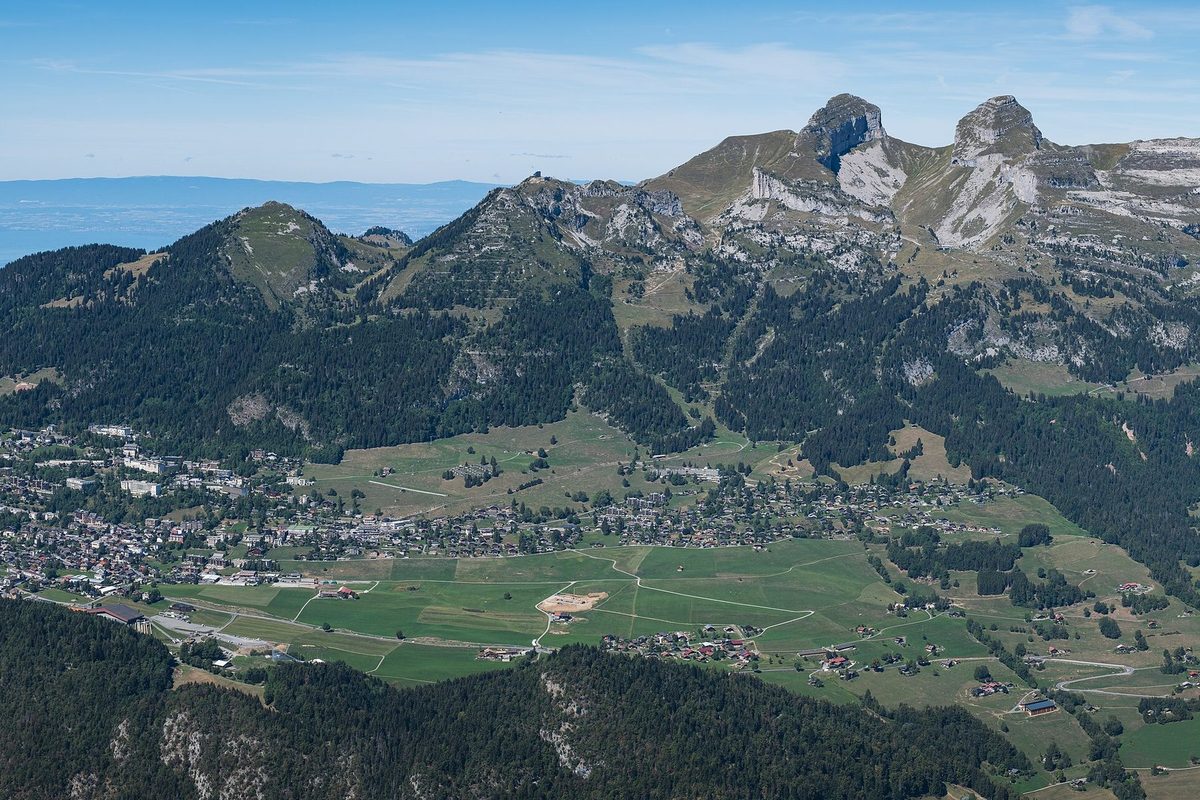
In 1946 Leysin housed an average of 3'500 patients and had up to eighty sanatoriums, before antibiotics brought about their decline.
Entry based on 10 sources · Our method · Reusable text (CC BY-SA)
Origin of the name Leysin
The place appears as « Leissins » in 1231-1232 and « Leisins » in 1352. The name « Leysin » still awaits an explanation.[1]
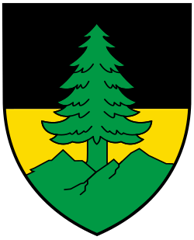
Coat of arms of Leysin
Per fess sable and or, a fir tree vert overall, planted between two mounts of the same. The shield is divided horizontally, black above and yellow below. A green fir tree, planted between two green mountains, stands over both colours. Adopted in 1905, these arms recall that Leysin was separated from the large parish community of Aigle. The fir tree stands for the commune's vast forests, the two mounts for the Tours d'Aï and de Mayen.[6][7]
Founding of Leysin
Nobody knows who founded Leysin or when. The village stands on a plateau at 1'260 metres, at the foot of the Tours d'Aï and de Mayen. In the Middle Ages the village was attached to the vidomnat of Aigle and came under the House of Savoy, which granted the inhabitants the alpine pastures of Aï and Mayen. Until the late 19th century a few hundred people lived here from alpine livestock farming and the growing of wheat, flax and hemp. Today the municipality comprises the village of Leysin and the hamlets of Veyges, Feydey, Aï and Mayen.[1]
History of Leysin
1231-1232. First mention, « Leissins ».[1]
1313. Leysin has 61 households.[1]
14th century. The House of Savoy grants the inhabitants the alpine pastures of Aï and Mayen.[1]
1439. Pétremand de Chivron pays homage to the Duke of Savoy for twenty-two men of the village.[1]
1445. The bishop of Sion authorises the building of a chapel dedicated to Saint Theodul and Saint Mary Magdalene.[1]
1475-1798. Under Bernese rule, Leysin forms a métralie of the government of Aigle.[1]
1485. The inhabitants are freed from personal servitude.[1]
1520. The inhabitants elect a general council of twelve prud'hommes.[1]
1528. Leysin adopts the Reformation; it becomes a parish in 1702.[1]
1764. The exceptional longevity of the inhabitants is noted, later cited in 1798 by Thomas Robert Malthus in his « Essay on the Principle of Population ».[1]
1798. Opposed to the Revolution, the inhabitants obtain the reoccupation of the village by a Bernese troop, which withdraws on 5 March after the battle of La Forclaz.[1]
1873. Arrival of the first patients with pulmonary tuberculosis.[1]
1875. Opening of the Le Sépey-Leysin road.[1]
1892. Opening of the Grand Hôtel.[1]
1900. Opening of the Aigle-Leysin rack railway, extended to the Grand Hôtel in 1915.[1]
1903. Opening of the first clinic for bone tuberculosis. Dr Auguste Rollier develops the altitude cure and heliotherapy.[1]
1946. The resort hosts an average of 3'500 patients and has up to eighty sanatoriums.[1]
1947. Decline begins because of antibiotic treatments. The clinics close between 1955 and 1962.[1]
1956. Construction of the Berneuse gondola. The shift to summer and winter tourism continues with holiday homes (from 1958) and international private schools.[1]
Population of Leysin
Sources and references: [1][3]
| 1313 | 61 hearths (households) |
| 1850 | 415 |
| 1900 | 1'065 (including resident patients) |
| 1950 | 4'242 (including resident patients) |
| 1980 | 2'057 |
| 2000 | 2'998 |
| 2025 | 3'722 |
Families of Leysin
Citizen families before 1800. Fifteen families, with no precise date: Barroud, Berthoud, Drapel, Dufrêne, Dufresne, Dupertuis-dit-Neveu, Durgnat, Durgniat, Maricot, Neveu, Ogay, Paris, Tauxe, Vaudroz and Warpelin.[8]
From 1901 to 1962. Fifty-three registrations, from 1918 to 1962. Italy leads with nineteen families, ahead of Germany (four), France (three) and Czechoslovakia (two). Belgium, Poland and Yugoslavia supply one each. The twenty families from other Swiss communes were all registered between 1956 and 1962. The last, in 1962, are the Eugler, from Straubenzell SG, and the Jankovic, from Yugoslavia.[8]
Notable people of Leysin
Auguste Rollier (Saint-Aubin 1874 - Leysin 1954). Physician. He settled in Leysin in 1903, opened the children's clinic "Le Chalet" there and developed the sun cure, aimed mainly at tuberculosis of the bones and joints. He created open-air schools and in 1930 founded the Clinique manufacture, where patients did manual work.[9][1]
Eduard Scherrer, Alfred Neveu, Alfred et Heinrich Schläppi. This four-man bobsleigh crew, all from Leysin, won the first Olympic gold medal in the discipline at the first Winter Olympics in Chamonix in 1924.[7]
Silvio Giobellina. Bobsledder. He won gold at the 1982 World Championships in St. Moritz, then bronze in the four-man bob at the 1984 Sarajevo Olympics. In the 1990s he created the Tobogganing Park in Leysin.[7]
Economy of Leysin, past and present
Alpine pastures and fields. For a long time Leysin was a small mountain village living mainly from farming. People practised alpine dairy farming and grew wheat, flax and hemp. From the late 19th century, these activities gave way to health tourism.[1][7]
The sanatoriums. In the 1930s, the village had more than 4'000 inhabitants. In 1940, Doctor Rollier ran 18 sanatoriums, which took in more than 1'500 patients from all over the world. In 1950, the commune counted 4'242 inhabitants, resident patients included.[1][7]
Resort and international schools. After the sanatoriums, Leysin became a tourist resort. In 1956, Club Méditerranée opened one of its snow villages there. Some 100 kilometres of runs are served by about thirty lifts. The village is also home to several international schools, including Leysin American School and Kumon Academy Leysin.[1][7]
Historic sites in Leysin
Reformed church. Former chapel of Sainte-Madeleine-et-Saint-Théodule, whose construction was authorised in 1445 by the bishop of Sion. A mid-15th-century building with a porch tower probably dating from the late 15th century. Cultural property of regional importance.[1][2]
Grand Hôtel. Opened in 1892, it marks the beginning of cure tourism. The Aigle-Leysin railway was extended to it in 1915.[1]
Alpine pastures of Aï and Mayen. Granted to the inhabitants by the House of Savoy in the 14th century, at the foot of the Tours d'Aï and de Mayen.[1]
La Berneuse. Summit served by a gondola since 1956, a symbol of Leysin's tourist reconversion.[1]
Protected heritage in Leysin
Cultural property of regional significance (B objects)[5]
- Chalets d'Aï, deux chalets d'alpage et treize écuries
- Clinique «manufacture» du Dr Rollier
- Eglise réformée Saint-Théodule
- Grand Hôtel (ancien hôtel de la Source)
- Swiss hôtel management school (ancien hôtel Belvédère)
Legends of Leysin
Michel and Nérine. In a cave in the Tour d'Aï lived fairies who watched over the herds in return for a pail of cream. The young fairy Nérine fell in love with Michel, a herdsman from Leysin, and carried him through the air in a chariot drawn by swallows, offering him riches and distant lands. Michel always refused: nothing was worth more than his mountain, and he loved Salomé. Out of jealousy, another girl had the fairies' pail rubbed with gentian. The fairies left Aï for ever, and Michel married Salomé.[4]
The sorcerer of Crettaz. An invisible spirit harassed passers-by at Crettaz, throwing stones at them. A soldier from Leysin, on his way home from a review at Le Sépey, took aim at it behind a plank and fired. A shadow fled howling, and the sorcerer never troubled the area again.[4]
Traditions and festivals in Leysin
The Nuit des Fées. A village festival, the Nuit des Fées livens up the village centre for a weekend: a procession from Feydey station, shows and concerts, an ecumenical service, children's workshops and craft stalls.[10]
Sources
- Dictionnaire historique de la Suisse, Jean-Jacques Bouquet, « Leysin », version du 13.02.2023
- Office fédéral de la protection de la population, Inventaire suisse des biens culturels d'importance nationale et régionale, liste du canton de Vaud (état au 1.1.2026)
- Statistique Vaud, « Population résidante permanente au 31 décembre 2025 »
- Alfred Cérésole, Légendes des Alpes vaudoises, ill. Eugène Burnand, Lausanne, 1885, p. 91-99 et 153-154
- Federal Office for Civil Protection (FOCP), Swiss Inventory of Cultural Property (PCP), list for the canton of Vaud (as of 1.1.2026)
- IPI, Swissreg, emblems database: coat of arms of Leysin (no. 101868)
- Official Gazette of the Canton of Vaud (FAO), "Alphabet des communes vaudoises: Leysin"
- Register of Swiss Surnames, 3rd edition (1989), search Commune "Leysin", Canton VD
- Historical Dictionary of Switzerland (HDS), article "Rollier, Auguste" (version of 23.05.2012)
- Vaud Promotion, vaud.ch, "Nuit des Fées" (Leysin)
Published by Sébastien Jörg ·
Other villages near Leysin
Missing information, or do you have a source? Suggest a correction or addition. Every submission is checked before it's published.
Suggest a change