Cornaux
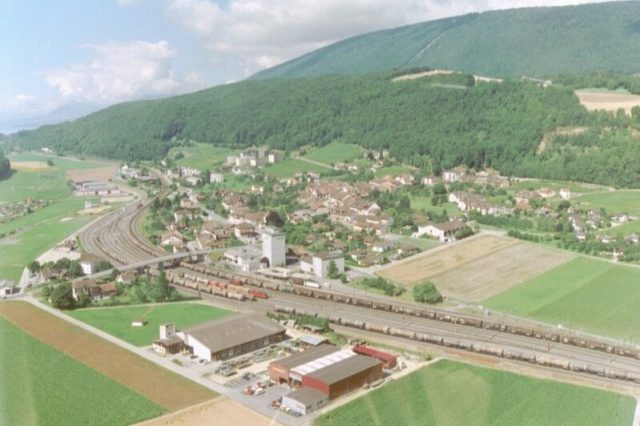
Winegrowing village of the Entre-deux-Lacs at the foot of the Jura, known to archaeologists worldwide for the Celtic bridge of Les Sauges, uncovered in 1965.
Entry based on 10 sources · Our method · Reusable text (CC BY-SA)
Origin of the name Cornaux
The name appears in 1212 as « Curnaul », in a charter concerning a dispute between the first inhabitants of the place and the abbey of Saint-Jean. It then went through several spellings (Cunal, Culnau, Cornaul) before settling as « Cornaux ». Its origin is not established: it may come from the Romance « corte » (farm estate or hamlet, from the Latin cohors) combined with the Germanic first name « Arnald » or « Arnold », i.e. « the estate of Arnald ». An old German name, « Gurnau », now out of use, is reportedly also recorded. In the 13th century the inhabitants were called the « Corbonetchs » (attested between 1212 and 1220). Today they are reportedly nicknamed « les Chasseurs » (the Hunters), a nickname of unknown origin.[1][3][4]
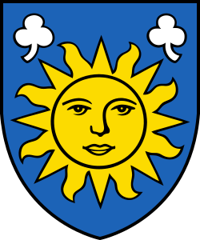
Coat of arms of Cornaux
Azure, a sun Or, in chief two trefoils argent. A yellow sun shines on a blue field, with two white trefoils above it. The arms are inspired by the sign of the commune's inn and replaced, in the late 19th century, the old emblem of 1746, a pale charged with chevrons in the Neuchâtel colours beneath a trefoil, which the two trefoils recall. Olivier Clottu dates the change to 1888, while the commune's history gives 13 December 1890.[9][4]
Founding of Cornaux
No founding charter or founder is known: Cornaux took shape gradually as a rural community. Modest springs probably favoured its settlement. One of them, now vanished, is cited as early as 1373 to the east of the territory. Fragments of Roman tiles have suggested a Roman farming colony, but the hypothesis is not confirmed. A rural community existed in any case at the beginning of the 13th century: its inhabitants were then in dispute with the abbey of Saint-Jean. It only became a political body in the 15th century. Apart from a few families who had become burghers of Neuchâtel in the 14th century, most inhabitants remained of servile status until the general emancipation. Cornaux belonged to the châtellenie of Thielle, while the neighbouring village of Cressier depended on that of Le Landeron. The parish of Saint-Pierre belonged to the deanery of Soleure, in the diocese of Lausanne.[1][4]
History of Cornaux
Hallstatt (early Iron Age, approx. 800-450 BC). A group of Hallstatt-period burial mounds is attested above the place called Souaillon.[1]
1892. Six skeletons are exhumed in a gravel pit located between Cornaux and Cressier. One wears three stamped bronze bracelets and another a lignite bracelet, dated to the Hallstatt period.[2]
2nd-1st century BC (Late La Tène). A wooden bridge about 90 metres long, with seven pile bents each made of three piles and two oblique side supports, crosses the Thielle at the place called Les Sauges. Dendrochronology dates the felling of the oaks to 116 BC. The bridge is sometimes dated to about 300 BC, though this is not certain.[1]
Roman period. Isolated Gallo-Roman finds, in the village and in the bed of the Thielle, attest a presence in Roman times. Fragments of Roman tiles have also been noted. They may point to a Roman farming colony linked to a spring cited in 1373, a hypothesis not yet confirmed.[1][4]
Early Middle Ages. Isolated Merovingian finds are also attested, in the village and in the bed of the Thielle.[1]
1212-1220. First written mention of the village, in the form « Curnaul » (1212). The first inhabitants, then called « Corbonetchs », are documented in dispute with the abbey of Saint-Jean.[1][4]
1228. The parish of Cornaux (church of Saint-Pierre) is cited for the first time. It belongs to the deanery of Soleure, in the diocese of Lausanne.[1]
1340. Construction of the church, dedicated to Saint Peter.[4]
15th century. The rural community of Cornaux organises itself politically.[1]
1500. Claude Layderrier and Guillauma Marchandet finance the construction of the Chapelle Clottu, adjoining the church.[4]
1526. General emancipation of the inhabitants: until then, apart from a few families who had become burghers of Neuchâtel in the 14th century, the majority were of servile status.[1]
1532. With the Reformation, the Protestants of Enges are attached to the parish of Cornaux.[1]
1743-1746. First coats of arms of the village, commissioned by local notables: those of 1743 (Abraham Clottu and Abraham Charles) are carved into the stone lintel of the entrance door of the forge, rue des Fontaines, where they are still visible today. Those of 1746 (Jean-Pierre Clottu and Abraham Junod) are not preserved anywhere in Cornaux, but engraved on two pewter wine jugs (semaises) now in the Musée d'art et d'histoire of Neuchâtel.[4]
1770. Construction of the Hôtel du Soleil.[4]
1775. The king of Prussia Frederick II, then sovereign of Neuchâtel, authorises the transformation of the Hôtel du Soleil into a tavern and hotel.[4]
1806-1814. Under prince Berthier, sovereign of Neuchâtel during the Napoleonic period, the Hôtel du Soleil becomes the seat of the justice of the châtellenie.[4]
until 1848. Cornaux is part of the châtellenie of Thielle.[1]
1869. Creation of the municipality of Cornaux.[1]
13 December 1890. Adoption of the modern coat of arms of the municipality: « azure with a sun of gold, accompanied in chief by two clovers of silver ».[4]
1895. Extension of the nave of the church by about 50%, with the addition of galleries.[4]
1937. Construction of an organ in the church.[4]
1964. The second Jura water correction makes it possible to drain the banks of the Thielle and to establish heavy industry there. Winegrowing and agriculture had dominated the economy until the mid-20th century.[1]
1965-1966. During the second correction of the Jura waters, excavations uncover at the place called Les Sauges the collapsed remains of the Late La Tène wooden bridge. Beneath it lay about twenty human skeletons, or perhaps nine, as well as livestock remains, accompanied by swords, spearheads, tools, fibulae, bits, coins and vessels, now kept at the Laténium (Archaeology Museum of Hauterive).[1][4]
1966. Commissioning of the Juracime cement works, which quarries the limestone of the Bois Jacques. Cornaux also hosts the marshalling yard of the Cressier refinery, opened the same year.[1][4]
1978. Thorough restoration of the church, which reveals remains of plaster and sacred decorations from the 15th century.[4]
1979. Installation of a new organ in the church.[4]
1 January 2018. The district of Neuchâtel, on which Cornaux administratively depended, is abolished with the suppression of districts in the canton.
Population of Cornaux
Sources and references: [1][6]
| 1750 | 308 |
| 1850 | 459 |
| 1900 | 522 |
| 1950 | 405 |
| 1990 | 1'545 |
| 2000 | 1'473 |
| 2025 | 1'681 (or 1'650) |
Families of Cornaux
Clottu. An old village family, linked to the chapel that Claude Layderrier known as Clottu and his wife Guillauma Marchandet had built against the church in 1500. In the 18th century, members of the Clottu family serve as governors of the commune. One branch, the Clottu known as "les Chapelins", had sole use of the chapel. It had given up this privilege by the time of the 1895 works.[4]
Citizen families before 1800. Belperroud, Charles, Clottu, Junod, Pfisterer and Tissot, with no precise date.[10]
In the 19th century. The Gern, with no precise date, then the Varacca (from Italy) in 1899 and the Schwörer (from Germany) in 1900.[10]
Show more families (1)
From 1901 to 1962. Nine families, four of them from Bern. They are the Häberli (from Münchenbuchsee BE) in 1905, the Essich (from Austria) in 1910, the Brinkmann (from Germany) and the Otter (from Aedermannsdorf SO) in 1911, the Clénin (from Ligerz BE) in 1917 and the Probst (from Ins BE) in 1923. Then come the Krebs (from Wattenwil BE) in 1931 and the Turuvani (from Italy) in 1938. The last entry, in 1945, concerns the Portmann (from Escholzmatt LU).[10]
Economy of Cornaux, past and present
Vines and crops. Until the middle of the 20th century Cornaux lived mainly from its vines and fields. The Société d'agriculture et de viticulture of the Neuchâtel district set up its depots here in 1927. Its mill followed in 1950, then its collection centre in 1963.[1]
The commune's inn. Built in 1770 as the commune house, the Hôtel du Soleil also served as a tavern and hotel from 1775. Villagers could buy meat and salt there as well.[4]
Cement, rail and workshops. Drained after the second Jura water correction, the banks of the Thielle took in heavy industry from 1964. The Juracime cement works has operated since 1966. It quarries limestone at Bois Jacques and clayey marl on the plateau near Wavre. The village also hosts the marshalling yard of the Cressier refinery, along with small joinery and engineering firms.[1]
Historic sites in Cornaux
The Church. Main religious building of the village, built in 1340 and dedicated to Saint Peter. It is enriched in 1500 by the Chapelle Clottu, financed by Claude Layderrier and Guillauma Marchandet. Its nave is extended by about 50% in 1895. A thorough restoration carried out in 1978 reveals plaster and remains of sacred decorations from the 15th century. It houses an organ built in 1937, replaced in 1979.[4]
L'Hôtel du Soleil. Built in 1770, this building receives in 1775 royal authorisation (Frederick II, king of Prussia and sovereign of Neuchâtel) to operate as a tavern and hotel. It also serves as the municipal house, then, under prince Berthier (1806-1814), as the seat of the justice of the châtellenie.[4]
Estate and garden of the Château de Souaillon. A group of buildings erected from 1718 for Pierre de Chambrier, including the manor house with two wings at right angles. To the south-east lies a remarkable terraced French-style garden with many water features, an octagonal Louis XV fountain and an orangery. The house was extended to the south-west (turrets and annexes) in 1882 for James-Ferdinand de Pury. The château, with its garden, pavilion and orangery, is cultural property of national importance.[7]
Old houses of the village. Several houses in the village centre date from the 16th century, witnesses to the antiquity of the village core.[4]
Ensemble of the Vieille Thielle. Archaeological ensemble grouping Neolithic and Roman sites along the former bed of the Thielle (before its correction), listed in the Swiss Inventory of Cultural Property of National and Regional Importance under the category « archaeology ».[7]
Remains in Cornaux
Celtic wooden bridge of Les Sauges. Uncovered in 1965-1966 during the second Jura water correction, this wooden bridge about 90 metres long, with seven pile bents, crossed the Thielle in the 2nd and 1st centuries BC (Late La Tène). Dendrochronology dates the felling of the oaks to 116 BC. The bridge is sometimes dated to about 300 BC. Under the collapsed structure lay about twenty human skeletons, or perhaps nine, some still containing their brain, as well as cattle, with Late La Tène finds (swords, spearheads, tools, fibulae, bits, coins, ceramic vessels), now kept at the Laténium (Archaeology Museum of Hauterive). This discovery made Cornaux renowned in the world of Celtic archaeology.[1][4]
Hallstatt-period tumuli of Souaillon. A group of tumuli dating from the early Iron Age (Hallstatt period, approx. 800-450 BC) is attested above the place called Souaillon.[1]
1892 burials on the border with Cressier. Six skeletons were exhumed in 1892 in a gravel pit located between Cornaux and Cressier. One wore three stamped bronze bracelets, another a lignite bracelet, dated to the Hallstatt period.[2]
Scattered Gallo-Roman and Merovingian finds. Isolated Gallo-Roman and Merovingian finds have been made in the village and in the bed of the Thielle. Fragments of Roman tiles have also been noted near a now-vanished spring. The related hypothesis of a Roman farming occupation remains to be confirmed.[1][4]
Protected heritage in Cornaux
Cultural property of national significance (A objects in the PCP inventory)[7]
- Château de Souaillon avec jardin, pavillon et orangerie
- Vieille Thielle, ensemble de sites néolithiques - Époque romaine (cf. Cressier (NE) et Le Landeron)
Cultural property of regional significance (B objects)[7]
- Cure
- Maison
- Maison Droz
- Maisons
- Temple
Sources
- Dictionnaire historique de la Suisse, article « Cornaux »
- Dictionnaire historique de la Suisse, article « Cressier (NE) »
- Commune de Cornaux, Histoire de la commune (page officielle)
- Commune de Cornaux, document historique officiel (Meier)
- Commune de Cornaux, La commune en bref
- État de Neuchâtel, arrêté du 4 février 2026 homologuant le recensement cantonal de la population au 31 décembre 2025
- Office fédéral de la protection de la population, Inventaire suisse des biens culturels d'importance nationale et régionale (PBC), liste du canton de Neuchâtel (état au 1.1.2026)
- Inventaire fédéral des biens culturels (PBC), fiche 10462 « Château de Souaillon avec jardin, pavillon et orangerie », texte de la Société d'histoire de l'art en Suisse
- Olivier Clottu, « Trois armoiries communales neuchâteloises anciennes » (II), Swiss Heraldic Archives
- Register of Swiss Surnames, 3rd edition (1989), search Commune "Cornaux", Canton NE
Published by Sébastien Jörg ·
Localities of the municipality with a page
Other villages near Cornaux
Missing information, or do you have a source? Suggest a correction or addition. Every submission is checked before it's published.
Suggest a change