Cressier
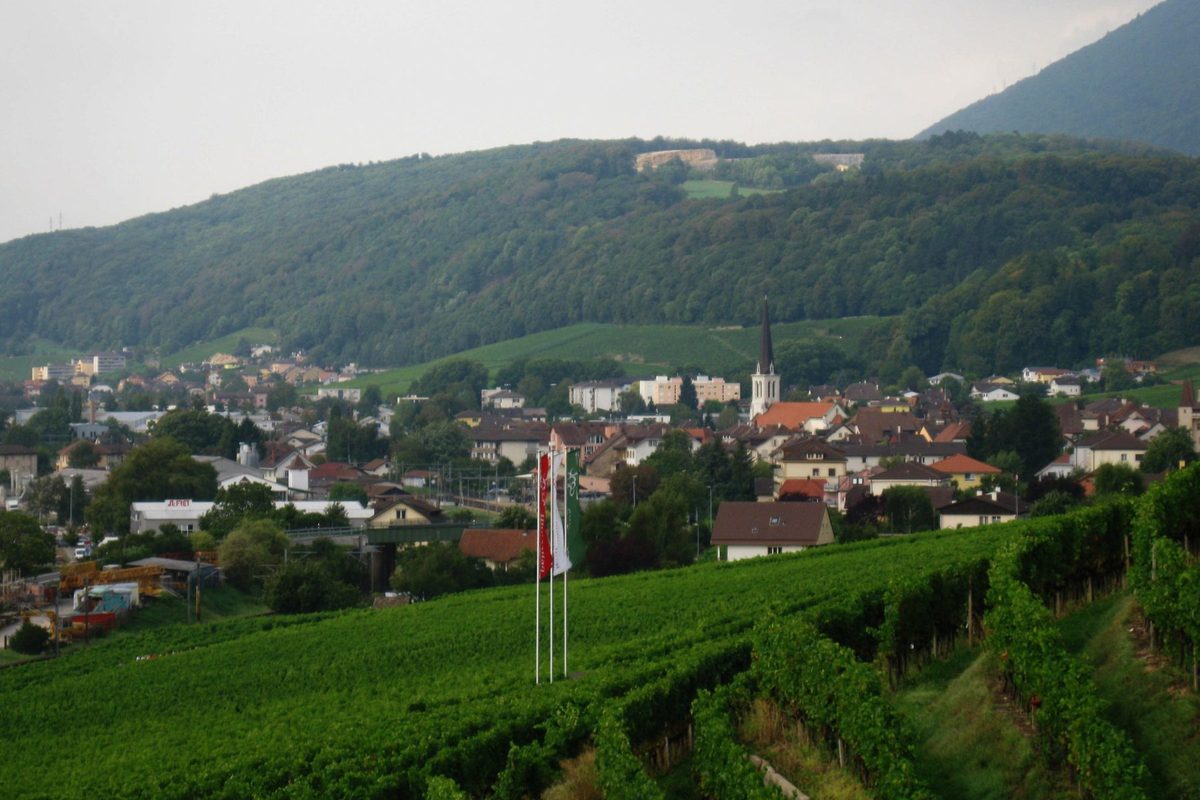
Together with Le Landeron, the only corner of the county of Neuchâtel to stay Catholic at the Reformation: a wine-growers' village at the foot of the Jura, marked by the Vallier family and its castle.
Entry based on 27 sources · Our method · Reusable text (CC BY-SA)
Origin of the name Cressier
The name appears in 1180 as « Crisciaco ». The historian Gonzague de Reynold saw in it the estate of a Gallo-Roman settler called « Criscius » (also read « Crixsius »): this is the most widely repeated explanation, but it still needs confirming. It fits with the Gallo-Roman settlement on the Cressier hill (see Remains), without the etymology being established for all that.[2]
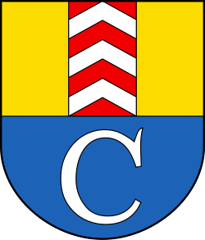
Coat of arms of Cressier
Per fess, first Or a pale gules charged with three chevrons argent, second azure a letter C argent. The upper half of the shield is yellow, crossed by a vertical red band bearing three white chevrons. The lower half is blue, with a large white C, the village's initial.[17]
Founding of Cressier
A clustered village at the foot of the Jura, on the edge of the Thielle floodplain, Cressier has no known founder. It grew slowly around a Gallo-Roman settlement: a villa and probably a temple to Mars on the hill. In the Middle Ages it became a parish, which also included Enges, and then a rural community. Its people organised early: between 1212 and 1220 they set the limits of their common pasture. Count Rodolphe de Neuchâtel is said to have granted them franchises in 1260. From the 14th century most families were burghers of Le Landeron, and the commune of Cressier, with the hamlet of Frochaux, belonged to the châtellenie of Le Landeron.[1][2]
History of Cressier
Prehistory. A Middle Bronze Age burial mound (12 m in diameter, 2 m high, made of Alpine pebbles and Jura limestone) is built at La Baraque, in the Eter forest, at 730 m above sea level. A man who had undergone the beginning of a frontal trepanation is buried in it with high-ranking grave goods (pin, axe, dagger blade, decorated gold ring). The mound is reused in the Hallstatt D period for a man and two women. Excavated in 1936-1937 by Paul Vouga and Samuel Perret, its finds are now at the Laténium (Hauterive).[1][2]
Gallo-Roman period. Establishment of a Roman villa and probable temple on the Cressier hill. Steles dedicated to Mars and the Celtic goddess Naria are found there, now kept at the Laténium.[2]
6th-7th century. A church may already have stood on the site of the former Gallo-Roman temple, though this is not established. The training excavations held every summer since 2013 at the former church of Saint-Martin have uncovered four graves provisionally dated to the 7th century: the place of worship is very old.[11]
1180. First written mention of the village in the form « Crisciaco ». The Bishop of Lausanne gives the church of Cressier, located above the village, with its property, to the abbey of Fontaine-André.[1][2]
1212-1220. The inhabitants mark out the boundaries of their common pastures, a sign of a structured village community.[1]
1260. Count Rodolphe de Neuchâtel is said to have granted the village its first franchises.[2]
14th century. Most families are burghers of Le Landeron. At the same time the commune of Cressier takes shape, as part of the châtellenie of Le Landeron.[1]
1329. The abbey of Fontaine-André obtains the right to choose the parish priest of Cressier from among its monks.
1373. The inhabitants of Cressier, then subjects of Le Landeron, are included in the co-citizenship treaty concluded between Countess Isabelle de Neuchâtel and the town of Soleure.
1396. First document attesting to a wine trade in Cressier, at the origin of the village's long winegrowing tradition.[2]
circa 1424. Gothic reconstruction of the choir of the church of Saint-Martin.[7]
1457 / 1518. Founding of the Vallier chapel (1457), then of the Rosary chapel (1518).[2]
16th century. At the Reformation, Soleure and the powerful Vallier family prevent the new faith from being established: the area of Cressier and Le Landeron remains the only Catholic one in the county of Neuchâtel. From 1517, two castellans and two governors from the Vallier family succeed one another.[1][2]
1560. Pierre Vallier has the village's first school built.[2]
1610-1616. Governor Jacques (Jacob) Vallier has the château of Cressier built, a spacious rectangular residence with four corner towers and a crenellated wall. It is then the largest residence in the region.[2]
1630. A tannery sets up on the banks of the Thielle. Its premises are later used by a printed cotton (indiennes) factory, active from 1728 to 1763. When it closed, Cressier became a winegrowing and farming village again, with a few small watchmaking workshops.[1]
1645. Jacques d'Estavayer, lord of Mollondin, governor and later field marshal, leaves his mark on the village. His son François-Louis-Blaise d'Estavayer distinguishes himself in the Swiss Guards Regiment.[2]
1707. The burghers of Cressier refuse to pay homage to the King of Prussia, then Prince of Neuchâtel.[2]
1764. Jean-Jacques Rousseau passes through Cressier.[2]
Late 18th century. Cressier takes in more than 400 refugees from the French Revolution.[2]
1802. The widow of Jean-Baptiste Ruedin opens the Hôtel de la Couronne with a wine cellar, at the origin of the many wine houses bearing the name Ruedin.[2]
1859. Opening of Cressier station, on the Neuchâtel-Bienne line. It hardly changes the winegrowing and farming character of the village.[1][2]
1868-1888. During the first correction of the Jura waters, the château of Thielle is exchanged with Bern for the island between the new canal and the former watercourse (the « Vieille Thielle »). The commune of Cressier thus receives this territory of about 70 hectares.
1872. The cantonal water engineer Jaques Louis Léo Jeanjaquet, sometimes called « Eugène Jeanjaquet », buys the former rectory and its wine estate after its deconsecration.[7]
1872-1877. Commissioned by him, the architect Léo Châtelain transforms the property into a « small château » in neo-medieval style, keeping the old elements (chapel, small bell tower, stair tower): this is the present-day château Jeanjaquet.[7]
1872-1876. Construction of the new neo-Gothic Catholic church, dedicated like the old one to Saint Martin, in the centre of the village on the site of a Rosary chapel, on the initiative of Abbé Raymond Vuichard. It is dated either to 1872 or to 1873-1876.[2]
1888. The painter Gustave Jeanneret (born in Môtiers in 1847, died in Cressier in 1927) has another house in the village renovated, adding a tower (1888) and then a painting studio (1898). This house, today the Maison Gustave Jeanneret, is to be distinguished from the nearby château Jeanjaquet.[8][12]
1899. Opening of the Hospice, today the Home Saint-Joseph.[2]
1945-1966. After 1945 the locality industrialised: a potato processing plant and a pump factory were established. In 1966 the oil refinery opened (Shell, then the Dutch group Petroplus from 2000), linked to Fos-sur-Mer near Marseille by the South European and Neuchâtel Jura pipelines. It employed 240 people in 1984 and 197 in 2000.[1]
1966. Creation of the Vieille Thielle nature reserve.
1995 / 1999. Layout of the new village square (1995) and opening of the Caveau de l'Entre-deux-Lacs (1999).
Since 2013. Training excavations every summer at the former church of Saint-Martin (universities of Lausanne and Neuchâtel, cantonal heritage office), revealing 7th-century graves.[11]
Population of Cressier
Sources and references: [1][4][13][14][16]
| 1750 | 432 |
| 1850 | 607 |
| 1900 | 794 |
| 1950 | 957 |
| 1970 | 1'530 |
| 2000 | 1'923 |
| 2020 | 1'893 |
| 2022 | 1'888 |
| 2023 | 1'920 |
| 2025 | 2'070 |
Families of Cressier
Burghers of Le Landeron. In the Middle Ages Cressier had no burgher community of its own. From the 14th century most of its families were burghers of Le Landeron. A local burgher community appeared later, and its political role ended in 1889.[1][2]
De Cressier. Minor nobility from the village. In 1306 Pierre and Jean, sons of Jacques, paid homage to the Count of Neuchâtel. Henri became a burgher of Le Landeron in 1387 and his two sons founded two branches. The elder settled in Le Landeron and died out around 1670. The younger stayed in Cressier: its founder Jean fought in France in 1465 in the War of the Public Weal and was ennobled the same year. His grandson, also named Jean (1464-1498), left all his property to his half-brother Jacques Vallier.[18]
Vallier. A burgher family of Le Landeron, known from the early 14th century, which inherited the de Cressier estates in 1498. Pierre, eldest son of Jacques, was a councillor of state. His son, also Pierre, and his grandson Jacob were governors of the county. Another branch settled in Solothurn in 1521 and took the name Wallier there.[19]
Show more families (4)
Ruedin. In 1802 Catherine Ruedin opened the Hôtel de la Couronne with its wine cellar. Some 25 wine houses of the same name descend from it.[2]
Burgher families before 1800. Ganguillet, Guenot, Kranck, Persoz, Richard, Ruedin, Thomas and Vuichard, with no precise date. The Guinchard, from Gorgier, became burghers in 1700, the Michel, from France, in 1784.[27]
In the 19th century. Bazin, Steckler and Varnier, as well as the Fontaine (from Fétigny FR) and the Walther (from Kehrsatz BE), with no precise date. Then the Marrer (from Dulliken SO) in 1882, the Sauser (from Sigriswil BE) in 1889, the Bosson (from France) in 1890, the Ferraris (from Italy) and the Oehle (from Germany) in 1892, the Brenneisen (from Germany) in 1893 and the Blanche (from France) in 1895.[27]
From 1901 to 1962. Twenty entries. Many families came from Germany (Kneissler and Laitner in 1901, Reichel in 1923, Almendinger in 1925, Winterstein in 1936, Schild in 1948) or from Italy (Cemin in 1937, Cairoli in 1945, Risoli in 1951, Zanini in 1955). Others came from elsewhere in Switzerland: the Carrard from Poliez-Pittet VD (1909), the Pauchard from Russy FR (1921), the Aubry from La Chaux-des-Breuleux JU (1929), the Berger from Oberthal BE (1935) and the Küng from Gebenstorf AG (1955). The last family registered, in 1962, was the Chéhab, from Lebanon.[27]
Notable people of Cressier
Jacob Vallier. Governor of the county of Neuchâtel. He had Cressier castle built in 1610.[19][2]
Pierre Vallier. He founded the village's first school in 1560.[2]
Jacques d'Estavayer. Lord of Mollondin, governor and lieutenant general in 1645. His son François-Louis-Blaise d'Estavayer distinguished himself in the Swiss Guards regiment.[2]
Jacques-Louis de Pourtalès. With his sons he built up a vineyard in Cressier between 1811 and 1823. The estate's income was to pay for the free care of 40 poor people in their hospital in Neuchâtel.[2]
Jean-Joseph Ruedin. In 1848 he sat in the constituent assembly of the new Republic of Neuchâtel.[2]
Gustave Jeanneret (Môtiers 1847 - Cressier 1927). Painter. He settled for good in Cressier in 1888, the year he married Emma Wolfrath, and mainly painted the vineyards and fields of the area. Their children were all born in Cressier.[20][12]
Beaucis de Coulon (1896-1983) and Blaise Jeanneret (1897-1988). Children of Gustave Jeanneret, both painters.[2]
Jules Ruedin. With his two sons he invented a motorised winch for vineyard work around 1930.[2]
Economy of Cressier, past and present
Vines. The first to plant vines in Cressier were the Benedictine monks of Trub Abbey in the Emmental. A wine trade is recorded in 1396. The vineyard was reorganised between 1976 and 1987, with terraced vines.[21][2]
Crafts and early factories. A tannery opened in 1630. A calico works, printing cotton cloth, then operated from 1728 to 1763. The village went back to vines and farming, with a few watchmakers. In the late 19th century watchmaking and jewel workshops opened, followed by a lime and cement works in 1895.[1][2]
Industry after 1943. The CISAC company started up in 1943. It later became FRIGEMO. Émile Egger founded a pump factory in 1947.[2]
The refinery. It was built on the plain in 1966, linked by pipeline to Fos-sur-Mer near Marseille. It employed 240 people in 1984 and 197 in 2000. In 2012 its operator Petroplus was in composition proceedings. On 3 May the refinery was sold to Varo Holding, a joint company of Vitol and AtlasInvest, saving some 270 jobs.[21][1][22]
Rail and road. The station opened in 1859 on the Neuchâtel-Biel line. The N5 motorway was opened near the village in 1975.[1][21]
Disasters and major events in Cressier
The flood of 22 June 2021. Around 7 pm violent storms made the Ruhault burst its banks. Water, mud and gravel swept through the streets. The Bois-Rond stream also flooded the lower village. The police counted about 75 buildings affected and several families had to be rehoused. No one was injured.[25][26]
Historic sites in Cressier
Château de Cressier (1610-1616). Built by Governor Jacques Vallier, this rectangular château with four corner towers and a crenellated wall was the largest residence in the region at the time. It today houses the school and the communal administration.
Former church of Saint-Martin. The only medieval religious building in the canton to have remained in private hands. Romanesque construction documented from 1180, Gothic choir rebuilt around 1424, chapel added in the 16th century. Cultural property of national significance (federal PCP inventory), together with the Château Jeanjaquet.[7][10]
Château Jeanjaquet. Former rectory and wine estate bought in 1872 by the cantonal water engineer Jaques Louis Léo Jeanjaquet (sometimes called « Eugène Jeanjaquet »), who had it transformed by the architect Léo Châtelain (1872-1877): a floor was fitted out in the attic and an imposing machicolated tower was built, while the original chapel, small bell tower and stair tower were kept. Cultural property of national significance, together with the former church. Not to be confused with the Maison Gustave Jeanneret, a quite different house in the village.[7]
Maison Vallier. A 16th-century patrician residence built on a vault, adorned with a corner turret with a sundial. Pierre Vallier is buried there in the adjoining chapel. It today serves as a venue for events.
Maison Gustave Jeanneret. House rebuilt in 1729-1730 for Paul de Froment, whose panelled dining room is decorated with painted Régence-style chinoiserie. Renovated for the painter Gustave Jeanneret, with the addition of a tower (1888) and then a painting studio (1898). His works decorate the interior. Cultural property of national significance (federal PCP inventory).[8]
La Vieille Thielle. A former meander of the Thielle which once formed the border between Bern and Neuchâtel, today a nature reserve of about 70 hectares, with protected wildlife (including the beaver).
Catholic church of Saint-Martin (1872-1876). A neo-Gothic church built in the centre of the village on the site of a Rosary chapel, dedicated like the old church to Saint Martin. It preserves furnishings from the old chapels, including a crucifix that may date from the 13th-14th century.[2]
Remains in Cressier
Tumulus de la Baraque. Middle Bronze Age burial mound (12 m in diameter, 2 m high), excavated in 1936-1937 in the Eter forest, where a high-ranking man lay (pin, axe, dagger blade, decorated gold ring). Reused in the Hallstatt D period for a man, with a biconical vessel, and two women adorned with bronze and lignite bracelets and belt hooks. Test pits dug in 1940 nearby revealed pavings and hearths from the Bronze Age and the Hallstatt period, and elongated mounds and cultivation terraces show occupation from the Middle Bronze Age to Roman times. Finds kept at the Laténium (Hauterive).[1]
Gallo-Roman steles dedicated to Mars and Naria. Discovered on the Cressier hill, the probable site of a Gallo-Roman temple; kept at the Laténium.[2]
7th-century burials under the church of Saint-Martin. Four graves provisionally dated to the 7th century, uncovered during the training excavations held since 2013. They confirm the great age of the place of worship, predating the Romanesque church mentioned from 1180.[11]
Fragment of Roman stone. A fragment of Roman stone is kept in the former Restaurant du Chasseur, a building that also served as a hospital (1518) and then as the village's first school (1560).
Celtic coin of the Pictones. Before 1870 a silver coin (quinarius) from Late La Tène, attributed to the Celtic tribe of the Pictones, was found in the vineyards of Cressier.
Burials in the gravel pit between Cornaux and Cressier. In 1892 six skeletons buried directly in the ground were exhumed in a gravel pit between Cornaux and Cressier. One wore three bronze bracelets with buffer ends and another a lignite bracelet from the Hallstatt period. In 1908 a bronze bracelet decorated with grooves, attributable to Early La Tène, was found at the same spot.
Protected heritage in Cressier
Site of national importance. The village is listed in the federal inventory of Swiss heritage sites of national importance for its excellent historical and architectural qualities. The vineyard behind the village has remained almost untouched.[21]
Lion Fountain. It has a large basin of white limestone. Its basins date from 1578 and 1640.[21]
Cultural property of national significance (A objects in the PCP inventory)[9]
- Ancienne église St-Martin et château Jeanjaquet
- Maison du peintre Gustave Jeanneret
- Vieille Thielle, ensemble de sites néolithiques - Époque romaine (cf. Cornaux et Le Landeron)
Cultural property of regional significance (B objects)[9]
- Château
- Fontaine du Lion
- Maison Vallier
Traditions and festivals in Cressier
The egg race. Every first Sunday in May the Jeunesse de Cressier holds an egg race. It commemorates the consecration of the new church in 1879.[23]
The New Wine Festival. In 1974 commune president Henri Berger asked Bernard Meylan, president of the Association de développement de Cressier, to create an annual festival. As autumn was already busy, early May was chosen, when the new wine is bottled, and the festival was combined with the egg race. The first festival took place on 2, 3 and 4 May 1975, with stalls run by the village societies.[23][24]
The Pourtalès wine auction. The wines of the Pourtalès estate, matured in the cellars of the Maison Troub, are sold at public auction on the last Monday of every February. The house has belonged to the Hôpital Pourtalès since 1823.[2][21]
Sources
- Dictionnaire historique de la Suisse (DHS/HLS), article « Cressier (NE) »
- Commune de Cressier, page officielle « Histoire »
- Commune de Cressier, page officielle « Patrimoine »
- Commune de Cressier, page officielle « La commune en bref » (population au 31.12.2023)
- Swisscastles.ch, « Le château de Jeanjaquet » (détail de la transformation, nomme l'acquéreur « Eugène Jeanjaquet »)
- Société neuchâteloise de généalogie, bulletin 56, « Une branche de Jeanjaquet » (identifie l'acquéreur comme Jaques Louis Léo Jeanjaquet, ingénieur cantonal des eaux ; signalé par un lecteur du site)
- Inventaire fédéral des biens culturels (PBC), fiche 4009 « Ancienne église St-Martin et château Jeanjaquet », d'après le Guide artistique de la Suisse (SHAS)
- Inventaire fédéral des biens culturels (PBC), fiche 11868 « Maison du peintre Gustave Jeanneret », d'après le Guide artistique de la Suisse (SHAS)
- Office fédéral de la protection de la population, Inventaire PBC, liste cantonale de Neuchâtel (état au 1.1.2026)
- État de Neuchâtel, communiqué « En bref » du 30 août 2007 (Journées européennes du patrimoine, église Saint-Martin de Cressier)
- Université de Lausanne, l'uniscope n° 617 (2016), « Actualités » : fouille-école de Cressier
- Dictionnaire historique de la Suisse (DHS/HLS), article « Jeanneret, Gustave » (Pascal Ruedin)
- État de Neuchâtel, arrêté homologuant le recensement cantonal de la population au 31 décembre 2020
- État de Neuchâtel, arrêté homologuant le recensement cantonal de la population au 31 décembre 2022
- Panneau historique communal de Cressier, photographié sur site (2026), recoupé avec les sources ci-dessus
- État de Neuchâtel, arrêté du 4 février 2026 homologuant le recensement cantonal de la population au 31 décembre 2025
- Commune de Cressier, page officielle « Présentation » (description des armoiries)
- Dictionnaire historique de la Suisse (DHS/HLS), article « Cressier, de (NE) »
- Dictionnaire historique de la Suisse (DHS/HLS), article « Vallier »
- Société neuchâteloise de généalogie, bulletin 46, P.-A. Borel, « Famille Jeanneret, branche de l'artiste-peintre »
- Inventaire fédéral des sites construits d'importance nationale (ISOS), fiche 2673 « Cressier » (2e version, 10.2007)
- État de Neuchâtel, communiqué du 3 mai 2012 sur la vente de la raffinerie de Cressier
- Fête du Vin Nouveau Cressier, « L'histoire »
- Commune de Cressier, page « Fête du Vin Nouveau Cressier »
- Police neuchâteloise, communiqué du 23 juin 2021 « Inondations Entre-deux-Lacs »
- Blick (édition romande), 23 juin 2021, « Importantes inondations après les orages »
- Répertoire des noms de famille suisses, 3e édition (1989), recherche Commune « Cressier », Canton NE
Published by Sébastien Jörg ·
Other villages near Cressier
Missing information, or do you have a source? Suggest a correction or addition. Every submission is checked before it's published.
Suggest a change