Cudrefin
Founded by the House of Savoy between 1246 and 1255 on Lake Neuchâtel, Cudrefin is one of the rare new towns in Vaud with a concentric quadrangular plan.
Entry based on 9 sources · Our method · Reusable text (CC BY-SA)
Origin of the name Cudrefin
Cudrefin appears in 999 as «Curtefin». The name «Cudrefin» has not yet been explained.[1]
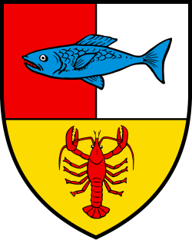
Coat of arms of Cudrefin
Per fess, the first per pale gules and argent, overall a trout azure fesswise, the second or, a crayfish gules. The shield is divided horizontally. At the top, a blue trout swims across a field that is red on the left and white on the right. At the bottom, a red crayfish stands out on yellow. In force since 1 January 2002, the date of the merger with Champmartin, these arms unite the colours of the two former municipalities.[7][8]
Founding of Cudrefin
The area was settled long before the town: numerous archaeological remains are attested from the Neolithic onwards. In 999 the place depended on the bishop of Sion. In 1246 it was sold to Peter II of Savoy, and it was the House of Savoy that created the town. Attested in 1268, it must have been founded between 1246 and 1255. This new town is one of the rare urban foundations in Vaud with a concentric quadrangular plan. Ditches and two castles or large towers, at the southern and northern corners, made it a fortified town.[1]
History of Cudrefin
Neolithic. Numerous archaeological remains attest early settlement of the area.[1]
999. First mention, as «Curtefin»; the place is dependent on the bishop of Sion.[1]
1246. Cudrefin is sold to Peter II of Savoy.[1]
1246-1255. Probable foundation of the Savoyard new town.[1]
1268. First attestation of the town.[1]
around 1280. The fortified town is protected by ditches. Two castles or large towers reinforce its southern and northern corners.[1]
early 14th century. The town passes into the hands of the Grandson family.[1]
1342. The town, attached to the parish of Montet, has a chapel dedicated to Notre-Dame.[1]
1393. Confiscation of the property of Otto III of Grandson, ending the rule of the Grandson family.[1]
1403. Cudrefin is part of the appanage of Humbert the Bastard of Savoy.[1]
1471. Confirmation of the town's franchises, received at an unknown date.[1]
1474-1477. The Fribourgeois occupy the town during the Burgundian Wars.
before 1522. The chapel is transferred to the building that is today's Protestant church.[1]
1536. The town submits to the Bernese. It is united with Avenches in a single bailiwick but continues to follow the Coutumier de Vaud. A council of the XII, chaired by a castellan representing Their Excellencies of Bern, governs the community.[1]
1553-1554. A tower is added to the church. It is rebuilt in 1636-1637.[1]
1605. Erection of the Fountain of Justice (fontaine de la Justice), the work of Benoît Magnin.[1]
1790. A fire destroys part of the town.[1]
1798. Cudrefin belongs to the district of Avenches, until the end of 2007.
1839. Rebuilding of the town hall. In the 19th century the town gates are demolished.[1]
1970. The vast wetland created by the first Jura water correction is designated a nature reserve.[1]
2002. The former municipality of Champmartin is merged into Cudrefin.[1]
2008. Cudrefin becomes part of the new district of Broye-Vully.[4][5]
Population of Cudrefin
Sources and references: [1][2]
| 1416 | 70 hearths (households) |
| 1453 | 60 hearths (households) |
| 1764 | 483 |
| 1803 | 625 |
| 1850 | 683 |
| 1900 | 658 |
| 1950 | 651 |
| 1970 | 544 |
| 2000 | 844 |
| 2025 | 1'915 (municipality, including Champmartin and Montet) |
Families of Cudrefin
Citizen families before 1800. Fontanellaz, Jaunin, Magnin, Milliet, Ramus, Reuille, Richard, Treyvaud, Tschiffeli and Vassaux, without a precise date. The de Perrot family (from Neuchâtel NE) obtains citizenship in 1663, the Audéoud family (from France) in 1701 and the Cornaz family (from Faoug VD) in 1795.[9]
In the 19th century. Matthey and Oblaser, as well as the Burnier family (from Lutry VD) and the Mosimann family (from Biglen BE), without a precise date. Then the Widmer family (from Heimiswil BE) obtains citizenship in 1866.[9]
From 1901 to 1962. 9 registrations. Several families come from abroad: from France (Schell in 1931) and from Great Britain (Pedler in 1946). From Switzerland come the Siegfried family from Worb BE (1955), the Baumann family from Schafisheim AG, the Biolley family from Vully-le-Haut FR, the Spring family from Gerzensee BE and the Thoutberger family from Ringgenberg BE (1956) and the Steiner family from Walterswil BE (1958). They are joined by the Nicolet family (1946). The last family registered, in 1958, is the Steiner family.[9]
Economy of Cudrefin, past and present
Harbours, beach and campsite. Cudrefin enjoys great success as a tourist spot, with two large marinas, a beach and holiday homes. The municipal campsite and the harbours bring the municipality substantial income.[1][8]
Fields and business zone. The municipality owns about 130 hectares of farmland, leased to farmers. Fields and market gardens lie mostly on the outskirts. Created in 2012, the business zone has drawn many firms and created jobs.[8]
Historic sites in Cudrefin
The old town. Savoyard new town founded between 1246 and 1255, one of the rare urban foundations in Vaud with a concentric quadrangular plan. It was surrounded by ditches and flanked by two castles or large towers at its southern and northern corners. Its gates were demolished in the 19th century.[1]
The Fountain of Justice. Fountain dating from 1605, the work of Benoît Magnin, listed as a Swiss heritage site of national significance.[1][3]
The Protestant church. The chapel of Notre-Dame, attested in 1342, was transferred before 1522 to the building that forms today's church. A tower was added in 1553-1554 and rebuilt in 1636-1637.[1]
The town hall. Rebuilt in 1839, after the fire of 1790 that had destroyed part of the town.[1]
Montet and its church. The village of Montet, seat of the old parish to which Cudrefin belonged, overlooks the town. Its Reformed church of Saint-Théodule and its parsonage are cultural properties of regional importance. The church is reportedly a 15th-century Gothic building. The site of Montet is also reportedly listed in the Federal Inventory of Swiss Heritage Sites (ISOS).[3]
The Vers-chez-Jacot school. At Vers-chez-Jacot, a building now houses the school.[1]
Remains in Cudrefin
Prehistoric remains. Numerous archaeological remains are attested from the Neolithic onwards. The Neolithic lakeside settlement of Chavannes is a cultural property of regional importance. Two Late Bronze Age sites are also reportedly located at the place called Le Brolliet.[1][3]
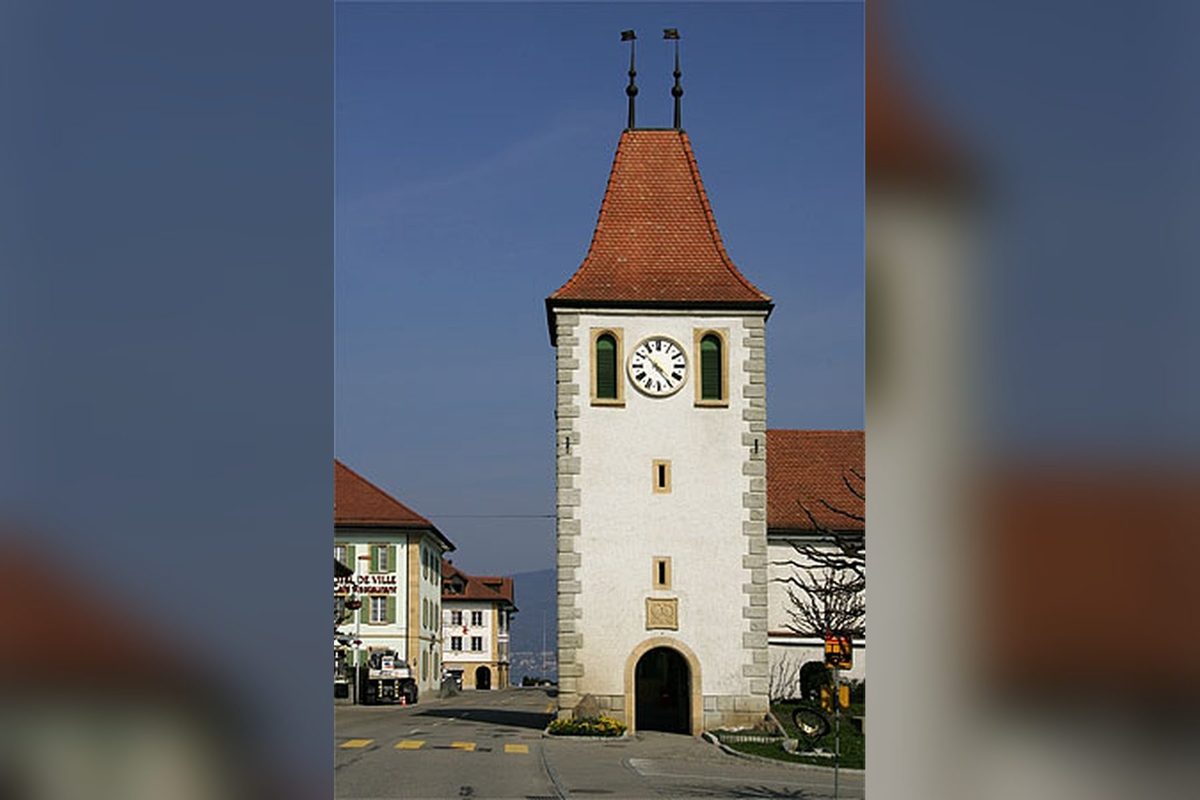
Layout of the fortified town. The quadrangular plan of the medieval town, protected by ditches around 1280, can still be read in the town, even though the gates disappeared in the 19th century. A rampart tower on the Grand'Rue is a cultural property of regional importance.[1][3]
Protected heritage in Cudrefin
Cultural property of national significance (A objects in the PCP inventory)[6]
- Fontaine de la Justice
Cultural property of regional significance (B objects)[6]
- Chavannes, station lacustre néolithique
- Cure (Montet)
- Montet, Eglise réformée Saint-Théodule
- Tour des remparts
Traditions and festivals in Cudrefin
The Frogs. The inhabitants of Cudrefin are nicknamed the Grenouilles (frogs) or Tape-Gouilles.[8]
The Abbaye des Mousquetaires. Cudrefin's many societies include the Abbaye des Mousquetaires, alongside the Société de Jeunesse and La Persévérance.[8]
Sources
- Brigitte Pradervand, « Cudrefin », Dictionnaire historique de la Suisse (DHS), version du 04.01.2017
- Statistique Vaud, « Population résidante permanente au 31 décembre 2025 »
- Office fédéral de la protection de la population, Inventaire PBC, liste cantonale VD (état au 1.1.2026)
- Canton de Vaud, Loi sur le découpage territorial (LDecTer, RSV 132.15) du 30 mai 2006
- État de Vaud, communiqué du 12.07.2007, « Organisation des préfectures et adaptation au nouveau découpage territorial »
- Federal Office for Civil Protection (FOCP), Swiss Inventory of Cultural Property (PCP), list for the canton of Vaud (as of 1.1.2026)
- IPI, Swissreg, emblems database: coat of arms of Cudrefin (no. 101942)
- Official Gazette of the Canton of Vaud (FAO), "Alphabet des communes vaudoises: Cudrefin"
- Register of Swiss Surnames, 3rd edition (1989), search Commune "Cudrefin", Canton VD
Published by Sébastien Jörg ·
Localities of the municipality with a page
Other villages near Cudrefin
Missing information, or do you have a source? Suggest a correction or addition. Every submission is checked before it's published.
Suggest a change