
Essert-sous-Champvent
Its name, «Exertas» in 1095, means cleared land, and its inhabitants bear the dialect nickname «Lè Pequa-Vè», the worm-pickers.
Entry based on 8 sources · Our method · Reusable text (CC BY-SA)
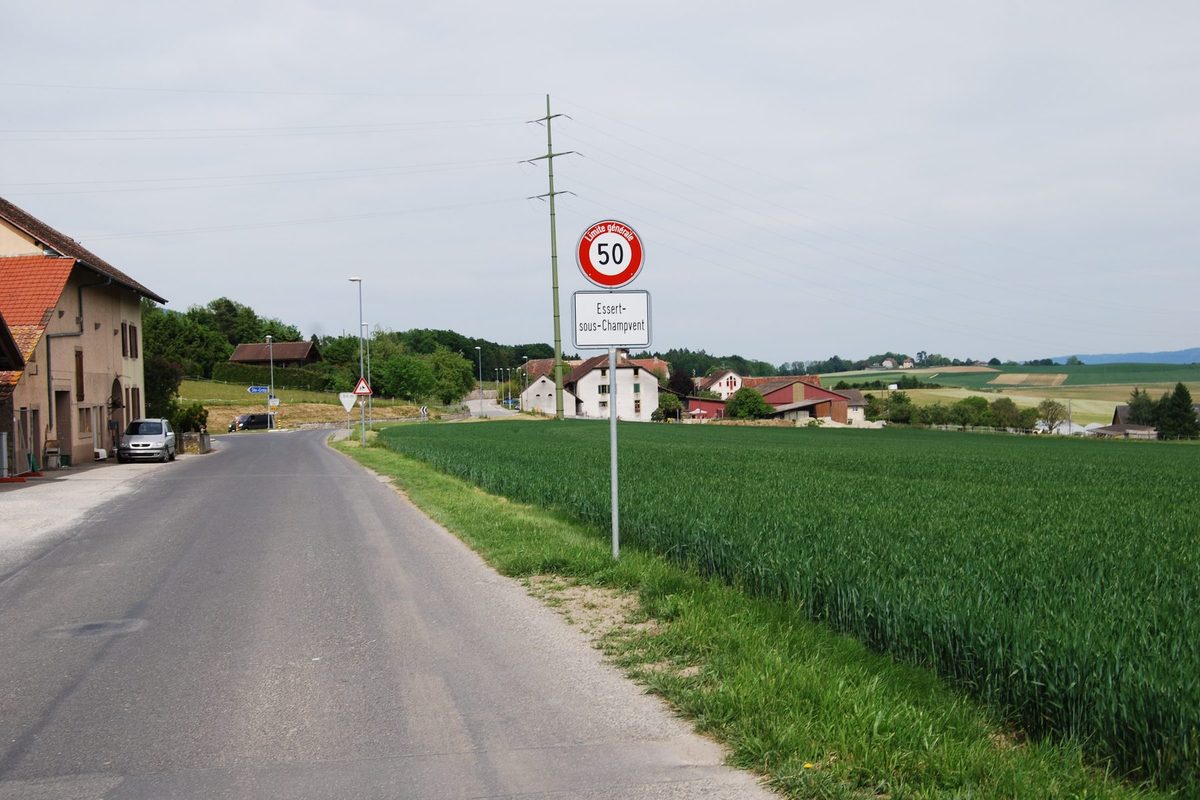
Origin of the name Essert-sous-Champvent
The name first appears in 1095, in the Latin form «Exertas». The term «essert» comes from a Latin word meaning cleared land. The addition «sous-Champvent» distinguishes the place from the neighbouring village of Champvent, on which it depended first as a lordship and then as a parish. The inhabitants, the Essertois, bear the dialect nickname «Lè Pequa-Vè» (the worm-pickers), whose origin is unknown.[2][4][6]
Founding of Essert-sous-Champvent
As its name indicates, the place is thought to have arisen from the clearing (essartage) of wooded land, probably during the agricultural development of the region in the Middle Ages. The hamlet first belonged to the powerful seigneury of Grandson. When this was divided among the sons of Ebal III of Grandson, in 1225 or 1234, Essert-sous-Champvent passed to the new seigneury of Champvent, along with Villars-sous-Champvent, Mathod, Suscévaz and several other villages in the region. From then on its history stays tied to that of Champvent, up to the municipal merger of 2012. No founder, religious order or dated founding act is known.[2][3]
History of Essert-sous-Champvent
1095. First written mention of the place, in the Latin form Exertas.[2]
around 1225-1234. Attachment of Essert-sous-Champvent to the seigneury of Champvent, newly created when the seigneury of Grandson was divided among the sons of Ebal III. The hamlet remains associated with it until the 2012 municipal merger.[2][3]
1336. Extinction of the de Champvent family. The seigneury, and Essert-sous-Champvent with it, passes by succession to the de Neuchâtel and then de Vergy families.[3]
1475. The château of Champvent is burned down during the Burgundian Wars, an episode affecting the whole seigneury on which Essert-sous-Champvent depends.[3]
1798. Abolition of seigneurial rights with the end of the Ancien Régime. The village, which then had 59 inhabitants, is attached to the district of Yverdon.[2][3]
1834. The parish of Essert-sous-Champvent, until then attached to Montagny, passes to that of Champvent.[2]
1921. Closure of the village school.[2]
around 1950. Development of a market-gardening activity aimed in particular at the market of Yverdon-les-Bains, which would become a lasting economic activity of the village.[2]
2008. On 1 January 2008 the village moves from the district of Yverdon to the new district of Jura-Nord vaudois.[6]
1 January 2012. Essert-sous-Champvent merges with Champvent and Villars-sous-Champvent to form the new municipality of Champvent. The village loses its independent municipal status and becomes a locality of this municipality.[2][4][6][7]
Population of Essert-sous-Champvent
Sources and references: [2]
| 1798 | 59 |
| 1850 | 109 |
| 1870 | 124 |
| 1900 | 114 |
| 1950 | 78 |
| 1980 | 60 |
| 2000 | 132 |
Families of Essert-sous-Champvent
Citizen families before 1800. Boulet, Cochet, Corset, Gétaz, Gillard and Gilliard, without a precise date.[8]
In the 19th century. Gruet, as well as the Houst family (from France), without a precise date.[8]
From 1901 to 1962. 8 registrations. Several families come from abroad: from Italy (Simoncini in 1922, Lanzarini in 1943, Tosetti in 1950 and Panighini and Rovero in 1955), from Germany (Bloch in 1916 and Stehlé in 1917) and from France (Gérard in 1932). The last registrations date from 1955 (Panighini and Rovero).[8]
Economy of Essert-sous-Champvent, past and present
Market gardening. A market gardening business was founded in Essert more than 150 years ago. It has become known nationwide and employs more than 160 people.[4]
Historic sites in Essert-sous-Champvent
Essert-sous-Champvent railway halt. Station on the Yverdon-les-Bains-Sainte-Croix line, long a landmark of the village.[4]
The former school building and its bell tower. The village school closed in 1921. The building and its bell tower, reportedly restored in 1974, remain a landmark of the hamlet.[2]
La Salle d'Essert. Multipurpose communal hall located in the centre of the village (Rue du Centre), today managed by the municipality of Champvent and made available to residents for their events.[5]
The market-garden land. Since the mid-20th century, the village has been associated with a market-gardening activity aimed in particular at supplying the market of Yverdon-les-Bains, an activity that has continued and developed locally.[2]
Sources
- Philippe Heubi, « Essert-sous-Champvent », Dictionnaire historique de la Suisse, version du 04.01.2017
- Historisches Lexikon der Schweiz : Essert-sous-Champvent (DE)
- Pierre-Yves Favez, « Champvent (seigneurie) », Dictionnaire historique de la Suisse, version du 29.08.2005
- Commune de Champvent : Présentation
- Commune de Champvent : Salle d'Essert
- État de Vaud, Panorama, fiche de l'ancienne commune d'Essert-sous-Champvent
- Canton de Vaud, Loi sur le découpage territorial (LDecTer, RSV 132.15) du 30 mai 2006
- Register of Swiss Surnames, 3rd edition (1989), search Commune "Essert-sous-Champvent", Canton VD
Published by Sébastien Jörg ·
Other villages near Essert-sous-Champvent
Missing information, or do you have a source? Suggest a correction or addition. Every submission is checked before it's published.
Suggest a change