Orges
Village that became an independent municipality in 1849, after tensions between the millers on the Arnon and the landowning farmers of Vugelles-La-Mothe.
Entry based on 7 sources · Our method · Reusable text (CC BY-SA)
Origin of the name Orges
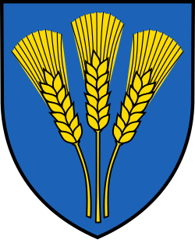
The village is first mentioned in 1260 as «Orses». The estate of Longeville, the old core of the village, appears in 1261 as «Longavilla». The origin of the name Orges has not yet been explained. The coat of arms, adopted in 1904, is canting and shows three ears of barley.[1][2]
Coat of arms of Orges
Azure three ears of barley or. On a blue field stand three yellow ears of barley. These canting arms, a play on the village's name, were adopted in 1904, when armorial stained-glass windows were set in the restored church of Giez. Blue and yellow are the colours of the lords of Grandson.[5][2]
Founding of Orges
It is not known who founded Orges. The municipal territory covers 4.02 km², with the village at 560 m above sea level. In 2000 it was divided into 78% farmland, 15% forest and 7% settlements and infrastructure. The estate of Longeville forms the old core of the village. Since the Middle Ages Orges shared its history with Vugelles-La-Mothe, within a community made up of Orges, Longeville, La Mothe and Vugelles. In the Middle Ages the village supplied grain to the lords of Grandson, whose colours, blue and yellow, the municipal arms keep. Orges belonged to the parish of Grandson until 1834, then to that of Montagny-près-Yverdon. The separation from Vugelles-La-Mothe in 1849 arose from tensions between the mill operators on the Arnon and the landowning farmers. The inhabitants, the Orgelais, are nicknamed «lè Patte-rodze».[1][2][3]
History of Orges
1260. First mention of Orges, «Orses».[1][2]
1261. First mention of the Longeville estate, «Longavilla», the old core of the village.[1]
Middle Ages. Orges forms a single community with Longeville, La Mothe and Vugelles and belongs to the parish of Grandson.[1][2]
1526. The municipal archives of Orges begin in this year: their fonds, kept at the Archives cantonales vaudoises, covers the years 1526 to 1960.[7]
1798-2007. The village is part of the district of Yverdon.
1834. Orges leaves the parish of Grandson for that of Montagny-près-Yverdon.[1]
1849. Orges becomes an independent municipality after separating from Vugelles-La-Mothe (split of 21 November).[1][2]
1904. Adoption of the coat of arms: azure, three ears of barley or.[2]
1924. The municipality has an alignment plan drawn up, signed by John E. Mermod.[7]
1947. The Vugelles-La-Mothe firing range is established, mostly on Orges territory.[1]
from the 1980s. A light-industrial zone develops.[1]
2000. Nine farms practise livestock breeding and cereal growing.[1]
2005. The secondary sector provides 40% of jobs in the municipality.[1]
2008. With the district reform the municipality joins the district of Jura-Nord vaudois.
Population of Orges
Sources and references: [1][3][4]
| 1860 | 227 |
| 1900 | 189 |
| 1950 | 211 |
| 1980 | 162 |
| 2000 | 203 |
| 2023 | 415 |
| 2025 | 416 |
Families of Orges
Citizen families before 1800. Bron, Duvoisin and Poyet. Around 1860 the village's citizen families were the Duvoisin, the Perrier and the Poyet.[6][2]
In the 19th century. The Perrier family, from Sainte-Croix VD, with no precise date.[6]
From 1901 to 1962. The Chareyrat family, from France, was registered in 1919, the Morcischek family, from Germany, in 1935 and the Bottinelli family in 1948.[6]
Economy of Orges, past and present
The lords' granary. In the Middle Ages Orges was the grain store of the lords of Grandson. Later, tensions with the wealthy mill operators on the Arnon led to the split of 21 November 1849. In 2000 nine farms raised livestock and grew cereals. Farming now also processes its own produce.[1][2]
Firing range and crafts. The Vugelles-La-Mothe firing range, for armoured vehicles and anti-tank weapons, has lain mostly on Orges land since 1947. A large craft zone grew from the 1980s, and in 2005 the secondary sector provided 40% of jobs. It includes carpentry and joinery firms among others.[1][2]
Historic sites in Orges
Longeville. Estate mentioned from 1261 as «Longavilla», regarded as the old core of the village. Today one of the municipality's outlying farms.[1]
Outlying farms. Besides Longeville, the territory includes several isolated farms: Montavaux, les Charrières and le Bois du Fey.[2]
Traditions and festivals in Orges
The Abbaye and the youth society. Neither the Société d'Abbaye nor the youth society was affected by the separation of 1849. Every two years the village celebrates the Abbaye, the raisinée and the brisolée. The youth society, shared with Vugelles-La Mothe, organises tours de jeunesse with dances and sports contests open to all.[2]
Sources
- Dictionnaire historique de la Suisse, « Orges »
- Feuille des avis officiels du canton de Vaud, « Alphabet des communes vaudoises : Orges »
- Commune d'Orges, « Présentation de la commune »
- Statistique Vaud, « Population résidante permanente au 31 décembre 2025 »
- IPI, Swissreg, emblems database: coat of arms of Orges (no. 101771)
- Register of Swiss Surnames, 3rd edition (1989), search Commune "Orges", Canton VD
- Archives cantonales vaudoises (PANORAMA), AC Orges GB 4, « Plan d'alignement pour la commune d'Orges » (1924)
Published by Sébastien Jörg ·
Other villages near Orges
Missing information, or do you have a source? Suggest a correction or addition. Every submission is checked before it's published.
Suggest a change