Fiez
A small Roman stone lion found in a villa at Fiez adorns the village fountain as a copy. The original is kept in the municipal hall.
Entry based on 12 sources · Our method · Reusable text (CC BY-SA)
Coat of arms: Public domain, Wikimedia Commons
Origin of the name Fiez
Fiez appears in 885 as «Figiaco» (also cited as «Fiaco»), then «Fyx» in 1179, «Fie» in 1228 and «Fiez» from 1453. No one has yet explained the name «Fiez».[1][3][4][5]
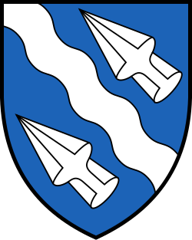
Coat of arms of Fiez
Azure a bend wavy Argent between two ploughshares of the same. On a blue field, a wavy white band runs diagonally from top left to bottom right, between two white ploughshares. In 1921 the commune still had no arms, but it had a seal bearing these figures, from which the present arms derive. Some see the wavy band as an allusion to the Diay stream.[11][4]
Founding of Fiez
The area has been occupied since Roman times, as the remains of a villa show. In the 9th century Fiez was a royal estate. It then passed to the Bishop of Lausanne, then to the lordship of Grandson, before being donated to the priory of Saint-Jean-Baptiste in Grandson, which kept it until the Reformation. The village lies at the foot of the Jura, on the left bank of the Arnon, and also owns an enclave north of the Chasseron with several alpine chalets. It was the seat of a mayoralty (métralie) grouping several neighbouring villages (Fontaines, Grandevent, Villars-Burquin, Mauborget), which was broken up in the 18th century. The medieval village of Fiez has no known founder.[1][3][4][5]
History of Fiez
Roman period. A Roman villa occupies the site. A small lion sculpture has been found there.[1][5]
885. First mention, as «Figiaco»; in the 9th century Fiez is a royal estate.[1][3][4][5]
Middle Ages. Fiez passes to the Bishop of Lausanne, then to the lordship of Grandson and finally, by donation, to the priory of Saint-Jean-Baptiste in Grandson, until the Reformation.[1][3][4][5]
12th century. The church of Saint-Clément is a parish church.[1][3][4][5]
1179. The name appears as «Fyx».[3][4]
1228. The name appears as «Fie».[3][4]
1416. The village has 40 hearths.[1]
1453. The name appears in its current form, «Fiez».[3][4]
1476-1798. In the bailiwick of Grandson, jointly held by Bern and Fribourg, Fiez is the seat of a mayoralty.[1][5]
late 15th century. A paper mill is recorded. It operates at least until 1570.[1]
1531. In October the church of Fiez goes over to the Reformation.[3][4]
1579. The young people of the parish ask for permission to practise shooting. Bern and Fribourg grant it and a company of arquebusiers is created.[3]
1596. The church of Saint-Clément is altered.[1][5]
1683. Date borne by houses in the village, including the former Henri Gilliard house, with a timber gallery, and the Edmond Gilliard house, with a Renaissance-style gallery and dovecote.[5]
1716-1717. The church of Saint-Clément is altered again, giving it its present appearance.[1]
1730. Fiez is broken up: among other changes, Mauborget becomes an independent municipality.[2]
1738. A second paper mill is mentioned. A dye works operates in the 18th century.[1]
19th century. A chocolate factory operates in the village. The company of arquebusiers disappears.[1][3][5]
1981. The shooting society is re-established under the name «Abbaye de la Métralie de Fiez».[3]
2008. Reform of the Vaud districts (law of 30 May 2006, in force on 1 January 2008): the district of Grandson is dissolved and Fiez joins the district of Jura-Nord vaudois.[7][8]
Population of Fiez
Sources and references: [1][9]
| 1416 | 40 hearths (households) |
| 1798 | 248 |
| 1850 | 337 |
| 1900 | 399 |
| 1950 | 270 |
| 1970 | 209 |
| 2000 | 345 |
| 2025 | 421 |
Families of Fiez
Burgher families before 1800. Garin, Maulaz, Maygeoz and Patthey, as well as the Quinche, from Neuchâtel, with no precise date. The Gilliard family was admitted in 1780. These six families make up the burghers of Fiez.[12][3]
From 1901 to 1962. The Passera, from Italy, in 1933, then the Jovanovic, from Yugoslavia, in 1953. Next come the Bühler of Rietheim AG, the Hodel of Unterlangenegg BE and the Maire of La Sagne NE in 1956, the Meylan and the Spycher of Oberwichtrach BE in 1957, the Matter of Muhen AG in 1958 and the Ramseyer of Arni BE in 1959.[12]
Economy of Fiez, past and present
The vineyard. Of the large vineyard of earlier times, about a dozen hectares remain, grouped on the best slope above the Arnon. According to the FAO, the commune has only three farms left.[4]
The power of the Diay. Besides farming, Fiez used water power. Mills, sawmills, oil mills and threshing mills served local production. A paper mill, a dye works and later a chocolate factory tried to settle here, without success. At Péroset, an industrial quarter active since the 18th century combined mills and a factory making perosite slabs used to clad façades. By 2011 only the mill was still working.[5][4]
Wood and new technologies. The rest of the working population works elsewhere or in local crafts, focused on woodworking or new technologies.[4]
Historic sites in Fiez
Church of Saint-Clément. Parish church from the 12th century, which went over to the Reformation in October 1531, altered in 1596 and again in 1716-1717. Its porch is sheltered by a centuries-old lime tree.[1][3][4]
Lion fountain. A copy of the Roman lion found at Fiez adorns the village fountain. The original is kept in the municipal hall.[3][4]
Village of Fiez. The whole village is listed in the Federal Inventory of Swiss Heritage Sites of national importance (ISOS).[5]
Remains in Fiez
Roman villa and stone lion. Remains of a Roman villa have been uncovered. A small limestone lion found during the excavations is thought to date from the late 1st or early 2nd century AD. The original is kept in the municipal hall.[1][3][4][5]
Chest said to be Charles the Bold's. The municipal hall keeps a strongbox presented as having belonged to Charles the Bold, defeated at Grandson in 1476.[3][4]
Protected heritage in Fiez
Cultural property of regional significance (B objects)[10]
- Maison bernoise (avec peinture)
- Maison de maître (Gilliard) avec maison paysanne et pigeonnier
Traditions and festivals in Fiez
The Abbaye de la Métralie. Heir to the company of arquebusiers founded in 1579, the shooting society re-established in 1981 draws its members from ten villages.[3]
The bricelet eaters. The inhabitants of Fiez bear the nickname "Lè Medze-Breci", the bricelet eaters.[3][4]
Sources
- Dictionnaire historique de la Suisse, « Fiez »
- Dictionnaire historique de la Suisse, « Mauborget »
- Commune de Fiez, « Présentation »
- Feuille des avis officiels du canton de Vaud, « Alphabet des communes vaudoises : Fiez »
- Office fédéral de la culture, ISOS, « Fiez », 2e version 03.2011
- Office fédéral de la protection de la population, Inventaire PBC, liste cantonale VD (état au 1.1.2026)
- Canton de Vaud, Loi sur le découpage territorial (LDecTer, RSV 132.15) du 30 mai 2006
- État de Vaud, communiqué du 12.07.2007, « Organisation des préfectures et adaptation au nouveau découpage territorial »
- Statistique Vaud, « Population résidante permanente au 31 décembre 2025 »
- Federal Office for Civil Protection (FOCP), Swiss Inventory of Cultural Property (PCP), list for the canton of Vaud (as of 1.1.2026)
- IPI, Swissreg, emblems database: coat of arms of Fiez (no. 101256)
- Register of Swiss Surnames, 3rd edition (1989), search Commune "Fiez", Canton VD
Published by Sébastien Jörg ·
Other villages near Fiez
Missing information, or do you have a source? Suggest a correction or addition. Every submission is checked before it's published.
Suggest a change