Novalles
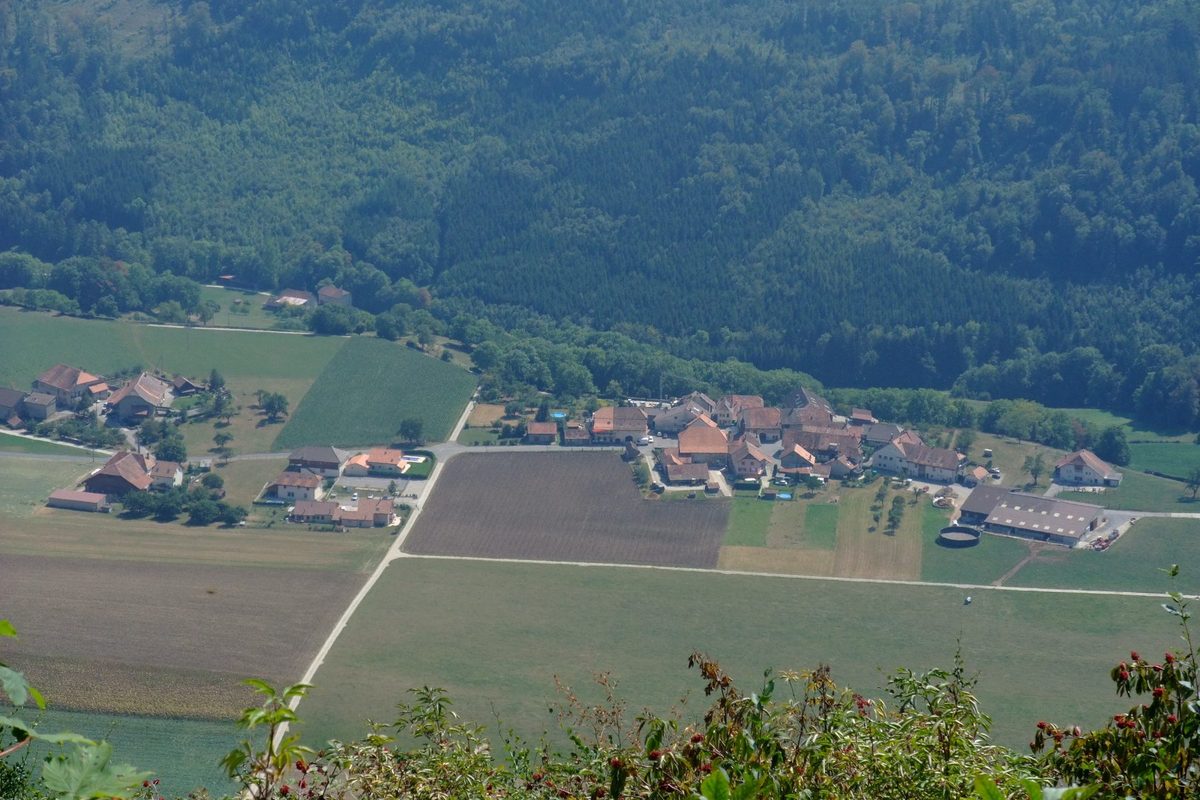
Small farming village on the plateau overlooking the left bank of the Arnon, attested in 1179, whose coat of arms recalls the old mill.
Entry based on 6 sources · Our method · Reusable text (CC BY-SA)
Origin of the name Novalles
First mentioned in 1179 in the form «Novellis», when the Cistercian abbey of Hautcrêt already owned a grange there, then «Novelles» in 1403. The meaning of «Novalles» remains unknown.[2]
Coat of arms of Novalles
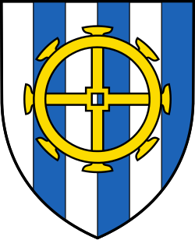
Paly argent and azure, a mill wheel or overall. The shield is covered with six vertical stripes, alternately white and blue, with a yellow mill wheel laid over them. The colours come from the arms of the former lords of the area. The wheel recalls the village's old mill.[5][2]
Founding of Novalles
Nobody knows who founded the village or how it came into being. Novalles lies on the plateau overlooking the left bank of the Arnon. It originally belonged to the barony of Grandson. In the 14th century part of the village passed to the lordship of Champvent, which then held the local church. In the 18th century another part forms a noble fief granted to the Calame family of Grandson. In church matters the inhabitants belong to the parish of Fiez. The municipality comprises the village and the hamlet of Moulin, north-west of Grandson. The village has kept its farming character.[2]
History of Novalles
1179. First mention, in the form «Novellis». The abbey of Hautcrêt owns a grange there.[2]
14th century. Part of the village, until then in the barony of Grandson, passes to the lordship of Champvent, which then controls the local church.[2]
1403. The name appears in the form «Novelles» (date uncertain).
1476-1798. Under Bernese rule, Novalles is attached to the «terre de Montagny» and forms part of the bailiwick of Grandson, shared by Bern and Fribourg.[2]
1531. On Christmas Day Catholics and Reformed clash violently at Novalles over access to the church.[2]
1532. The Reformation is said to have been adopted at Novalles.[2]
1671. A huge landslide buries the western part of the village and sweeps away the direct path to La Mothe. A new road is built further down.[2]
18th century. Hemp-beating mills appear; part of the village forms a noble fief granted to the Calame family of Grandson.
1798. Novalles is attached to the district of Grandson, to which it belongs until the reform of the districts.
around 1920. End of the water-powered industries, mills and sawmills, along the Arnon.
late 1950s. Vine-growing, practised in Novalles until then, comes to an end.[2]
2000. The municipality has four farms. Three quarters of the working population work outside the municipality.
1 January 2008. The new Vaud districts come into force: Novalles moves from the district of Grandson to the district of Jura-Nord vaudois.
Population of Novalles
Sources and references: [2][4]
| 1803 | 94 |
| 1850 | 117 |
| 1900 | 117 |
| 1950 | 83 |
| 1980 | 68 |
| 2000 | 99 |
| 2010 | 101 |
| 2020 | 100 |
| 2025 | 105 |
Families of Novalles
Citizen families before 1800. Cherbulliez, Dannelet, Gonin, Groux, Périllard and Taillefert, with no precise date. The Montandon-Girard family, from Le Locle NE, was admitted in 1793.[6]
From 1901 to 1962. The Patte family, from France, was registered in 1940. In 1955 came the Kobi family of Münchenbuchsee BE and the Schori family of Seedorf BE. The Leder family of Oberflachs AG was registered in 1955 and in 1959. The Hiltbrand family of Diemtigen BE closes the list in 1960.[6]
Economy of Novalles, past and present
The mill on the Arnon. For a long time Novalles lived from its fields, its forest and a gravel pit. On the Arnon stood a water mill with a sawmill, which ran until the early 20th century. Vines were grown until the late 1950s.[2]
Milk for Gruyère. Four farmers share the farmland of the municipality. Only one still produces milk. It goes to the cheese dairy in Villars-Burquin, which turns it into Gruyère.[2]
Disasters and major events in Novalles
The landslide of 1671. The mass of earth buried the whole western part of the village and swept away the path to La Mothe. An illustration kept in the Bern archives records the disaster.[2]
Historic sites in Novalles
Village of Novalles. A compact village on the plateau above the left bank of the Arnon. It is reportedly listed in the Federal Inventory of Swiss Heritage Sites of national importance (ISOS).
Mill on the Arnon. The municipal coat of arms, «palé d'argent et d'azur à la roue de moulin d'or brochante», recalls the village's old mill on the Arnon. The silver and blue take up the colours of the former lords, the barons of Grandson and the lords of Champvent. A mill and a sawmill along the Arnon ceased operating around 1920.[2]
Traditions and festivals in Novalles
The Abbaye. Every six years Novalles holds its Abbaye festival. The former threshing barn, now the village hall, also hosts the youth society's evenings and the shooting club's annual lotto.[2]
"Lè Tsa". The people of Novalles go by the nickname "Lè Tsa", the cats.[2]
Sources
- Dictionnaire historique de la Suisse, « Novalles » (Philippe Heubi, version du 05.05.2025)
- Feuille des avis officiels du canton de Vaud, « Alphabet des communes vaudoises : Novalles »
- État de Vaud, communiqué du 12.07.2007, « Organisation des préfectures et adaptation au nouveau découpage territorial »
- Statistique Vaud, « Population résidante permanente au 31 décembre 2025 »
- IPI, Swissreg, emblems database: coat of arms of Novalles (no. 102063)
- Register of Swiss Surnames, 3rd edition (1989), search Commune "Novalles", Canton VD
Published by Sébastien Jörg ·
Other villages near Novalles
Missing information, or do you have a source? Suggest a correction or addition. Every submission is checked before it's published.
Suggest a change