Giez
In 1476 Charles the Bold set up camp at Giez to prepare the assault on Grandson. Many fragments of weapons have been found there.
Entry based on 6 sources · Our method · Reusable text (CC BY-SA)
Origin of the name Giez
The village appears in 1011 as «Gies», in a donation by King Rudolph III of Burgundy to the priory of Romainmôtier. The old spellings «Gyz», «Giacum» and «Gie» also occur. The etymology of «Giez» has yet to be found.[1][2]
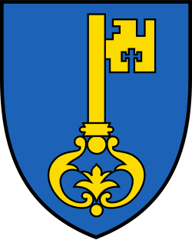
Coat of arms of Giez
Azure, a key palewise Or. An upright yellow key stands out on a blue field. The municipality adopted these arms in 1905, when stained-glass windows were installed in the restored church. The key is the emblem of Saint Peter, patron of the church, and already decorates the larger of the two bells cast in 1501. Blue and yellow are the colours of Grandson, recalling the old ties between the two places.[5][2]
Founding of Giez
Nobody knows who founded Giez. Its territory was already occupied in Roman times, as the remains of a large villa show, and then in the early Middle Ages, as Burgundian graves attest. The place enters written history through a donation by King Rudolph III of Burgundy to the priory of Romainmôtier. In the Middle Ages its lands belonged to the monasteries of Romainmôtier and Hautcrêt, to a noble family de Giez, and later to the de Pierre family. The church of Giez also served at that time as parish church for the inhabitants of Grandson. Under Bernese rule Giez came under the bailiwick of Grandson and was part of the lands of Montagny. Its inhabitants bear the nickname Repétassi, the Patched Ones.[1][2]
History of Giez
Roman period. A large Roman villa stands on the territory of Giez; remains of it survive.[1]
early Middle Ages. Burgundian graves bear witness to occupation of the site.[1]
1011. First mention, «Gies», in a donation by King Rudolph III of Burgundy to the priory of Romainmôtier.[1][2]
12th century. A noble family de Giez holds land in the village, alongside the monasteries of Romainmôtier and Hautcrêt. The church is built at the end of the century, some parts probably dating from its beginning.[1]
14th century. Construction of a first castle.[1]
1438. The church of Giez ceases to serve as the parish church of the inhabitants of Grandson.[1][2]
15th century. The de Pierre family owns land in Giez.[1]
1476. Charles the Bold sets up his camp at Giez to prepare the assault on Grandson. After his defeat by the Confederates, weapons, equipment and valuables are left behind.[1][2]
late 15th century. Rebuilding of the castle.[1]
Ancien Régime. Under Bernese rule Giez comes under the bailiwick of Grandson and is part of the lands of Montagny.[1]
1635. Construction of the «Les Tourelles» house, with its hexagonal staircase.[1][2]
1677. The church is partly demolished.[1]
1798. Giez joins the district of Grandson, to which it belongs until 2007.[1]
1845. The church is attached to the parish of Montagny.[1]
1905. Adoption of the municipal coat of arms: azure, a key or in pale.[2]
from the 1970s. Strong population growth thanks to a new district of detached houses west of the village, lived in mainly by commuters (more than two thirds of the working population in 2000).[1][2]
2008. After the dissolution of the district of Grandson, Giez becomes part of the Jura-Nord vaudois district.
Population of Giez
Sources and references: [1][3]
| 1803 | 214 |
| 1850 | 294 |
| 1900 | 289 |
| 1950 | 211 |
| 2000 | 348 |
| 2025 | 464 |
Families of Giez
Citizen families before 1800. Bourgeois, Chuat, Compondu and Périllard, with no precise date.[6]
In the 19th century. Dard, Groux, Meylan and Perrin are listed with no precise date. In 1819, Giez admits the de Rham family, from Germany.[6]
From 1901 to 1962. The Lavergnat family is admitted in 1921. Two Italian families follow, the Rubini in 1939 and the Rigo in 1946. The last to be registered, in 1956, are the Herren of Mühleberg BE and the Keller of Frauenfeld TG.[6]
Economy of Giez, past and present
The farms. Seven farms grow cereals, sugar beet, maize and rapeseed and produce milk. The village also supplies honey, beer and grapes. It has a few businesses as well, plus an equestrian centre and a riding hall.[2]
Historic sites in Giez
Church of Giez. Church built at the end of the 12th century, some parts probably dating from its beginning. It served as parish church for the inhabitants of Grandson until 1438, was partly demolished in 1677 and has belonged to the parish of Montagny since 1845. Its dedication varies between sources: Saint John the Baptist, or Saint Peter, whose key appears on the municipal coat of arms.[1][2]
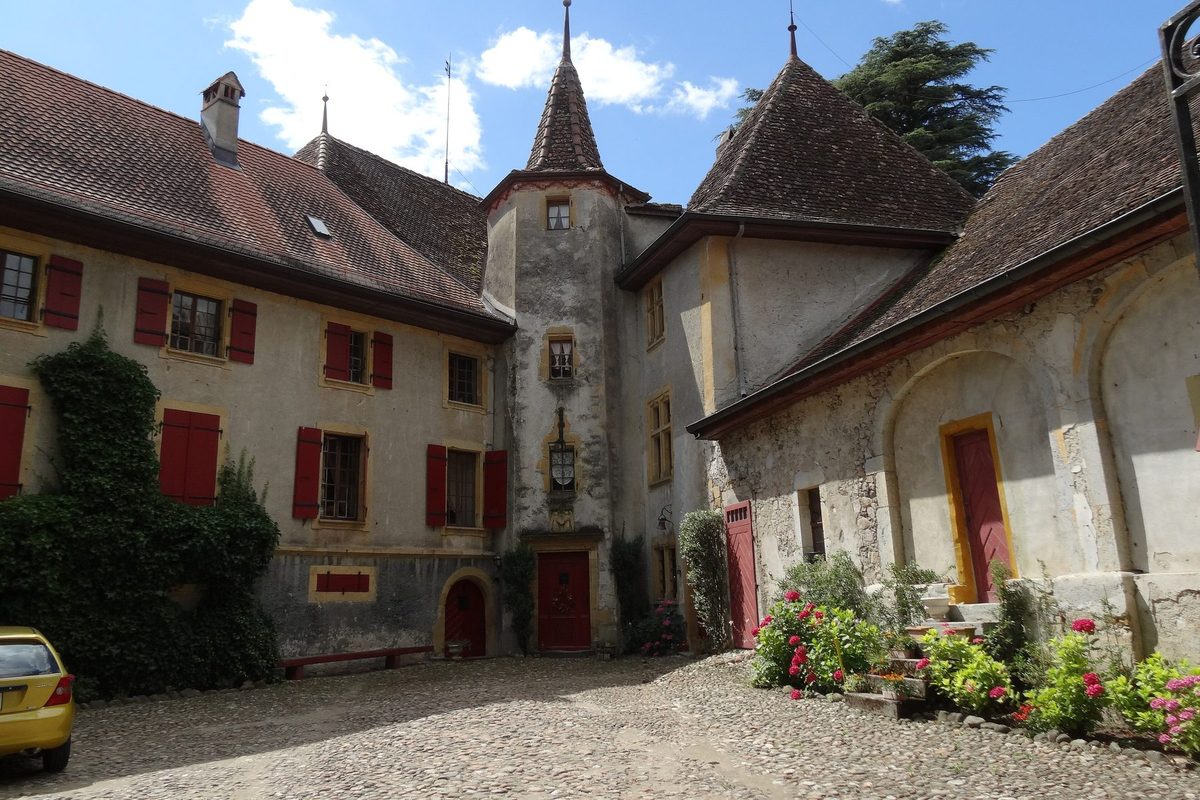
Giez Castle. 14th-century castle, rebuilt at the end of the 15th century, with the character of a large fortified manor house.[1][2]
«Les Tourelles» house. House next to the castle, dated 1635, recognisable by its hexagonal staircase.[1][2]
Village listed in the ISOS. Giez reportedly appears in the Federal Inventory of Swiss Heritage Sites of national importance.
Remains in Giez
Roman villa. Remains of a large Roman villa on the municipal territory.[1]
Burgundian graves. Early medieval burials discovered at Giez.[1]
Traces of Charles the Bold's camp. Numerous fragments of weapons have been found at Giez, where the Duke of Burgundy camped in 1476. A pond laid out by the Burgundians to water their horses also survives.[1]
Protected heritage in Giez
Cultural property of regional significance (B objects)[4]
- Château avec rural
- Eglise réformée Saint-Jean-Baptiste
- Maison des Tourelles avec communs
Traditions and festivals in Giez
The communal oven on Fast Monday. The village's very old communal oven (four banal) has been restored and brought back into use. On Fast Monday (Lundi du Jeûne), bread, pizzas and plum tarts are baked in it and sold to residents. Giez also has a bread oven club, the Amicale du four à pain.[2]
Le Lombric. The small festival Le Lombric began in 2003 at the municipal hut. Every year, a group of residents also holds the 1 August celebration there.[2]
Sources
- Dictionnaire historique de la Suisse, « Giez »
- Feuille des avis officiels du canton de Vaud, « Alphabet des communes vaudoises : Giez »
- Statistique Vaud, « Population résidante permanente au 31 décembre 2025 »
- Federal Office for Civil Protection (FOCP), Swiss Inventory of Cultural Property (PCP), list for the canton of Vaud (as of 1.1.2026)
- IPI, Swissreg, emblems database: coat of arms of Giez (no. 101280)
- Register of Swiss Surnames, 3rd edition (1989), search Commune "Giez", Canton VD
Published by Sébastien Jörg ·
Other villages near Giez
Missing information, or do you have a source? Suggest a correction or addition. Every submission is checked before it's published.
Suggest a change