Grandson
On 28 February 1476 Charles the Bold takes the castle and the whole Bernese garrison perishes. On 2 March the Confederates put his army to flight.
Entry based on 9 sources · Our method · Reusable text (CC BY-SA)
Origin of the name Grandson
The name appears in the second half of the 11th century as «Grancione». Around 1100 we read «de castro Grancione», and around 1126 «castri Grandissoni». Its origin does not appear to have been explained.[1]
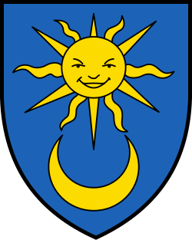
Coat of arms of Grandson
Azure, a sun above a crescent Or. On a blue field, a yellow sun rests on a yellow crescent moon. The town's arms go back to the 15th century and their origin is unknown. They have no link with the arms of the lords of Grandson.[5][6]
Founding of Grandson
Lakeside villages occupy the site from the Neolithic and above all in the Bronze Age, among them the one at Corcelettes. The medieval town later grows up around the castle that the lords of Grandson, one of the great noble families of the Pays de Vaud, build around the year 1000. Otto I of Grandson greatly enlarges the fortress at the end of the 13th century and again in the early 14th. Around 1146 a Benedictine priory, Saint-Jean, settles in the town.[1]
History of Grandson
Neolithic. Lakeside settlements at Les Buttes, Le Repuis, Le Stand and Les Tuileries.[1]
Bronze Age. Lakeside village of Corcelettes-Les Violes, the most important Bronze Age site in the municipality.[1]
around the year 1000. The lords of Grandson build a castle.[1]
second half of the 11th century. First mention, as «Grancione».[1]
around 1146. Foundation of the Benedictine priory of Saint-Jean.[1]
1277-1281. Otto I of Grandson greatly enlarges the castle, and again in the early 14th century.[1]
21 February 1476. During the Burgundian Wars, Charles the Bold takes the town.[2]
28 February 1476. The duke takes the castle. The entire Bernese garrison dies by drowning or hanging.[2]
2 March 1476. Battle of Grandson: the Confederate army puts the Burgundian army to flight and seizes rich booty in the duke's camp.[2]
1475-1798. Grandson forms a condominium (common bailiwick) of Bern and Fribourg.
1531. First iconoclastic riots.[1]
1554. The town adopts the Reformation by popular vote.[1]
1798-2006. Grandson is the seat of a district.
1803. The town has 822 inhabitants.[1]
1850. The town has 1'248 inhabitants.[1]
1900. The town has 1'771 inhabitants.[1]
2000. The town has 2'759 inhabitants.[1]
2011. The Corcelettes lakeside site is inscribed on the UNESCO World Heritage List among the Prehistoric Pile Dwellings around the Alps.
Population of Grandson
Sources and references: [1][3]
| 1803 | 822 |
| 1850 | 1'248 |
| 1900 | 1'771 |
| 1950 | 1'800 |
| 2000 | 2'759 |
| 2010 | 3'039 |
| 2025 | 3'391 |
Families of Grandson
De Grandson. High-noble family that dominated the Pays de Vaud from the 11th century to the end of the 14th and took its name from the castle. The lineage split in 1185, then in 1235, into several branches, including those of La Sarraz, Grandson and Champvent. One Guillaume founded the Grandisson line in England, while Gérard and Henri became bishops of Verdun. Othon III died in a duel in 1397, marking the family's extinction, and the House of Savoy confiscated its lordships.[8]
Burgher families before 1800. Amiet, Banderet, Beausire, Berthiez, Bioley, Bourgeois, Chaboux, de Buren, Despland, Doxat, Duvoisin, Grandguillome, Guilloud, Hinderer, Martin, Panchaud, Perret, Ray and Rossat, with no precise date. The de Ribaupierre, from France, were admitted in 1650.[7]
In the 19th century. Two families from Germany: the Brecht in 1817 and the Pfänder in 1821.[7]
Show more families (1)
From 1901 to 1962. Forty-two entries. The first four came from abroad, starting with the Tonazzi, from Italy, in 1912. The year 1956 alone accounts for twenty-five, all of them Swiss families. Half the families registered in the period came from the canton of Bern, and four from Ticino. In 1962 the Renaud from Montet (Glâne) FR and the Strehl from Saanen BE closed the list.[7]
Notable people of Grandson
Othon Ier de Grandson. He transformed the old Romanesque castle and enlarged it considerably. Around 1289 he allowed the Friars Minor to build their friary at the western entrance to the town, of which the church tower survives. He granted franchises to the burghers before 1328.[1]
Guillaume Amiet. A tile-maker from Bevaix, he settled in 1459 with his brother at Fiez-Pittet-dessous, which then took the name Tuileries-de-Grandson. The Amiet are among the old burgher families of Grandson.[1][7]
Guillaume Farel. In 1531 he had the altars of the Franciscan church destroyed. After this show of force and the preaching of the Frenchman Jean Le Comte, Bern imposed the Reformation only in 1554.[1]
Gabriel-Antoine Miéville. He brought the ideas of the Revolution to Grandson. He edited the "Peuple vaudois", official bulletin of the Provisional Assembly and forerunner of the Gazette de Lausanne.[1]
Economy of Grandson, past and present
Vines, fishing and livestock. In the Middle Ages, market halls stood along the north side of the church and butchers' stalls were found in the Faubourg du Revelin. In the 19th century the inhabitants lived from farming, fishing and above all from cattle raising on the slopes of the Jura. Vineyards, once widespread, declined sharply at the end of the century because of parasitic diseases. The former vine slopes were later covered with housing.[1]
Tobacco. The firm de Vos, Decoppet & Cie, based in the castle, was taken over in 1831 by H. Vautier & Cie. Tobacco became Grandson's main industry in the 19th century. As major landowners, the Vautier family held the office of syndic from 1899 to 1914. Their factories at the western entrance to the town closed in 1972.[1]
Building, transport and prototypes. Grandson is home to building firms such as Herren Frères & Cie and Beati Frères SA. Landi, founded in 1896, and Cand, founded in 1920, both in transport and civil engineering, merged in 1974 as Cand-Landi SA. Les Sables & Graviers La Poissine SA supplies building materials. At Les Tuileries-de-Grandson, Franco Sbarro opened a workshop in 1968 that builds car prototypes known worldwide. In 2000 two thirds of the population worked in services.[1]
Rail, lake and tourism. The Yverdon-Biel line, opened in 1858 on an embankment, cut the town off from its shore. The medieval harbour at the western entrance was abandoned and new quays were built at the end of the 19th century. From the 1970s the municipality turned to tourism and leisure, with a small-boat harbour in 1971, the castle open to the public and receiving about 40'000 visitors a year, and a nature and heritage trail opened in 2000. The last section of the A5 motorway, between Grandson and Vaumarcus, was built from 1999 to 2005.[1]
Disasters and major events in Grandson
The great fire of around 1378. Around 1378 a great fire destroyed all the roofs of the castle and much of the town. It is recorded only in 1397.[1]
The Burgundian Wars in 1476. The Burgundian Wars hit Grandson hard. In February 1476 Charles the Bold took the town and then the castle. The damage was heavy, above all to the castle.[1]
Historic sites in Grandson
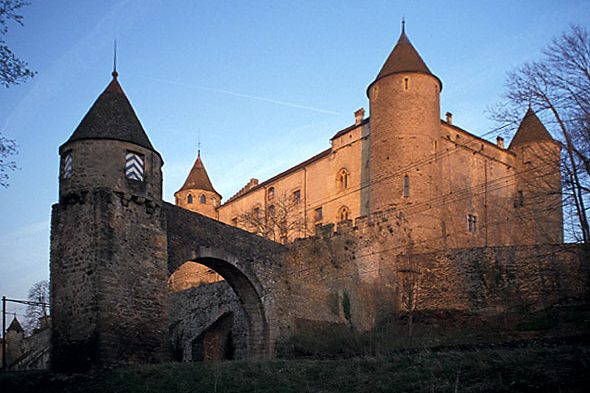
Grandson Castle. Built around the year 1000 and greatly enlarged by Otto I of Grandson between 1277 and 1281 and in the early 14th century, it overlooks Lake Neuchâtel. Charles the Bold took it on 28 February 1476.[1][2]
Church of Saint-Jean. Church of the former Benedictine priory founded around 1146.[1]
Battlefield of 1476. The battle of 2 March 1476, fought near Grandson, was the first great defeat of Charles the Bold at the hands of the Confederates.
Remains in Grandson
Corcelettes lakeside site. Bronze Age village on the lakeshore, a UNESCO World Heritage site as part of the Pile Dwellings around the Alps.[1]
Grandson booty. The rich booty taken in Charles the Bold's camp in 1476 was shared among the Confederates. Pieces of it are kept in Swiss museums, though no one knows exactly which.
Protected heritage in Grandson
Cultural property of national significance (A objects in the PCP inventory)[4]
- Château
- Corcellettes Les Violes (CH-VD-10), site du patrimoine mondial de l’UNESCO «Sites palafittiques préhistoriques autour des Alpes»
- Eglise réformée Saint-Jean-Baptiste
- Grandson, bourg avec château - Moyen Age - Époque contemporaine
Cultural property of regional significance (B objects)[4]
- Ancien Hôtel de Ville
- Champs des Echâtelards, menhir néolithique
- Cure
- Fontaine de la rue Haute
- Maison du Bailli
- Maison gothique
- Musée régional et musée de l'automobile dans le Château
- Tour des Cordeliers
Traditions and festivals in Grandson
The Brandons. In February the Brandons enliven the little town. A procession with school classes from Grandson, the gym club and guggen bands comes down by the Crêt-aux-Moines and the rue Haute to the place du Château. There a confetti battle precedes the putting to death of the Bonhomme hiver at the foot of the castle.[9]
Sources
- Dictionnaire historique de la Suisse, « Grandson (commune) »
- Dictionnaire historique de la Suisse, « Grandson, bataille de »
- Statistique Vaud, « Population résidante permanente au 31 décembre 2025 »
- Federal Office for Civil Protection (FOCP), Swiss Inventory of Cultural Property (PCP), list for the canton of Vaud (as of 1.1.2026)
- IPI, Swissreg, emblems database: coat of arms of Grandson (no. 101305)
- Official Gazette of the Canton of Vaud (FAO), "Alphabet des communes vaudoises: Grandson"
- Register of Swiss Surnames, 3rd edition (1989), search Commune "Grandson", Canton VD
- Historical Dictionary of Switzerland, Bernard Andenmatten, "Grandson, de", version of 15.10.2009
- La Région, "Se divertir avec 'Les Z'animaux'" (Grandson Brandons), article posted on the Commune of Grandson website, file dated 22.02.2024
Published by Sébastien Jörg ·
Other villages near Grandson
Missing information, or do you have a source? Suggest a correction or addition. Every submission is checked before it's published.
Suggest a change