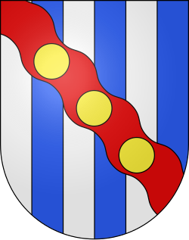
Gressy
On the hill of Sermuz, above Gressy, a Gallic wall was built in the 1st century BC. Later, the Bernese bailiff of Yverdon spent his summers in the village.
Entry based on 11 sources · Our method · Reusable text (CC BY-SA)
Coat of arms: Public domain, Wikimedia Commons
Origin of the name Gressy
The name Gressy is attested in 1228 as «Grissie». It may derive from a Roman gentile name, Criscius or Gracius (Gratius), but this hypothesis is uncertain.[1]
Founding of Gressy
Gressy has neither a precise founding date nor a known founder. Like most villages in the region, it formed little by little around a rural settlement core. From the 12th to the 16th century the place fell under the seigneury of Belmont, and it was within this framework that the village organised itself. A village community existed in 1390. In 1433 it had a syndic, a rector and a governor. The neighbouring hamlet of Sermuz, home to the remains of a Celtic rampart, was attached to Gressy before 1764.[1]
History of Gressy
Second half of the 1st century BC. A Gallic wall (murus gallicus) is built on the hill of Sermuz, above the hamlet.[3]
1154. Gressy falls under the seigneury of Belmont.[1]
1228. First certain written mention of the village, in the form Grissie.[1]
1390. An organized village community is mentioned at Gressy.[1]
1433. Bodies of local governance are set up in the village.[1]
1439. A chapel dedicated to Saint Anthony is added to the Saint-Martin parish church.[1]
1536. The Bernese conquest of Vaud places the region under Bernese administration. The seigneury of Belmont becomes a châtellenie after 1553, and the bailiff of Yverdon has his summer residence at Gressy.
1764. The village has 146 inhabitants (26 households). The hamlet of Sermuz already belongs to it.[1]
1798. The fall of the Ancien Régime ends the seigneurial system. Gressy is attached to the district of Yverdon.[1]
1814. A land register is drawn up for the municipality of « Gressy et Sermuz ».[9]
1850. The population reaches its known historical peak, with 222 inhabitants.[1]
1966. The village school closes its doors.[1]
1980. The population falls to 125 inhabitants, its lowest known level.[1]
1982. The Gressy zoning plan is drawn up. It is still in force in 2025, considered largely outdated.[11]
1990. Part of the Celtic rampart of Sermuz is partially reconstructed.[3]
1 January 2008. The reform of the Vaud districts abolishes the former district of Yverdon. Gressy joins the new district of Jura-Nord vaudois.
2011. Gressy merges with the municipality of Yverdon-les-Bains and loses its status as an independent municipality. The merger takes effect on 1 July. The former municipality's archives, about 25 linear metres, are closed that day and handed to the Yverdon City Archives.[1][9]
2014. On 14 June the Gressy archives, reduced to about 9 linear metres after sorting and arrangement, are presented to the public in the hall of the old school.[9]
2023. From 22 November to 21 December a new zoning plan for Gressy and Sermuz is put to public inquiry. It reduces building zones considered oversized under the federal spatial planning act.[10]
2025. In December the municipal council committee recommends adopting the plan and describing Gressy and Sermuz as a « quartier-village » rather than a « hameau ».[11]
Population of Gressy
Sources and references: [1]
| 1764 | 146 |
| 1850 | 222 |
| 1900 | 218 |
| 1980 | 125 |
| 2000 | 139 |
Families of Gressy
Burgher families before 1800. Auberson, Dessemontet, Henrioud, Miéville, Pavid and Planche, with no precise date. The Violon, from France, were admitted in 1701, then two families from Belmont-sur-Yverdon VD, the Chevalier in 1711 and the Grin in 1727.[7]
In the 19th century. Dupuis and Keysener are registered with no precise date. Two families came from France, the Huser in 1851 and the Cordier in 1898.[7]
From 1901 to 1962. Twenty-two entries. Up to 1919 they mainly concern families from Germany (Holzer in 1906, Schüler in 1907, Langenbach in 1913, Schwed in 1914, Meyer in 1915), France (Ullmo in 1914, Gresset in 1916, Dey in 1918) and Italy (Castelli in 1916, Viotti in 1919), as well as the Oreiller in 1919. Then came the Crozet, from France, in 1929, the Mau, from Germany, in 1940, the Peter in 1941, the Reinhofer, from Austria, in 1946, the Netter, from France, in 1952 and the Perolini, from Italy, in 1954. The last families were Swiss: the Oberson from Villaraboud FR in 1956, the Baldinger from Zurzach AG in 1957 and 1961, and the Felder from Schüpfheim LU, the Ischi from Rumisberg BE and the Maeder from Ried bei Kerzers FR in 1959.[7]
Economy of Gressy, past and present
Common land, commuters and motorways. Gressy managed its common land together with Belmont-sur-Yverdon until 1813, when it was divided. In 2000 more than two thirds of the working population had jobs outside the municipality. The village lies at the junction of the A1 and A5 motorways.[1]
Historic sites in Gressy
Saint-Martin parish church. Parish church dedicated to Saint Martin, whose right of patronage Bishop Amédée (1144-1159) gave to the chapter of Lausanne. It held a few relics and a statue. A chapel of Saint Anthony is attested there in 1439. The parish also included Belmont and Valeyres-sous-Ursins.[1]
Old school. Building of the village school, which closed in 1966. Its hall is still used for public events.[1][9]
Remains in Gressy
Celtic rampart of the Sermuz oppidum. On the hill of Sermuz, above the hamlet, a Gallic wall (murus gallicus) was built in the second half of the 1st century BC, in the Late La Tène period. Only an earth mound survives. Part of the rampart was partially reconstructed in 1990. The site, «Sermuz, oppidum celtique», is a cultural property of national importance. The rampart cut across the whole width of the hill and enclosed about 7 hectares. Graves date its construction to around 50 BC. The site's purpose is not established: it may have been a military camp occupied for two generations. The restored section shows the timber frame and stone facings, and a model of the rampart is on display at the Yverdon-les-Bains et région museum.[3][4][8]
Protected heritage in Gressy
Cultural property of national significance (A objects in the PCP inventory)[6]
- Sermuz, oppidum celtique
Sources
- Dictionnaire historique de la Suisse, Olivier Dessemontet, « Gressy », version du 05.01.2017
- Historisches Lexikon der Schweiz, Olivier Dessemontet, « Gressy (VD) » (version allemande du même article)
- Dictionnaire historique de la Suisse, Philippe Curdy, « Sermuz », version du 24.11.2011
- Office fédéral de la protection de la population, Inventaire PBC (geo.admin.ch), objet n° 10991 « Sermuz, oppidum celtique », catégorie A
- État de Vaud, Bureau d'information et de communication, « Organisation des préfectures et adaptation au nouveau découpage territorial », communiqué du 12.07.2007
- Federal Office for Civil Protection (FOCP), Swiss Inventory of Cultural Property (PCP), list for the canton of Vaud (as of 1.1.2026)
- Register of Swiss Surnames, 3rd edition (1989), search Commune "Gressy", Canton VD
- Archeoplus, « Gressy, oppidum de Sermuz »
- Ville d'Yverdon-les-Bains, journal communal, « Coup de projecteur sur les archives de Gressy » (2014)
- Ville d'Yverdon-les-Bains, communiqué « Mise à l'enquête d'un plan d'affectation sur les localités de Gressy et de Sermuz » (20.11.2023)
- Conseil communal d'Yverdon-les-Bains, rapport de commission PR25.39RA, plan d'affectation « Gressy-Sermuz » (28.12.2025)
Published by Sébastien Jörg ·
Other villages near Gressy
Missing information, or do you have a source? Suggest a correction or addition. Every submission is checked before it's published.
Suggest a change