Épendes
From 1764 the people of Épendes began turning the Orbe marshes into meadows and pastures, below the hill of La Poëpe and its early medieval refuge.
Entry based on 8 sources · Our method · Reusable text (CC BY-SA)
Origin of the name Épendes
The village is mentioned in 1154 as «Spinles» and in 1174 as «Espinnes». The name reportedly derives from the Latin word for thorn.[1]
Coat of arms of Épendes
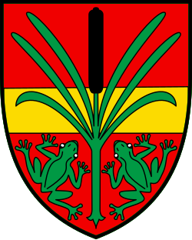
Gules, a fess or, overall a reed proper palewise, in base two frogs vert. On a red field a horizontal yellow band is crossed by an upright reed. Two green frogs sit in the lower part of the shield. Adopted in 1926, these are the arms of the Gouret family. The reed recalls the former marshes, the frogs the inhabitants' nickname.[6][2][7]
Founding of Épendes
Nobody knows who founded Épendes. Above the village, the hill of La Poëpe already held a refuge in the early Middle Ages. Épendes later belonged to the lords of Grandson-Belmont, who shared its revenues between the abbey of the Lac de Joux and the charterhouse of La Lance. The locality was part of the lordship of Belmont before coming under Bernese authority.[1]
History of Épendes
Early Middle Ages. A refuge stands on the hill of La Poëpe, which overlooks the village.[1]
1154. First mention, as «Spinles».[1]
1172. Bishop Landri de Durnes hands over the parish church of Saint-Martin to the Premonstratensians of the Lac de Joux, who serve it until the Reformation. The parish has daughter churches at Suchy and Essert-Pittet.[1]
1174. Mentioned as «Espinnes».[1]
1404. Épendes has 17 hearths.[1]
1536. After the Bernese conquest the village belongs to the bailiwick of Yverdon.
1550. The village has 16 hearths.[1]
1663. Épendes is made a lordship for André du Plessis-Gouret. It forms the castellany of the same name, in the bailiwick of Yverdon.[1][2]
1722. Construction of the castle, date uncertain.
1764. Épendes has 252 inhabitants in 47 hearths. The inhabitants begin turning the Orbe marshes into meadows and pastures. Bobbin lace-making develops at the same time.[1]
1798. Épendes becomes part of the district of Yverdon.
1830-1971. A cheese dairy cooperative is in operation.[1]
1855. Opening of a station on the Morges-Yverdon line.[1]
1868. Construction of a school building.[1]
1920. First land consolidation, followed by others in 1945 and 1990.[1]
1972. The village now supplies its milk to Migros.[1]
1982. Opening of a junction of the A1 motorway.[1]
2008. Épendes becomes part of the new district of Jura-Nord vaudois.[3][4]
Population of Épendes
Sources and references: [1][5]
| 1404 | 17 hearths (households) |
| 1550 | 16 hearths (households) |
| 1764 | 252 |
| 1798 | 265 |
| 1850 | 320 |
| 1900 | 249 |
| 1950 | 293 |
| 1980 | 205 |
| 2000 | 320 |
| 2025 | 376 |
Families of Épendes
Du Plessis-Gouret. In 1663 Bern made Épendes a seigneurial fief for André du Plessis-Gouret. His family held it until 1798. The municipal arms adopted in 1926 are those of the Gouret family.[1][2][7]
Citizen families before 1800. Beausire, Chevalier, Henry, Miéville and Perrin, without a precise date.[8]
In the 19th century. Gonrard and Massonnet, without a precise date.[8]
Show more families (1)
From 1901 to 1962. Several families come from abroad: from Italy (Ganio-Mego and Perelli-Cippo in 1954), from the United States (Gueydan in 1916 and 1921) and from the Soviet Union (Sedlatchek in 1932). From Switzerland come the Poncet family from Neyruz FR (1959) and the Derendinger family from Lüterkofen-Ichertswil SO (1960). They are joined by the Viasemsky family (1950). The last family registered, in 1960, is the Derendinger family.[8]
Economy of Épendes, past and present
Fields and poplars. Ependes remains a farming village, with horticulture and poplar plantations. The Aarberg sugar factory owns large arable fields here.[1]
The Pré-Vuacoz craft zone. The Pré-Vuacoz zone was meant to host a road safety training centre. In the end it was divided into plots for small businesses and the self-employed.[7]
Historic sites in Épendes
Saint-Martin church. Parish church handed over in 1172 to the Premonstratensians of the Lac de Joux, who served it until the Reformation. In the 20th century the parish of Épendes was united with that of Suchy.[1]
Épendes Castle. 18th-century manor house near the station. It was reportedly built in 1722 and is said to be rented to a Rudolf Steiner school; both points are uncertain.
La Poëpe hill. Hill overlooking the village, site of an early medieval refuge.[1]
Remains in Épendes
Early medieval refuge. An early medieval refuge occupied the hill of La Poëpe, which overlooks Épendes.[1]
Traditions and festivals in Épendes
The Abbaye du cordon rouge-vert-blanc. Every three years, in July, the Abbaye du cordon rouge-vert-blanc holds its festival. The whole village takes part. The Jeunesse, for its part, organises two festivals a year.[7]
Sources
- Olivier Dessemontet, « Ependes (VD) », Dictionnaire historique de la Suisse (version allemande), version du 14.03.2006
- Commune d'Ependes, « Histoire »
- Canton de Vaud, Loi sur le découpage territorial (LDecTer, RSV 132.15) du 30 mai 2006
- État de Vaud, communiqué du 12.07.2007, « Les préfètes et les préfets sont attribués aux nouveaux districts »
- Statistique Vaud, « Population résidante permanente au 31 décembre 2025 »
- IPI, Swissreg, emblems database: coat of arms of Ependes (no. 101522)
- Official Gazette of the Canton of Vaud (FAO), "Alphabet des communes vaudoises: Ependes"
- Register of Swiss Surnames, 3rd edition (1989), search Commune "Épendes", Canton VD
Published by Sébastien Jörg ·
Other villages near Épendes
Missing information, or do you have a source? Suggest a correction or addition. Every submission is checked before it's published.
Suggest a change