Yverdon-les-Bains
Second city of the canton, heir to Celtic and Roman Eburodunum, a Savoyard new town founded in 1260 around its castle, where Pestalozzi taught from 1805 to 1825.
Entry based on 16 sources · Our method · Reusable text (CC BY-SA)
Origin of the name Yverdon-les-Bains
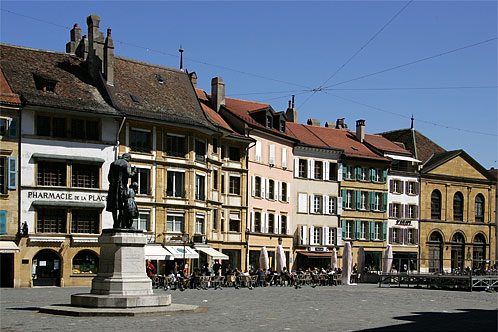
The name is Celtic. The Roman form "Eburodunum" (its inhabitants are called "vikani Eburodunenses" in the 2nd century) combines "dunum", a fortress or fortified place, with a first element "eburo", read either as the yew tree or as a personal name. From it came "Yverdon". In 1981 the commune took the official name "Yverdon-les-Bains", in reference to its thermal springs. The change was reportedly confirmed on 27 November 1981, a date that is uncertain.
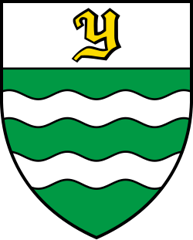
Coat of arms of Yverdon-les-Bains
Vert two bars wavy Argent, on a chief Argent a letter Y Or. On a green field, two wavy white bands cross the shield horizontally. At the top, a white band bears a yellow Y. In 1898 the arms are disputed: two white waves or three green ones? The Municipal Council then officially adopts the arms shown on a silver-gilt dish dated 1583, kept in Bern.[12][13]
Founding of Yverdon-les-Bains
The site has been occupied since prehistory, as the Clendy menhirs show. In Roman times a settlement (vicus) grew up around the thermal springs, followed from 325 by a fortified camp (castrum). The present town is a medieval "new town": around 1258 Peter II of Savoy began building the castle and a planned town, whose official foundation dates from 26 April 1260. The regular plan of three parallel streets laid out by the Savoyard prince still shapes the historic centre.[3]
History of Yverdon-les-Bains
4500-4000 BC. Erection of the Clendy menhirs, a group of 45 Neolithic standing stones, some of them anthropomorphic.[3][4]
2nd century. The inhabitants of the Roman vicus are called "vikani Eburodunenses". The settlement grows around the thermal springs.
around 325. Construction of a Roman fortified camp (castrum) covering two hectares.[3]
around 1258. Peter II of Savoy begins building the castle and the new town.
26 April 1260. Official foundation of the Savoyard new town.
1268. The town has about 700 inhabitants.
1379. The population reaches about 1'800.
1536. Bernese conquest of Vaud; Yverdon becomes the seat of a Bernese bailiwick.
1730-1735. Rebuilding of the thermal baths.
1757. Construction of the temple (Reformed church).
1770-1780. Publication of the Encyclopédie d'Yverdon under the direction of Fortunato Bartolomeo De Felice.
1773. Construction of the town hall.
1798. The town has 2'484 inhabitants.
1805-1825. The educator Johann Heinrich Pestalozzi runs his institute in the castle. He reportedly arrived as early as autumn 1804.
1 May 1855. The first railway line in French-speaking Switzerland opens between Bussigny and Yverdon. The first passenger train reportedly ran on 7 May.
1900. The town has 7'985 inhabitants.
1909. The battery maker Leclanché sets up in the town.
1920-1974. Manufacture of Paillard (Hermes) typewriters.
1975. The Clendy menhirs, reported in the 19th century and then forgotten, are cleared and excavated. They are reset in 1986.[3][4]
1977. The thermal baths reopen after a long closure.
27 November 1981 (date uncertain). The new official name "Yverdon-les-Bains" is confirmed.
1986. Creation of the Y-Parc technology park.
2002. Yverdon-les-Bains is one of the sites (arteplage) of the Swiss national exhibition Expo.02.
1 July 2011. Merger with the commune of Gressy.[7]
Population of Yverdon-les-Bains
Sources and references: [10]
| 1268 | 700 (approx.) |
| 1379 | 1'800 (approx.) |
| 1528 | 1'500 (approx.) |
| 1700 | 2'000 (approx.) |
| 1798 | 2'484 |
| 1850 | 3'619 |
| 1900 | 7'985 |
| 1950 | 12'266 |
| 2000 | 24'376 |
| 2010 | 27'678 |
| 2025 | 30'600 |
Notable people of Yverdon-les-Bains
Pyramus de Candolle. From 1617 to 1626 he ran a first manufactory set up in Yverdon.[1]
Fortuné-Barthélemy de Felice (Rome 1723 - Yverdon 1789). In Yverdon he published the Encyclopédie that bears the town's name and earned it a European reputation.[1][14]
Elie Bertrand. He created the Société économique of Yverdon, which founded a museum around 1760 and a public library in 1763.[1]
Johann Heinrich Pestalozzi. The educator set up his boys' institute in the château, which at its height had up to 150 pupils and some thirty teachers. He did not teach there himself and called himself "the awakener" ("l'éveilleur").[5]
Johann Konrad Naef. Trained by Ulrich, he came at the age of 20 to work with Pestalozzi. On 1 July 1813 he founded in Yverdon an institute for deaf-mute children, independent of the one in the château. In 1869 the institute moved to Moudon, to the château of Carouge.[5]
Puzant Masraff. An Armenian industrialist, he bought the springs of the Arkina mineral water in 1920.[1]
Pierre Versins. A French author, Resistance fighter and Auschwitz survivor, he wrote the Encyclopédie de l'utopie, des voyages extraordinaires et de la science-fiction. In 1975 he gave his vast collection to the town of Yverdon. The Maison d'Ailleurs opened in 1976.[15][1]
Economy of Yverdon-les-Bains, past and present
Boatmen, wine and salt. From the outset, the Savoyard town has a market, and from 1264 a yearly fair. With the improvement of the Thielle from 1279, Yverdon develops its river and lake trade. The boatmen's guild obtains the monopoly on transport between Orbe and Solothurn. From 1636, the Entreroches canal boosts this traffic, mainly in Lake Geneva wines and French salt. Under Bernese rule, the town also lives from the salt trade and serves as a market place for the surrounding countryside.[1][13]
The Baths. The Romans already used the thermal spring. Restored in the 1730s, the baths draw a wealthy Swiss and foreign clientele. Revived from 1878, enlarged and modernised, they enjoy their heyday. Hit hard during the First World War, they cease operating until 1977.[13][1]
Mills, tobacco and machines. Built from 1279, the Mills canal drives the wheels of local industry for six centuries. The railway fosters industrial growth, with a railway repair workshop and, in 1858, the Vautier tobacco factory. The machine industry then takes the lead, headed by Paillard, which employs about 1'400 people in 1960. The crisis of the 1970s costs many jobs. Arkina mineral water closes in 2008.[1]
Schools and technology. The engineering school opened in 1975 becomes the Haute école d'ingénierie et de gestion du canton de Vaud in 1998. Y-Parc, created in 1986, is Switzerland's first science and technology park.[1]
Disasters and major events in Yverdon-les-Bains
The sack of 1476. During the Burgundian Wars, Bernese and Fribourg troops sack Yverdon and set it on fire.[1]
Historic sites in Yverdon-les-Bains
Yverdon Castle. Peter II of Savoy built it from 1258-1260. It is the heart of the Savoyard new town. Seat of the Bernese bailiffs after 1536, it housed Pestalozzi's institute from 1805 to 1825, possibly from as early as 1804.
Historic centre with three streets. The regular plan laid out by Peter of Savoy, with three parallel streets, still shapes the old town. The temple (1757) and the town hall (1773) reflect the 18th-century revival.
Thermal centre. The springs used since Roman times gave the town its present name. The baths were rebuilt in 1730-1735 and reopened in 1977 after a long closure.
Maison d'Ailleurs. Museum of utopia, extraordinary journeys and science fiction, founded by Pierre Versins.[8]
Remains in Yverdon-les-Bains
Clendy menhirs. A group of 45 standing stones erected around 4500-4000 BC, some in human form. Reported in the 19th century and then forgotten, they were cleared and excavated in 1975, then reset in 1986 on the lakeshore according to aesthetic rather than scientific criteria.[3][4]
Roman castrum. Diamond-shaped fortified camp of two hectares built around 325, whose rampart had 15 towers and two gates. It shows the importance of Eburodunum in late Antiquity.[3]
Protected heritage in Yverdon-les-Bains
Cultural property of national significance (A objects in the PCP inventory)[11]
- Baie de Clendy (CH-VD-15), site du patrimoine mondial de l’UNESCO «Sites palafittiques préhistoriques autour des Alpes»
- Bibliothèque publique et scolaire d'Yverdon-les-Bains
- Château avec fontaine
- Hôtel de Ville
- L'ancien Hôtel de l'Aigle
- Maison Thorens (ancienne maison Steiner)
- Musée d'Yverdon-les-Bains et région
- Sermuz, oppidum celtique (Gressy)
- Temple
- Temple de Fontenay avec sacristie
- Villa d'Entremonts avec orangerie, parc, portail et fontaine
- Yverdon-les-Bains, oppidum celtique / EBURODUNUM, vicus romain / ville médiévale - Époque contemporaine
Cultural property of regional significance (B objects)[11]
- Ancienne maison Crinsoz de Givrins
- Ancienne maison de Mandrot
- Anciennes casernes avec tour d'enceinte et pavillon des officiers
- Anciennes halles et ancien Casino «Café du château»
- Anciennes prisons, Maison d'Ailleurs
- Archives de la Ville d'Yverdon-les-Bains
- Casino-théâtre
- Collège
- Hôtel des Bains avec rotonde, bassin romain et portail du parc des bains
- Maison Constançon, ancienne maison Bourgeois
Show the other 6
- Maison d'Ailleurs, Musée de la science fiction, de l'utopie et des voyages extraordinaires (anciennes prisons)
- Maison du Cercle d'Yverdon
- Maison Gonset, ancienne maison Haldimand
- Maison Piguet, ancienne maison Roguin
- Maison Vaucher, ancienne maison Russillion
- Musée suisse de la Mode
Traditions and festivals in Yverdon-les-Bains
The Brandons. Almost abandoned in the 1960s, the Yverdon Brandons carnival revived around 1980. The Bonhomme Hiver (Old Man Winter) is burned, and a Brandons foot race goes with the festival.[1][16]
The fairs. The new Savoyard town had its annual fair from 1264. It held three from 1427 and five from 1510.[1]
The Jeux du Castrum. The Jeux du Castrum date from 1979. Along with the Maison d'Ailleurs and the Echandole theatre, they are among the signs of the town's cultural revival.[1]
Sources
- Dictionnaire historique de la Suisse, « Yverdon-les-Bains »
- Dictionnaire historique de la Suisse, « Vaud »
- Sylvain Gailloud, Archeoplus, « Yverdon-les-Bains (VD) »
- Thomas Weibel, « Les alignements de Clendy ou le Stonehenge suisse », blog du Musée national suisse, swissinfo.ch, 18.02.2025
- Centre de documentation et de recherche Pestalozzi, « Pestalozzi à Yverdon »
- Le Temps, « Le rail, une histoire de 150 ans qui rapproche les Romands »
- Conseil d'État du canton de Vaud, exposé des motifs et projet de décret sur la fusion des communes de Gressy et d'Yverdon-les-Bains, juin 2010
- Maison d'Ailleurs, dossier de presse « Horizons », 2025
- Suisse Tourisme, « Château d'Yverdon-les-Bains »
- Statistique Vaud, « Population résidante permanente au 31 décembre 2025 »
- Federal Office for Civil Protection (FOCP), Swiss Inventory of Cultural Property (PCP), list for the canton of Vaud (as of 1.1.2026)
- IPI, Swissreg, emblems database: coat of arms of Yverdon-les-Bains (no. 101379)
- Official Gazette of the Canton of Vaud (FAO), "Alphabet des communes vaudoises: Yverdon-les-Bains"
- Deutsche Biographie, entry "Félice, Fortuné Barthélemy de"
- swissinfo.ch, "Fifty years of the Maison d'Ailleurs, a mecca for science fiction fans", 7 September 2026
- Canton of Vaud, Cantonal inventory of intangible heritage, "Brandons"
Published by Sébastien Jörg ·
Localities of the municipality with a page
Other villages near Yverdon-les-Bains
Missing information, or do you have a source? Suggest a correction or addition. Every submission is checked before it's published.
Suggest a change