Montagny-près-Yverdon
The ruins of the castle of Montagny-le-Corbe, destroyed in 1475 during the Burgundian Wars, still overlook the Orbe plain. The inhabitants are nicknamed «lè fouetta-corbé».
Entry based on 9 sources · Our method · Reusable text (CC BY-SA)
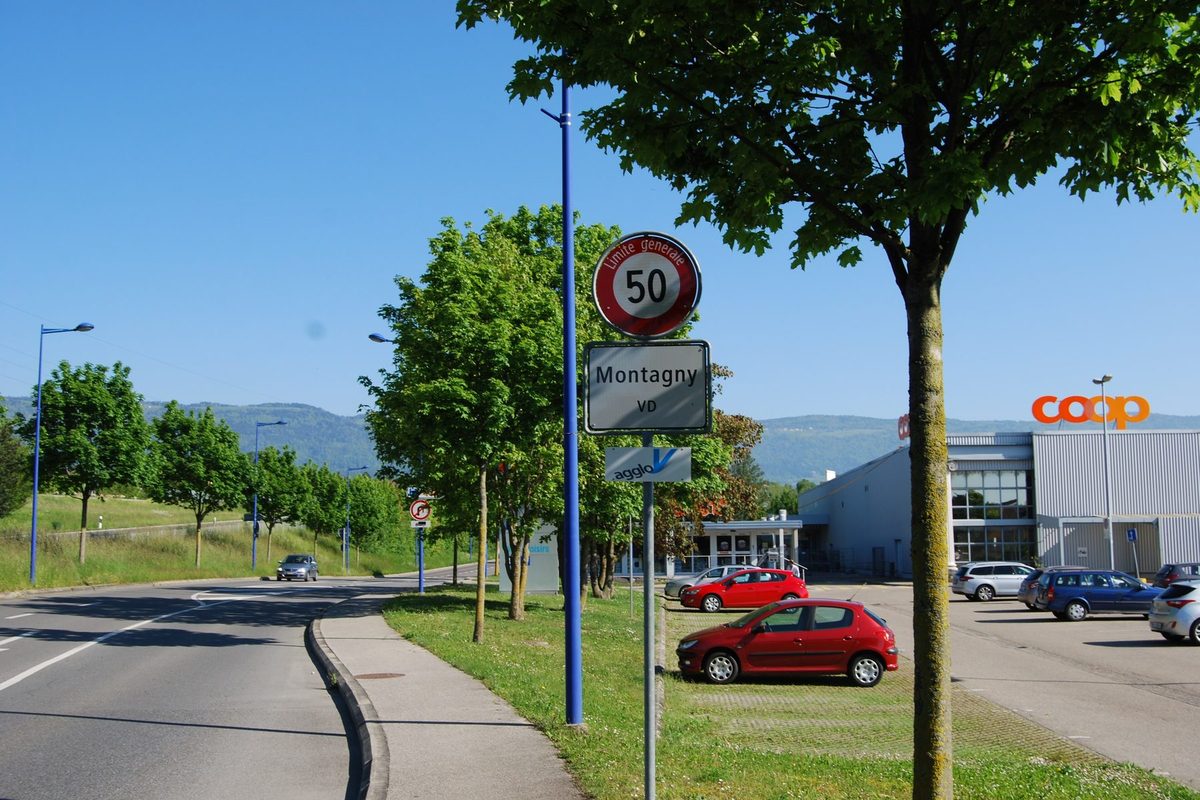
Origin of the name Montagny-près-Yverdon
The village appears in 995/996 in the form «in villa Montaniaco», then in 1397 «Montaigny-le-Courbe». It also bore the name Montagny-le-Corbe. The name is said to come from «Montaniacum», the estate (suffix «-acum») of a Roman named Montanius.[1]
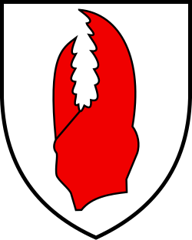
Coat of arms of Montagny-près-Yverdon
Argent, a crayfish claw gules palewise. On a white field stands a red crayfish claw, upright. These arms appear on a municipal seal from 1733. According to a tradition reported by the FAO, they come from a division with Onnens under the Ancien Régime, Onnens receiving the crayfish without the claw that Montagny kept.[8][2]
Founding of Montagny-près-Yverdon
Who founded the village is not known, but the site has been occupied since prehistoric times: a Neolithic station and a cup-marked stone are known there. A path that may be Roman crossed it. In the Middle Ages Montagny was the centre of a large lordship, whose castle was held by the lords of Montfaucon (Montfalcon), then by the house of Châlons. After the castle's destruction, the lordship was incorporated into the bailiwick of Grandson. The municipal territory stretches from the hill overlooking the Brinaz to the Orbe plain. The inhabitants are nicknamed «lè fouetta-corbé», the crow-whippers.[1][2][5]
History of Montagny-près-Yverdon
Neolithic. Neolithic station; a cup-marked stone weighing over a tonne lies in the Les Planches wood.[1][2][5]
Antiquity. The site is crossed by a path possibly of Roman origin.[1]
995/996. First mention, «in villa Montaniaco».[1]
11th century. Construction of Montagny castle, centre of a large lordship.[1]
1397. Mentioned in the form «Montaigny-le-Courbe».[1]
1416. The village has 36 hearths. First mention of the parish church of Saint-Julien.[1]
1475. During the Burgundian Wars the castle is destroyed by the Confederates. The lordship is then incorporated into the bailiwick of Grandson.[1][2][5]
1532. The parish of Montagny adopts the Reformation; date uncertain.
1733. First known municipal seal bearing the arms «argent, a crayfish claw gules in pale».[2]
1769. Construction of the present Protestant church, replacing the church of Saint-Julien.[1][2]
1798. Montagny joins the district of Yverdon, to which it belongs until 2006.[1]
1981. Opening of the A1 motorway near the En Chamard area.[1]
1984. Opening of the A5 motorway. Since the 1980s, strong commercial and industrial development in the En Chamard area.[1]
2008. Montagny becomes part of the Jura-Nord vaudois district.
Population of Montagny-près-Yverdon
Sources and references: [1][3]
| 1416 | 36 hearths (households) |
| 1850 | 256 |
| 1900 | 263 |
| 1950 | 337 |
| 2000 | 606 |
| 2025 | 768 |
Families of Montagny-près-Yverdon
Citizen families before 1800. Bourgeois, Decoppet, Jeannin, Pillard, Pilliard, Tétaz and Walther, with no precise date.[9]
In the 19th century. Christin, Cochet, Henny, Hützener and Stebler, with no precise date. The Schaffert family, from Germany, was admitted in 1834, the Servien family, from France, in 1892.[9]
From 1901 to 1962. Nineteen entries. Until 1929 the families came mainly from Germany: Klink and Nock in 1909, Schnapp and Toberer in 1916, Störk in 1921, Kretschmer in 1924, Elikann in 1929. France gave the Buchet (1904), the Bec (1915) and the Lucas-Guilloud (1955), Italy the Berti (1952). The Emery family was admitted in 1933. Swiss families followed: the Klaus of Wangen an der Aare BE, the Zbinden of Guggisberg BE and the Suter of Kölliken AG in 1956, the Crausaz of Villeneuve FR and the Wüthrich of Trub BE in 1957, the Burkhard of Schwarzhäusern BE in 1958. The last to be registered, in 1960, were the de Merey, from Hungary.[9]
Economy of Montagny-près-Yverdon, past and present
From fields to greenhouses. Montagny has changed from a farming and wine-growing municipality into a "rurban" one. On the plain, at the place called Cléettes, very large greenhouses belong to the Ratusse estate, owned by market gardeners from Montagny and one of the largest farms in Switzerland.[2]
The En Chamard retail hub. The En Chamard zone draws customers from all over northern Vaud and the western part of the canton of Neuchâtel, with two large shopping centres, Coop and Migros. Nearly two million people visit this retail and services hub every year. The Le Bey zone has large car dealerships and a furniture store, the Sur le Crêt zone the Pidoux marble works. In November 2025 the municipality had more than 120 registered businesses and about 1'500 jobs.[2]
Historic sites in Montagny-près-Yverdon
Protestant church of Montagny. Church built in 1769 on the hill overlooking the plain. It replaces the parish church of Saint-Julien, mentioned from 1416 and probably linked to the abbey of La Chaise-Dieu. The parish is said to have adopted the Reformation in 1532. The last priest, having married, became pastor at Champvent.[1][2]
En Chamard area. Commercial and industrial area developed since the 1980s near the A1 and A5 motorways.[1]
Remains in Montagny-près-Yverdon
Ruins of Montagny-le-Corbe castle. 11th-century fortress, centre of the lordship of Montagny, held by the lords of Montfaucon and then by the house of Châlons. It was destroyed in 1475 during the Burgundian Wars. A ruined tower is still visible on the heights.[1][2][5]
Cup-marked stone of the Les Planches wood. Neolithic block weighing over a tonne. Moved to decorate a private swimming pool, it was later returned to its original site.[2]
Neolithic station. Traces of prehistoric occupation on the municipal territory.[1]
Protected heritage in Montagny-près-Yverdon
Cultural property of regional significance (B objects)[7]
- Montagny-le-Corbe, ruines du château - Moyen Age
Legends of Montagny-près-Yverdon
The crayfish claw shared with Onnens. The arms of Montagny, a red crayfish claw, are said by tradition to recall an old division with Onnens under the Ancien Régime: Montagny kept the claw, while Onnens bears the mutilated crayfish.[2]
The crow-whippers. The inhabitants' nickname, «lè fouetta-corbé» (the crow-whippers), is said to be linked to the old name of the village, Montagny-le-Corbe.[2]
Traditions and festivals in Montagny-près-Yverdon
The Abbaye festival. Every two years the Société de l'Abbaye militaire holds the Abbaye festival. At major events the municipality serves the wine of honour from its small vineyard.[2]
The Montagny-Baroque concerts. The church hosts the Montagny-Baroque concerts, organised together with those of Grandson.[2]
Sources
- Dictionnaire historique de la Suisse, « Montagny-près-Yverdon »
- Feuille des avis officiels du canton de Vaud, « Alphabet des communes vaudoises : Montagny-près-Yverdon »
- Statistique Vaud, « Population résidante permanente au 31 décembre 2025 »
- Dictionnaire historique de la Suisse, « Montagny (VD, seigneurie) »
- Archeoplus, « Montagny-près-Yverdon (VD) »
- État de Vaud, communiqué du 12.07.2007, « Organisation des préfectures et adaptation au nouveau découpage territorial »
- Federal Office for Civil Protection (FOCP), Swiss Inventory of Cultural Property (PCP), list for the canton of Vaud (as of 1.1.2026)
- IPI, Swissreg, emblems database: coat of arms of Montagny-près-Yverdon (no. 101466)
- Register of Swiss Surnames, 3rd edition (1989), search Commune "Montagny-près-Yverdon", Canton VD
Published by Sébastien Jörg ·
Localities of the municipality with a page
Other villages near Montagny-près-Yverdon
Missing information, or do you have a source? Suggest a correction or addition. Every submission is checked before it's published.
Suggest a change