Cheseaux-Noréaz
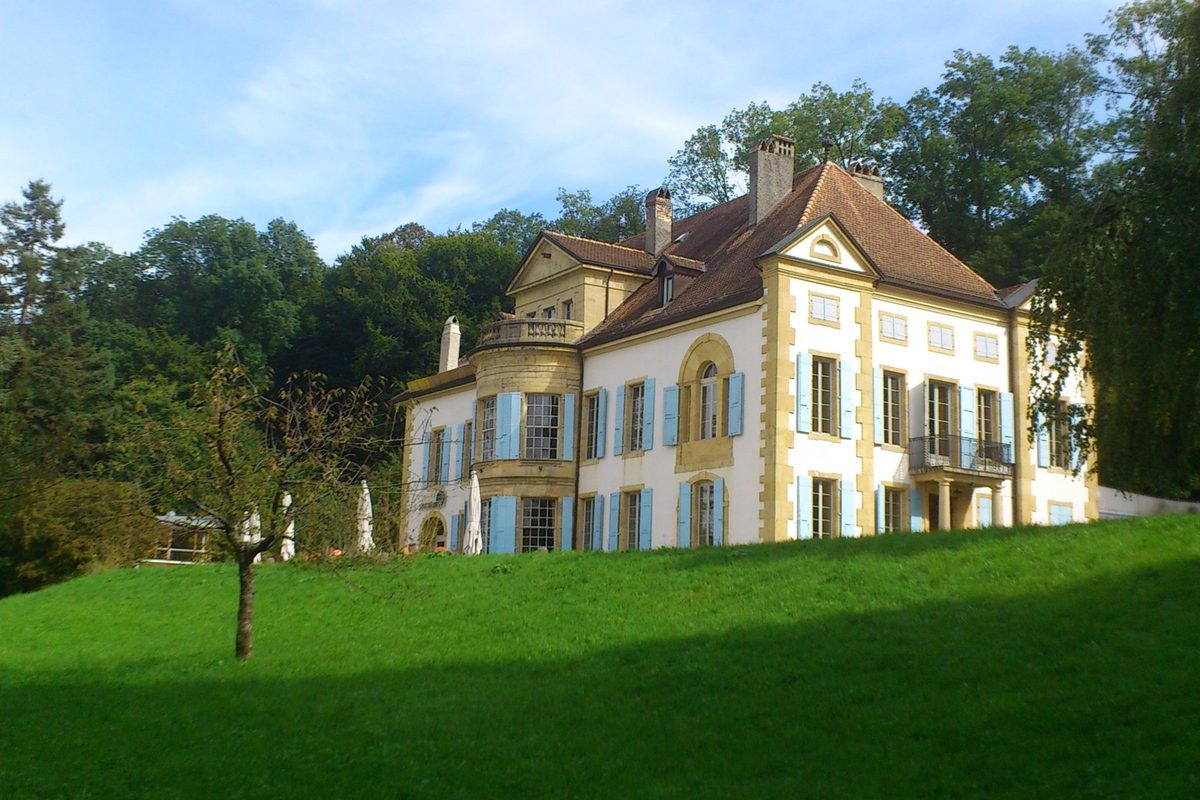
The Château de Champ-Pittet, built in 1789-1791 for François-Louis-Frédéric Haldimand, has housed the French-speaking Swiss headquarters of Pro Natura since 1991, next to 40 hectares of protected marshland.
Entry based on 7 sources · Our method · Reusable text (CC BY-SA)
Origin of the name Cheseaux-Noréaz
The two places are mentioned in 1174 in the form «Chesaut» (Cheseaux) and in 1177 in the form «Nobraia» (Noréaz). The municipal coat of arms, a so-called canting one, links «cheseau» to the ground of a house and «Noréaz» to a place planted with walnut trees. The double name recalls the 1798 merger.[1][2]
Coat of arms of Cheseaux-Noréaz
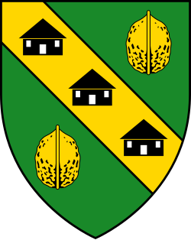
Vert, on a bend Or three small houses sable palewise, between two walnuts Or. On a green field, a yellow band runs from upper left to lower right. It carries three small black houses, standing upright. Two yellow walnuts flank it, one on each side. Adopted in 1928, the arms play on the name of the commune, which joins two former hamlets. Cheseaux once meant the ground of a house, Noréaz a place planted with walnut trees.[6][2]
Founding of Cheseaux-Noréaz
In the Middle Ages Cheseaux and Noréaz are granges, that is, farming estates, dependent on the priory of Val-de-Travers and the lordship of Belmont. In 1235 they are given to the Cistercian abbey of Montheron, which already collects tithes there. Both villages have always belonged to the parish of Yverdon. They became a single municipality only in 1798, by merging. The inhabitants are nicknamed the «Mange-Fruits». Who founded the two hamlets is not known.[1][2]
History of Cheseaux-Noréaz
1174. First mention of Cheseaux, «Chesaut».[1]
1177. First mention of Noréaz, «Nobraia».[1]
1186. The abbey of Montheron holds tithe rights in Cheseaux and Noréaz.[1]
1235. The granges of Cheseaux and Noréaz, until then linked to the priory of Val-de-Travers and the lordship of Belmont, are given to the abbey of Montheron.[1]
1536. With the Reformation the rights of the abbey of Montheron pass to the city of Lausanne. Under Bernese rule both hamlets come under the bailiwick and castellany of Yverdon.
17th century. Lausanne cedes its rights over Cheseaux to Bern but keeps those over Noréaz until 1798.[1]
1764. Cheseaux comprises only three estates. Noréaz refuses to form a municipality, that year or in 1765 (date uncertain).[1]
1789-1791. François-Louis-Frédéric Haldimand has the Château de Champ-Pittet built.[1]
1789-1799. The municipality of Cheseaux is placed under administration.[1][2]
1798. Merger of Cheseaux and Noréaz into a single municipality, part of the district of Yverdon until 2007.[1][2]
from 1960. Villa districts develop; the municipality becomes a residential district of Yverdon-les-Bains (zoning plans of 1961, 1966, 1973 and 1984).[1]
1975. Opening of the CESSNOV (Centre d'enseignement secondaire supérieur du Nord vaudois), today an upper secondary school with more than a thousand students.[1]
1984. Renovation of the Château de Champ-Pittet.[1]
1991. The Château de Champ-Pittet becomes the French-speaking Swiss headquarters of Pro Natura.[1]
2008. Cheseaux-Noréaz becomes part of the district of Jura-Nord vaudois.
Population of Cheseaux-Noréaz
Sources and references: [1][3]
| 1764 | 79 (26 in Cheseaux, 53 in Noréaz) |
| 1798 | 108 |
| 1850 | 156 |
| 1870 | 126 |
| 1900 | 132 |
| 1950 | 104 |
| 1960 | 98 |
| 1980 | 339 |
| 2000 | 528 |
| 2025 | 745 |
Families of Cheseaux-Noréaz
Citizen families before 1800. Glardon and Guldi, without a precise date.[7]
In the 19th century. The Collet family (from Suchy VD), the Gasser family (from Belp BE), the Volper family (from Austria) and the Wolper family (from Austria), without a precise date. Then the Trachsel family (from Wattenwil BE) obtains citizenship in 1803, the Petitpierre family (from Neuchâtel NE) in 1840, the Tanner family (from Lützelflüh BE) in 1841 and the Rodt family in 1889.[7]
From 1901 to 1962. The Nowak family comes from Poland (1957). From Switzerland come the Hofer family from Nennigkofen SO (1956), the Christen family from Affoltern im Emmental BE (1957) and the Schwander family from Aarberg BE (1957). They are joined by the Steiner family (1958).[7]
Economy of Cheseaux-Noréaz, past and present
Orchards, poultry and cows. Several families live from the land. The Hofers run a poultry farm and make pasta from the eggs of their free-range hens, alongside their fruit. The Müller and Schwander families grow cherry, apple and apricot trees and sell at the farm or at regional markets. At the Christens', Simmental dairy cows often win prizes at shows. Forest covers 384 hectares, 15 of which belong to the commune.[2]
The campsite and the lake. On the lakeshore, the VD8 campsite has 650 pitches and hosts about 2'600 holidaymakers in summer. The Châble-Perron estate has 34 holiday chalets. The commune has three restaurants, including a starred one, La Table de Mary.[2]
Historic sites in Cheseaux-Noréaz
Château de Champ-Pittet. Residence built between 1789 and 1791 for François-Louis-Frédéric Haldimand. Renovated in 1984, it has housed since 1991 the French-speaking Swiss headquarters of Pro Natura, at the centre of a 40-hectare protected area of marshes and reed beds. The Campagne de Champ-Pittet is a cultural property of national significance.[1][4]
Marshes and reed beds of the south-east lakeshore. Protected area of 40 hectares which is part of the Grande Cariçaie, the largest lakeshore marsh in Switzerland.[2]
Noréaz. Rights over this hamlet remained with the city of Lausanne until 1798. Noréaz refused to form a municipality, in 1764 or 1765, before being united with Cheseaux in 1798.[1][2]
Gymnase d'Yverdon (former CESSNOV). Upper secondary school opened in 1975 on municipal land, attended by more than a thousand students from northern Vaud.[1]
Protected heritage in Cheseaux-Noréaz
Cultural property of national significance (A objects in the PCP inventory)[5]
- Campagne de Champ-Pittet, château de Champ-Pittet avec fontaine datée 1878 et deux bûchers
Cultural property of regional significance (B objects)[5]
- Champittet, stations lacustres de l'Age du Bronze
- Châble-Perron, stations lacustres néolithiques
Sources
- Dictionnaire historique de la Suisse, « Cheseaux-Noréaz »
- Feuille des avis officiels du canton de Vaud, « Alphabet des communes vaudoises : Cheseaux-Noréaz »
- Statistique Vaud, « Population résidante permanente au 31 décembre 2025 »
- Inventaire suisse des biens culturels d'importance nationale et régionale (PBC), liste du canton de Vaud, état au 1.1.2026
- Federal Office for Civil Protection (FOCP), Swiss Inventory of Cultural Property (PCP), list for the canton of Vaud (as of 1.1.2026)
- IPI, Swissreg, emblems database: coat of arms of Cheseaux-Noréaz (no. 102054)
- Register of Swiss Surnames, 3rd edition (1989), search Commune "Cheseaux-Noréaz", Canton VD
Published by Sébastien Jörg ·
Other villages near Cheseaux-Noréaz
Missing information, or do you have a source? Suggest a correction or addition. Every submission is checked before it's published.
Suggest a change