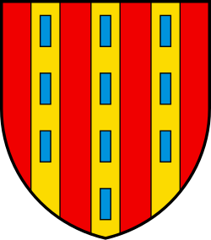
Hermance
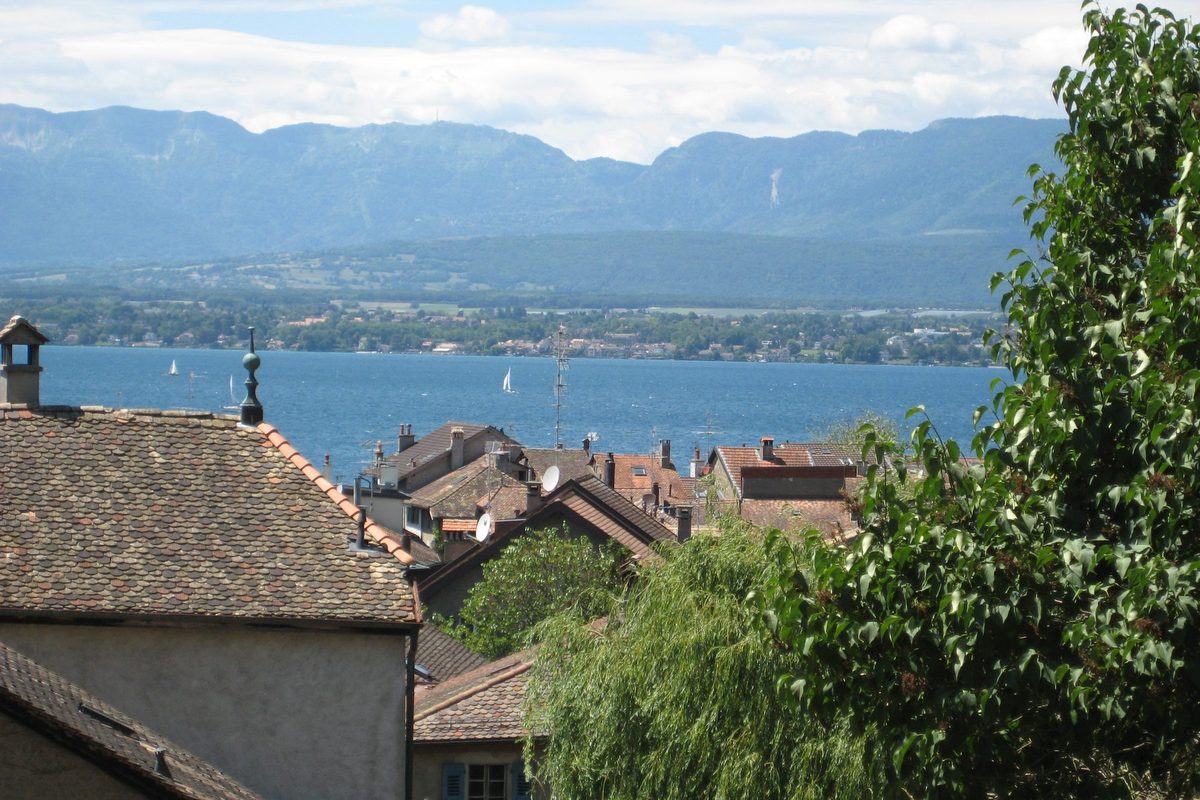
Origin of the name Hermance
The forms « intra Armentia » (1247) and « Eremencia » (1271) are recorded. The origin of the name is not established.[1]
Founding of Hermance
The site has been occupied since the Neolithic: remains of a lakeside settlement, Neolithic graves, a capital and Roman coins, as well as early medieval slab graves have been found there. Around 1100, Hermance was merely a castrum protecting a few fishermen's huts. At the same time the parishes of Cusy and Villars arose not far from each other. In 1247, Aymon II de Faucigny had a castle and a fortified market town built, whose church became the parish church. The parish of Villars then lost importance. The location on the lake, at a river mouth and on the important road to Langin, explains the growth of the new town: it attracted newcomers, to whom the lord of Faucigny granted certain rights (franchises) in 1351. After Faucigny's defeat by Savoy, Hermance surrendered in 1355 and became the seat of a Savoyard castellany. The Treaty of Turin transferred it to the canton of Genève in March 1816.[1]
History of Hermance
around 1100. Hermance is merely a castrum protecting a few fishermen's huts. The neighbouring parishes of Cusy and Villars arise at this time.[1]
1247. Aymon II de Faucigny has a castle and a fortified market town built. The church of the new town becomes the parish church and the parish of Villars loses importance. The name appears in the form « intra Armentia ».[1]
1271. Mention of the name in the form « Eremencia ».[1]
1351. The lord of Faucigny grants certain rights (franchises) to the newcomers attracted by the town's favourable location.[1]
1355. After Faucigny's defeat by Savoy, Hermance surrenders and becomes the seat of a Savoyard castellany.[1]
1373. Foundation of a hospital (hospice).[1]
1536. Bern and its French allies enter the Chablais. The Savoyard villages must adopt the Reformation and the Church of Genève appoints a pastor for Hermance.[1]
1542. The hospital is rebuilt and the school enlarged.[1]
1589. In spring the town is looted by the army of Nicolas Harlay de Sancy. On 4 August the Bernese troops of Johann von Wattenwyl defeat the local lord, François-Melchior de Saint-Jeoire. The town wall and the castle are razed, except for the tower.[1]
1598. The Peace of Vervins (May) restores peace; Catholic worship is reinstated.[1]
around 1680. The damaged church is finally rebuilt.[1]
around 1740. Closure of the hospital.[1]
1743-1748. Like the whole Chablais, Hermance suffers the Spanish occupation.[1]
1816. In March the Treaty of Turin transfers Hermance to the canton of Genève. Less than half of its surrounding land remains Sardinian.[1]
1851. Construction of the lakeside road, the quay and the landing stage begins.[1]
1873. Steamboats call regularly at the harbour.[1]
1902. A tram line links Hermance with Genève. It is replaced by a bus service in 1958.[1]
1992. The Maison Boujon on the Rue du Nord, dating from the 13th century, is listed as a historic monument.[2]
Population of Hermance
Sources and references: [1][5]
| 1444 | 80 hearths (households), about 400 inhabitants |
| 1801 | 307 |
| 1850 | 498 |
| 1900 | 362 |
| 1950 | 400 |
| 1980 | 594 |
| 2000 | 816 |
| 2025 | 1'236 |
Historic sites in Hermance
Medieval town. Fortified market town founded in 1247 by Aymon II de Faucigny on the lakeshore, at a river mouth and on the road to Langin. Its wall, razed in 1589, has left some sections of wall, preserved together with the tower.[1][3][4]
Tower of Hermance. The only element spared in 1589 when the wall and the castle of Aymon de Faucigny were razed. A round tower standing on a steep mound above the Bourg-dessous: this circular molasse keep was added to the castle in 1337-1338 by the master builder Mermet de Jonzier, known as Rosset. Listed as a historic monument in 1921.[1][3]
Church. Church of the new town, which became the parish church in 1247, damaged in the wars of the late 16th century and rebuilt around 1680. Dedicated to Saint George, it is a cultural property of regional importance (federal PCP inventory).[1][4]
Maison Boujon. House on the Rue du Nord whose construction dates back to the 13th century, to the origins of the town. Partly rebuilt after a fire in the 15th century, raised in the 19th century, entered in the inventory in 1979 and listed in 1992.[2]
Harbour and quay. Quay and landing stage built from 1851 onwards. Steamboats call regularly at the harbour from 1873.[1]
Remains in Hermance
Lakeside settlement and ancient graves. Remains of a lakeside settlement, Neolithic graves, a capital and coins from the Roman period, early medieval slab graves.[1]
Tower of the former castle. Tower of the castle of Aymon de Faucigny, the only part preserved after the demolition of 1589. Around 1895 it served as a vantage point to photograph the lower part of the town.[1]
Sources
- Dictionnaire historique de la Suisse, « Hermance » (Anne-Marie Piuz), version de 1998 remaniée le 09.04.2008 (version allemande lue)
- Office du patrimoine et des sites (Genève), recensement architectural, « Maison Boujon », rue du Nord 13, Hermance (fiche 2011-27057 ; inscription à l'inventaire 15.6.1979, classement 1.7.1992)
- Office du patrimoine et des sites (Genève), recensement architectural, « Tour d'Hermance » (fiche 2016-61116, générée le 24.09.2018 ; classement du 30.12.1921)
- Office fédéral de la protection de la population, Inventaire PBC, liste cantonale GE (état au 1.1.2026) : n° 2593, église Saint-Georges, et n° 2594, tour et restes de l'enceinte, objets B
- Office cantonal de la statistique (OCSTAT), Mémento statistique du canton de Genève 2026, tableau Population résidante par commune, en 2025
- geo.admin.ch, service de recherche de swisstopo (coordonnées)
Localities of the municipality with a page
Other villages near Hermance
Missing information, or do you have a source? Suggest a correction or addition. Every submission is checked before it's published.
Suggest a change