Juriens
In 1400 men from the barony of La Sarraz plundered Juriens and drove off 2'000 head of cattle. The monks of Romainmôtier won heavy damages.
Entry based on 7 sources · Our method · Reusable text (CC BY-SA)
Origin of the name Juriens
Juriens appears in 1263 as « iurians », then in its present form « Juriens » in 1359. The name reportedly comes, like that of the Jura, from a Celtic word « jor » meaning a wooded mountain, which became « juria » in Latin.[1]
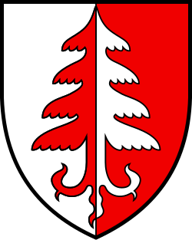
Coat of arms of Juriens
Per pale argent and gules, a fir tree eradicated counterchanged. The shield is divided vertically, white on the left and red on the right. A fir tree with its roots stands in the middle, red on the white half and white on the red half.[6]
Founding of Juriens
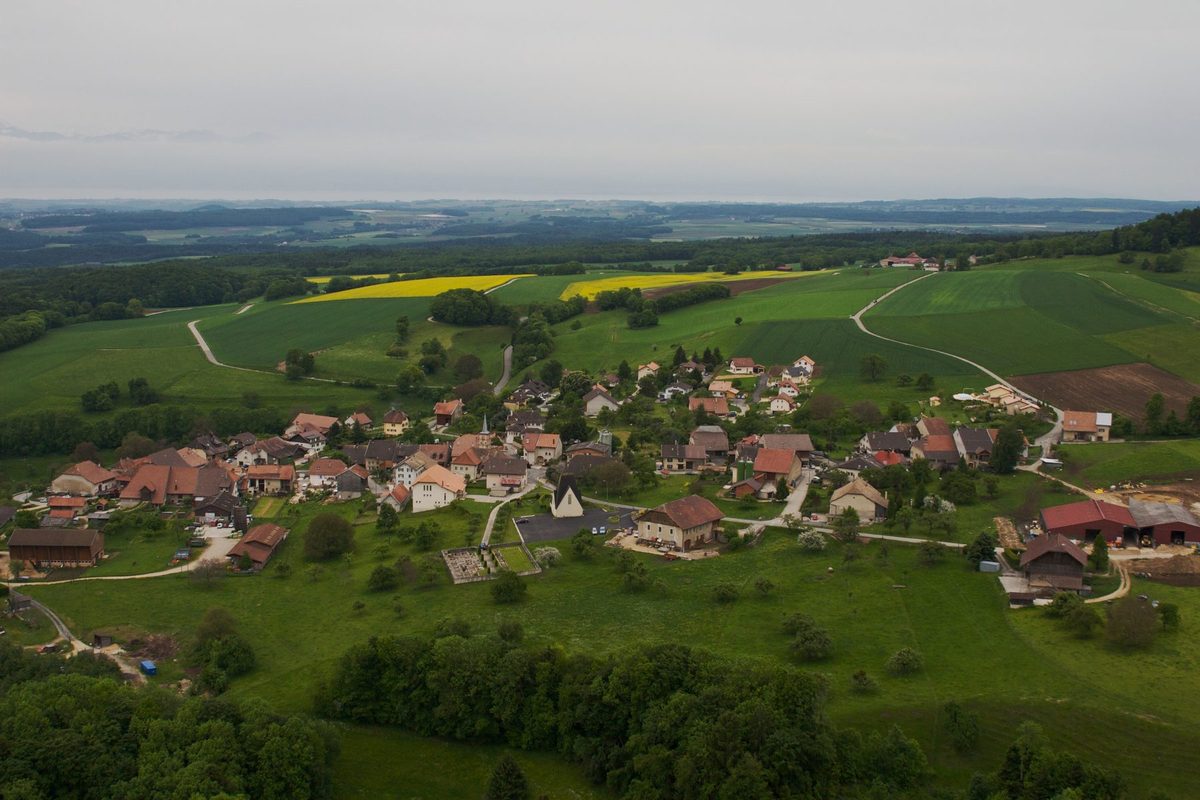
Nobody knows who founded Juriens. The area was frequented long before the Middle Ages: Bronze Age traces are reported, and the locality of Prims Bois has yielded Roman remains linked to the smelting of iron ore, along a trade route towards Geneva and Nantua. The medieval village appears in the 13th century as a possession of the monastery of Romainmôtier, in whose lordship it remained until the Bernese conquest. Originally a street village, Juriens took on a more scattered look as a result of successive fires. The municipality comprises the village and the hamlet of Cosson, on the slopes of the Mollendruz. Activity has always been agricultural. At the end of the 20th century livestock farming predominates.[1][2]
History of Juriens
Bronze Age. Traces of human occupation on the territory of the municipality.[2]
Roman period. Smelting of iron ore at the locality of Prims Bois, where pottery, tiles and heaps of slag remain.
1263. First mention of the village, in the form «iurians». It belongs to the monastery of Romainmôtier.[1]
1316. The inhabitants are already dealing with the parish priest of Romainmôtier. Juriens has always belonged to this parish.[1]
1359. The name appears in its present form, «Juriens».[1]
1400. People from the barony of La Sarraz invade Juriens, plunder the village and carry off 2'000 head of cattle as a pledge. The monks of Romainmôtier lodge a complaint and the attackers are sentenced to heavy damages.[2]
1529. Juriens has 26 hearths, more than Vallorbe (12), Vaulion (20), Arnex (20) or Bretonnières (16). The village prospers in the 16th century, then stagnates.[1][2]
1536. Bernese conquest of the Pays de Vaud: Juriens is incorporated into the castellany and bailiwick of Romainmôtier (until 1798).[1]
1705. The community, until then governed by a general council, has to accept the creation by Bern of a Council of Twelve.[1]
1733-1758. Four fires ravage the village. That of 21 May 1758 destroys fourteen buildings, barns and stables, with their furniture and small livestock.[1][2]
1798. Juriens is attached to the district of Orbe, to which it belongs until 2007.[1]
1811. A fire destroys half of the village.[1]
late 19th century. Lime kilns are brought back into operation near the forests that supply the wood.[2]
1968. A small Reformed chapel is built.[1]
1976. Opening of a care home by the deaconesses of Saint-Loup, taken over in 1988 by the Infirmerie Contesse.[1]
1989. Creation of a land improvement association.[1]
2008. On 1 January the district of Orbe is abolished and Juriens joins the new district of Jura-Nord vaudois.
Population of Juriens
Sources and references: [1][2][3]
| 1529 | 26 hearths (households) |
| 1550 | 30 hearths (households) |
| 1764 | 241 |
| 1850 | 280 |
| 1900 | 281 |
| 1950 | 235 |
| 1980 | 201 |
| 2000 | 237 |
| 2025 | 345 |
Families of Juriens
Burgher families before 1800. Benoit, Carmentrand, Chezeaux, Curtet, Grandjean, Hautier, Luquiens and Sordet.[7]
From 1901 to 1962. Only three families: the Lyon of Plaffeien FR in 1946, then in 1956 the Christen of Wolfenschiessen NW and the Kirchhofer of Arni BE.[7]
Economy of Juriens, past and present
Land and livestock. Juriens has always lived from farming. In 1400 raiders from the barony of La Sarraz drove off 2'000 animals, sheep. By the end of the 20th century livestock farming was the main activity.[1][2]
Iron and lime. At the place called Prims Bois, where iron ore was once smelted, many slag heaps are still visible. In the 19th century the lime kilns were lit again near the woods that supplied the fuel. The stones were fired in them for a week.[2]
Disasters and major events in Juriens
The fires of 1733 to 1811. Four fires ravaged the village between 1733 and 1758. On 21 May 1758, around 11 pm, fire destroyed fourteen buildings. The next day the Romainmôtier fire pump proved unusable. In 1811 another fire destroyed half the village. According to tradition, a lime tree once stopped the burning shingles and saved the village from complete destruction.[1][2]
Historic sites in Juriens
Juriens chapel. Small Reformed chapel built in 1968. The municipality celebrated its 50th anniversary in 2018. Juriens has always belonged to the parish of Romainmôtier.[1]
Village core. Former street village that became more scattered after the fires of the 18th and 19th centuries, surrounded by springs.[2]
Remains in Juriens
Roman ironworking site of Prims Bois. At the locality of Prims Bois, pottery, tiles and heaps of slag show the smelting of iron ore in Roman times, along a trade route to Geneva and Nantua.
Sources
- Guy Le Comte, « Juriens », Dictionnaire historique de la Suisse, version du 19.02.2009
- Commune de Juriens, « Histoire »
- Statistique Vaud, « Population résidante permanente au 31 décembre 2025 »
- Feuille des avis officiels du canton de Vaud, « Alphabet des communes vaudoises : Juriens »
- État de Vaud, communiqué du 12.07.2007, « Organisation des préfectures et adaptation au nouveau découpage territorial »
- IPI, Swissreg, emblems database: coat of arms of Juriens (no. 101265)
- Register of Swiss Surnames, 3rd edition (1989), search Commune "Juriens", Canton VD
Published by Sébastien Jörg ·
Other villages near Juriens
Missing information, or do you have a source? Suggest a correction or addition. Every submission is checked before it's published.
Suggest a change