Romainmôtier
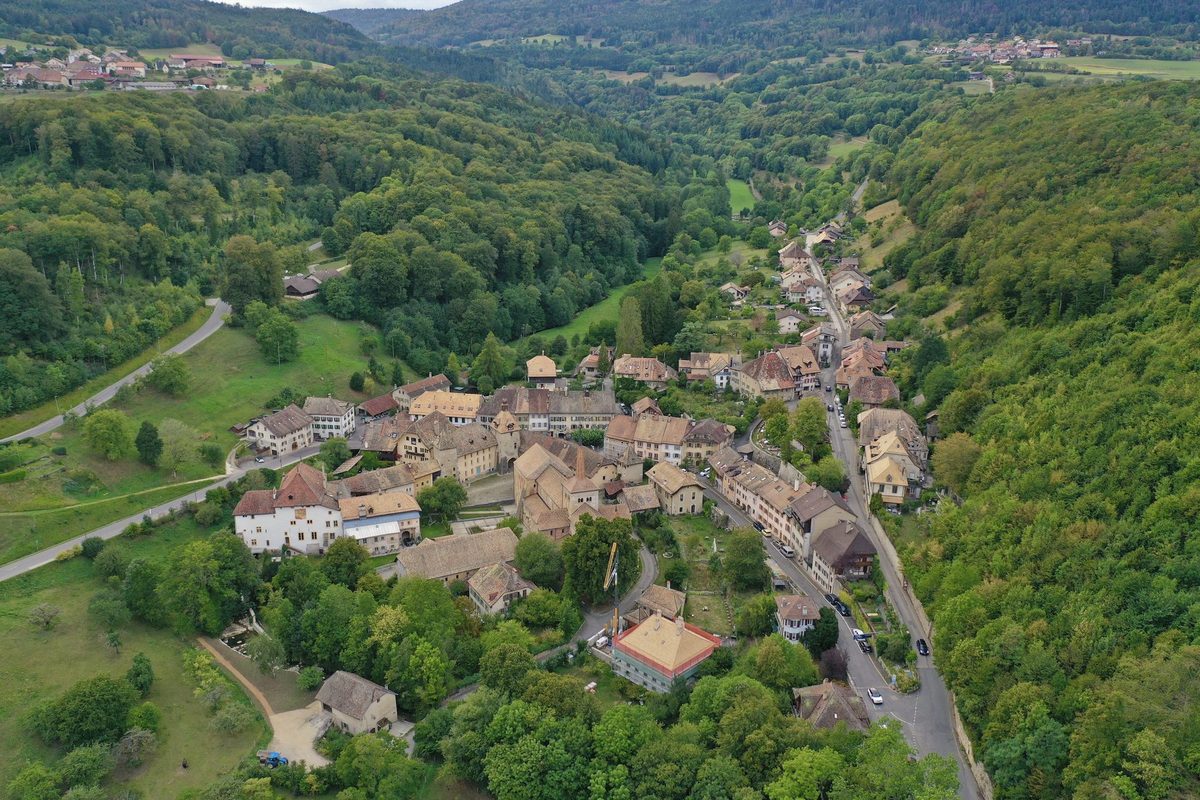
Born around a monastery that tradition traces to Saint Romanus around 450, the village saw nearly eleven centuries of monastic life end with the death of the last prior in 1537.
Entry based on 12 sources · Our method · Reusable text (CC BY-SA)
Origin of the name Romainmôtier
The name comes from the Latin Romanum monasterium, « monastery of [Saint] Romanus », after the founding monk of the abbey. Charters record it from the 7th-8th century, in phrases such as « monasterio qui [...] cognominatur Romanus » or « Romanis monasterium » (mid-8th century). The name then evolved into the current French form « Romainmôtier ».[4]
Coat of arms of Romainmôtier
Per pale, argent a key palewise gules, and gules a sword erect argent. These are the arms of the municipality of Romainmôtier-Envy, formed in 1970 by the merger of Romainmôtier and Envy. The shield is divided vertically. On the left, a red key stands upright on white. On the right, a white sword, point upwards, on red.[11]
Founding of Romainmôtier
The village has no founding charter: it grew up little by little around a monastery. According to tradition, Saint Romanus founded it around 450 on the bank of the Nozon, within the diocese of Aventicum. A monk from the Izernore region, in the French Jura, he had founded the monasteries of Condat, Lauconne and La Balme with his brother Saint Lupicinus. The excavations of 1905 to 1915 uncovered traces of an early 5th-century church: they fit this tradition but do not prove it, and the point is still to be confirmed. The village community appeared much later. In 1266 the inhabitants obtained franchises under the authority of the priory. In 1387 the prior allowed them to organise as a commune and elect two governors.[4][5][6]
History of Romainmôtier
around 450. According to tradition, foundation of the first monastery by Saint Romanus (Saint Romanus of Condat), on the bank of the Nozon. Excavations of 1905-1915 revealed the remains of a church from the early 5th century, consistent with this date.[4][5]
around 610. The monastery is said to have been destroyed during the Alemannic invasions.[4]
around 630-642. Restoration of the monastery by the Burgundian duke Chramnelenus, who introduces the rule of Saint Columbanus there. Monastic life is already flourishing there in 649. Saint Wandrille, future founder of the abbey of Fontenelle, is said to have resided there around 636-646.[4][5]
753. According to tradition, Pope Stephen II, on his way to crown Pepin the Short, stops at Romainmôtier in December and consecrates the churches dedicated to Saint Peter and Saint Paul.[4]
888. King Rudolf I of Burgundy grants the monastery to a relative of his family, the princess (or countess) Adelaide.[4]
928 (14 June). Adelaide grants the monastery to the abbey of Cluny, which thus becomes the seventh monastery to join the Cluniac order. This first grant, however, does not immediately lead to effective integration.[4][5]
966-990. King Conrad of Burgundy definitively renounces his rights over Romainmôtier and hands it over to Abbot Maiolus of Cluny, marking the effective and lasting attachment to the Cluniac order.
late 10th c. - around 1030. Construction of the present Romanesque abbey church on the model of the second church of Cluny (« Cluny II »), under the successive direction of the great Cluniac abbots Maiolus, Odilo and then Hugh, who personally direct the priory.[5]
12th century. Addition of a two-level narthex (initially fitted with two western towers) and then of a cloister to the south of the church.[5]
late 12th century. Two successive fires reportedly ravage the site. Major rebuilding follows, notably the vaulting of the nave and cloister.
13th century. Addition of a porch and a rectangular Gothic choir (continued in the 14th century).[5]
1266. The inhabitants of the place obtain franchises, under the dependence of the priory: first signs of a civil organization distinct from the monastery.
1323. Louis II of Savoy-Vaud grants the locality an annual fair, abolished in 1901.
1387. The prior authorizes the communal organization of the village, with the election of two governors.
late 14th - mid-15th century. Three great priors enrich the church with funerary monuments and ornaments, before the priory falls into commendam under the House of Savoy and declines as the Reformation approaches.[5]
1498. Construction of the first communal house.
22 March 1536. Bernese conquest of the Pays de Vaud. The Protestant Reformation is imposed, marking the end of Cluniac communal life.[4]
3 January 1537. Death of the last prior, Théodule de Riddes, ending nearly eleven centuries of monastic life on the site.[4]
27 January 1537. Official secularization of the priory by the Bernese authorities. The abbey church is converted into a Protestant church, and the cloister begins to be dismantled.
21 June 1537. Official creation of the Bernese bailiwick of Romainmôtier, whose seat becomes the former prior's house (« Romainmôtier château »).
1539. Establishment of a council of twelve members to administer the locality.
1549. Destruction of the old parish church (distinct from the abbey church).
1581 or 1589. Romainmôtier receives the title of town in 1581, or perhaps in 1589.
1566 and 1598. The bailiwick of Romainmôtier successively expands with the possessions of the abbey of Lac de Joux (1566) and then the barony of La Sarraz (1598).
1798. Fall of the Ancien Régime: the bailiwick of Romainmôtier, which had 11'366 inhabitants, is broken up among the new districts of Orbe, Cossonay, La Vallée, Aubonne and Rolle. The village of Romainmôtier is attached to the district of Orbe.
1803. The canton of Vaud becomes owner of the monastic ruins.
1835-1878. Development of local industrial activities: brickworks, mechanical workshops, pump factory.
1870. Opening of the Croy-Romainmôtier railway station.
1899-1915. First major restoration campaign of the abbey church, led by the archaeologist Albert Naef, accompanied by excavations confirming the existence of a 5th-century church beneath the Romanesque building.
1900-1929. Conversion of the old mill into a file factory, the origin of the company Maillefer SA.
1952. Celebration of the 1500th anniversary of the traditional founding of the monastery.[4]
1970. The commune of Romainmôtier merges with that of Envy to form the new commune of Romainmôtier-Envy, ending its autonomous political existence.
1972. Installation of a four-manual organ in the abbey church.[4]
1991-2001. Second major restoration campaign of the abbey church, accompanied by extensive archaeological excavations.
2008. New division of the Vaud districts in force on 1 January 2008: Romainmôtier-Envy joins the district of Jura-Nord vaudois, which replaces the former district of Orbe.
2017. The commune of Romainmôtier-Envy reportedly joins the association « The most beautiful villages of Switzerland ».
Population of Romainmôtier
Sources and references: [9]
| 1764 | 64 hearths (households), village of Romainmôtier alone |
| 1798 | 61 (Envy alone, for comparison); the entire bailiwick had 11'366 inhabitants |
| 1803 | 267, village of Romainmôtier alone |
| 1850 | 344, village of Romainmôtier alone |
| 1900 | 392, village of Romainmôtier alone (480 counting Envy, i.e. 392+88) |
| 1950 | 337, village of Romainmôtier alone |
| 1960 | 286, village of Romainmôtier alone (331 counting Envy, i.e. 286+45; last census before the 1970 merger) |
| 1980 | 342, merged commune of Romainmôtier-Envy |
| 2025 | 579, commune of Romainmôtier-Envy (31 December) |
Families of Romainmôtier
Burgher families before 1800. Bonard, Bonnard, Chantrens, Chevalier and Glayre appear with no precise date, as do the Perreaud, from L'Abbaye VD. The Buxcel were received in 1598, the Reignier from Zofingen AG in 1768 and the Courvoisier from Mont-la-Ville VD in 1780.[12]
In the 19th century. Two entries: the de Lerber, from Bern BE, in 1809, and the Boulaz from Premier VD in 1817.[12]
From 1901 to 1962. Four entries: the Anatra, from Italy, in 1955, the Herren from Oberbalm BE and the Zahnd from Guggisberg BE in 1956, then the Koller from Häggenschwil SG in 1959.[12]
Notable people of Romainmôtier
Henri de Sévery. Prior of Romainmôtier from 1371 to 1379. Of the fifty-three priors who succeeded one another until the Reformation, he is one of the three great names that stand out.[4]
Jean de Seyssel. He headed the priory from 1380 to 1432 and is likewise counted among its three great priors.[4]
Jean de Juys. The third great name of the priory, he was its prior from 1433 to 1447.[4]
Economy of Romainmôtier, past and present
Tourism. Romainmôtier lies on three of the Council of Europe's 33 cultural routes, including the Via Francigena. In 2018 the authorities intended to use this to develop tourism, without bringing coachloads of visitors into the village's narrow streets. The car park is designed for 150 cars at most.[7]
Historic sites in Romainmôtier
Romainmôtier Abbey Church. Romanesque abbey church built between the late 10th and the first third of the 11th century on the model of the second church of Cluny, considered one of the two finest Romanesque buildings in Switzerland alongside the abbey church of Payerne. It comprises an 11th-century nave vaulted in the 13th century (with wall paintings), a two-level 12th-century narthex, a 13th-century porch and a rectangular Gothic choir from the 13th-14th centuries. Converted into a Protestant church after the secularization of 1537, it is today a Reformed place of worship and a major cultural site, listed as a Swiss cultural property of national importance.[5][7]
Prior's House (Maison du Prieur). 13th-century building that once hosted the abbey's distinguished guests, considered one of the last great monastic palaces of this type preserved in Europe. It now houses a café-restaurant and a cultural venue.[5]
Romainmôtier Château (former seat of the bailiwick). The former prior's house became the seat of the Bernese bailiwick of Romainmôtier in 1537. The building retains elements from the 13th-17th centuries. It was reportedly restored around 1970.[7]
Cloister Court, Porter's House and Tithe Barn. Group of medieval buildings surrounding the former cloister court: the Porter's House today serves as a reception and exhibition centre on the history of the abbey and the Nozon valley, while the Tithe Barn regularly hosts exhibitions related to local heritage.
Remains in Romainmôtier
Foundations of the 5th-7th century churches. The archaeological excavations carried out in 1905-1915 and then in 1991-2001 uncovered, beneath the present Romanesque abbey church, the foundations of several earlier religious buildings, including a church from the early 5th century, confirming continuous religious occupation of the site for nearly eleven centuries.
Remains of the Gothic cloister. The medieval cloister and part of the adjoining monastic buildings were gradually destroyed after the secularization of 1537. Elements of the Gothic cloister nonetheless survive to the south of the abbey church, alongside other claustral buildings.
Protected heritage in Romainmôtier
Cultural property of national significance (A objects in the PCP inventory)[10]
- Périmètre de l'ancienne abbaye clunisienne avec abbatiale réformée, maison des moines, maison Reymond, dépôt, maison du Prieur, maison de la Dîme, maison de la poterie, deux ruraux, cure, petite cure, poulailler, tour Saint- Georges, tour de l'horloge, tour d'enceinte des martyrs, centre paroissial et culturel, maison d'habitation au sud de la tour Saint-Georges, salle de paroisse et bûcher, dépendance, maison d'habitation et deux fontaines
Cultural property of regional significance (B objects)[10]
- Maison du Lieutenant Baillival
- Maison Glayre de Lerber
- Romainmôtier, périmètre de l'ancienne abbaye clunisienne
Legends of Romainmôtier
No clearly documented local legend. Despite its monastic past, Romainmôtier has no known folk legend of its own, no hidden treasure, underground passage or apparition. The only traditional accounts concern semi-legendary episodes already part of the site's history, such as the founding by Saint Romanus or the visit of Pope Stephen II in 753, which belong to tradition rather than to established fact.
Traditions and festivals in Romainmôtier
The ecumenical community. Since the spring of 1973 a small ecumenical community has lived in Romainmôtier, with the agreement of the bishop and of the authorities of the Reformed Church of Vaud. It brings together deaconesses of Saint-Loup and sisters of the Congregation of the Sacred Hearts, prays three times a day in the church and welcomes the many visitors to the abbey church.[4]
Sources
- Dictionnaire historique de la Suisse - « Romainmôtier (village) »
- Dictionnaire historique de la Suisse - « Romainmôtier (prieuré) »
- Dictionnaire historique de la Suisse - « Romainmôtier (seigneurie, bailliage) »
- Site officiel de la commune de Romainmôtier-Envy - historique
- Clunypedia - Prieuré Saint-Pierre de Romainmôtier
- Société académique vaudoise, Bibliothèque historique vaudoise - « Romainmôtier : Histoire de l'abbaye »
- SWI swissinfo.ch - « Romainmôtier, perle médiévale au pied du Jura »
- loisirs.ch - « Romainmôtier : découvrez la cité médiévale et son abbatiale »
- Statistique Vaud, « Population résidante permanente au 31 décembre 2025 »
- Federal Office for Civil Protection (FOCP), Swiss Inventory of Cultural Property (PCP), list for the canton of Vaud (as of 1.1.2026)
- IPI, Swissreg, emblems database: coat of arms of Romainmôtier-Envy (no. 101300)
- Register of Swiss Surnames, 3rd edition (1989), search Commune "Romainmôtier", Canton VD
Published by Sébastien Jörg ·
Other villages near Romainmôtier
Missing information, or do you have a source? Suggest a correction or addition. Every submission is checked before it's published.
Suggest a change