Premier
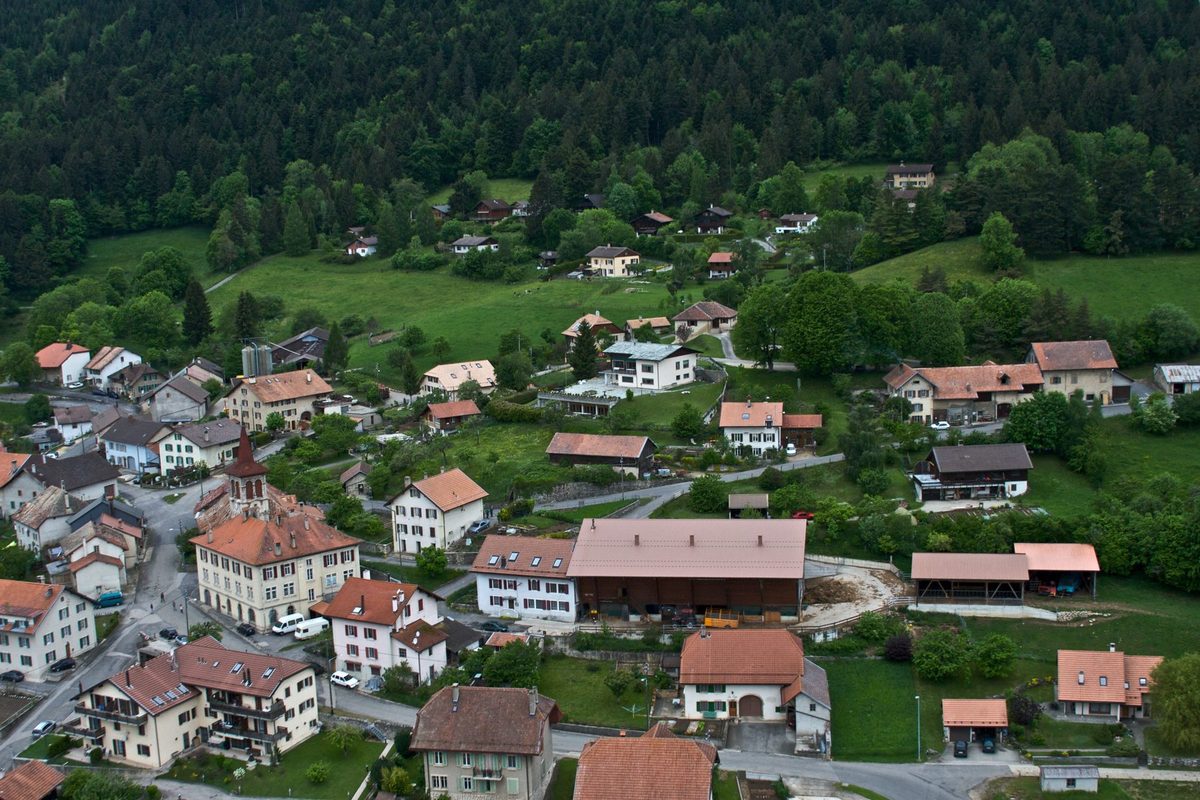
Staging-post village at the foot of the Jura between Romainmôtier and Vaulion, former land of the convent of Romainmôtier, rebuilt after the fires of the late 19th century.
Entry based on 7 sources · Our method · Reusable text (CC BY-SA)
Origin of the name Premier
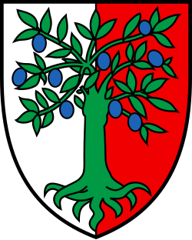
First established mention in 1403 in the form «Prumyer». The form «Prumier» also appears in the documents. According to the municipality, the name comes from the patois «premi», meaning plum tree, hence the plum tree in the coat of arms.[1][2]
Coat of arms of Premier
Per pale argent and gules, a plum tree vert eradicated and fructed proper overall. The shield is divided vertically, white on the left and red on the right. A green uprooted plum tree, bearing plums in their natural colour, stands over both halves. The plum tree recalls the origin of the name, from the patois word "premi", meaning plum tree.[5][2]
Founding of Premier
Premier lies on the slope of the Jura, halfway between Romainmôtier and Vaulion, between the valleys of the Orbe and the Nozon. Attested from the 14th century, the place had belonged since the Middle Ages to the lordship of the convent of Romainmôtier. According to local tradition, the village itself was founded in the mid-16th century by a few families, the Candaux, Cochet, Poget, Roy, Boulaz and Magnenat, who settled about two kilometres above the abbey. This late date fits poorly with the 14th-century mentions and with the 15 hearths recorded in 1396. Between Premier and Romainmôtier there then stood the old village of Lanfrey, on the road to Vaulion, abandoned in the 15th century. Located on the road from Orbe to the Vallée de Joux, Premier served as a staging post for carters. It lived from farming, on land that was sometimes poor and stony, and from crafts (blacksmiths, weavers, shoemakers, carpenters).[1][2]
History of Premier
14th century. The hamlet of Lanfrey exists between Premier and Romainmôtier, on the road to Vaulion.[1]
1316. The community reaches an agreement with the parish priest. Premier belongs to the lordship of Romainmôtier.[1]
1396. Premier has 15 hearths.[1]
1403. Mention of the place in the form «Prumyer».[1]
1405. Only one inhabitant remains in Lanfrey, Aymonod de Lanfrey. The hamlet disappears in the course of the 15th century.[2]
1536. Bernese conquest of Vaud: Premier is incorporated into the castellany and bailiwick of Romainmôtier.[1]
mid-16th century. According to local tradition, the Candaux, Cochet, Poget, Roy, Boulaz and Magnenat families are said to have founded the village.[2]
18th century. Under Bernese rule, the village is run by a Council of inhabitants chaired by the governor.[2]
1798-2007. Premier belongs to the district of Orbe, until the new Vaud districts come into force.
1804. During the demarcation of municipalities after the Vaud revolution, a boundary dispute sets Premier against Vallorbe.[2]
1827. The municipality already regulates the use of water, a scarce resource in the village.[2]
19th century. Premier is a busy staging post for carters between Orbe and the Vallée de Joux, with two inns, a forge, a dairy, a communal oven and many craftsmen.[2]
1884. A fire destroys twelve large buildings.[1][2]
1898. A fire ravages almost half the village. The rebuilding, supported by regional solidarity, gives the village its school, its tower and its cheese dairy.[1][2]
1900. The bell «Confiance» is installed in the tower, bearing the inscription «Dieu est un secours qui ne manque jamais dans la détresse».[2]
1959. A first land improvement cooperative is set up.[1]
1967. Premier is the centre of the «guerre des vaches», in which breeders of Montbéliard cattle oppose the federal administration.[1]
1979. A second land improvement cooperative is set up.[1]
1 January 2008. The new Vaud districts come into force: Premier moves from the district of Orbe to the district of Jura-Nord vaudois.
Population of Premier
Sources and references: [1][4]
| 1396 | 15 hearths (households) |
| 1529 | 10 hearths (households) |
| 1550 | 21 hearths (households) |
| 1764 | 205 (52 hearths) |
| 1803 | 232 |
| 1850 | 292 |
| 1900 | 178 |
| 1950 | 144 |
| 1970 | 138 |
| 2000 | 208 |
| 2025 | 233 |
Families of Premier
Citizen families before 1800. Candaux, Cochet, Poget, Richard and Roy, with no precise date. The Boulaz, from France, are admitted in 1690.[6]
From 1901 to 1962. No family is admitted in the 19th century. The Ducommun-dit-Verron join in 1935, the Lüthi of Rüderswil BE in 1956. In 1957 come the Baudin, from Italy, and the Froidevaux of Les Bois JU, then the Fournier, from France, in 1960.[6]
Notable people of Premier
Pierre-David Candaux (1922-2010). A farmer and postmaster in Premier, he served on the municipal executive from 1946 to 1962 and was syndic of the commune from 1962 to 1978. A Radical member of the Vaud Grand Council (1962-1984), he sat in the National Council from 1983 to 1987. He chaired the Federation of Vaud Abbayes from 1984 to 1993.[7]
Economy of Premier, past and present
Land, wood and crafts. Premier long lived from farming and crafts. The village had a forge and a weaving workshop, and woodworking is carried on until the fire of 1898. A few farms remain.[1][2]
Disasters and major events in Premier
The fires of 1884 and 1898. At the time the village is built of wood, with shingle roofs. The fire of 1884 destroys twelve buildings. That of 1898 ravages almost half the village.[1][2]
Historic sites in Premier
School, tower and cheese dairy. Municipal buildings rebuilt quickly after the fire of 1898, which remain emblematic of the village. Since 1900 the tower has housed the bell «Confiance».[2]
Main street. Houses standing close together along the main street, keeping the look of a traditional rural Vaud village, on the old carters' road between Orbe and the Vallée de Joux.
Chalet des Auges. Chalet on the heights above the village, now a refreshment stop, with a view over the Orbe plain, the Jura and the Alps.[3]
Remains in Premier
Vanished village of Lanfrey. Former village between Premier and Romainmôtier, on the road to Vaulion, attested in the 14th century. In 1405 it had only one inhabitant left, Aymonod de Lanfrey, and it disappeared in the course of the 15th century.[1][2]
Legends of Premier
The treasure of Lanfrey. According to tradition, a treasure was buried on the site of the old village of Lanfrey. Around 1842, digs were undertaken to find it. It is said that a pot of gold and a chest were uncovered, before mysteriously sinking into the ground.[2]
The «Ricllia-laitia». The people of Premier are nicknamed in patois «lè Ricllia-laitia» (the whey-shitters). The nickname is said to come from the fact that the whey produced in the chalet of the communal mountain pasture was shared among the burghers, who had considered laying pipes to bring it down to the village.
Sources
- Guy Le Comte, « Premier », Historisches Lexikon der Schweiz / Dictionnaire historique de la Suisse (DHS), version du 04.01.2010
- Commune de Premier, « Présentation »
- Commune de Premier, « Buvette des Auges »
- Statistique Vaud, « Population résidante permanente au 31 décembre 2025 »
- IPI, Swissreg, emblems database: coat of arms of Premier (no. 101318)
- Register of Swiss Surnames, 3rd edition (1989), search Commune "Premier", Canton VD
- Dictionnaire historique de la Suisse, « Candaux, Pierre-David », version du 05.01.2011
Published by Sébastien Jörg ·
Other villages near Premier
Missing information, or do you have a source? Suggest a correction or addition. Every submission is checked before it's published.
Suggest a change