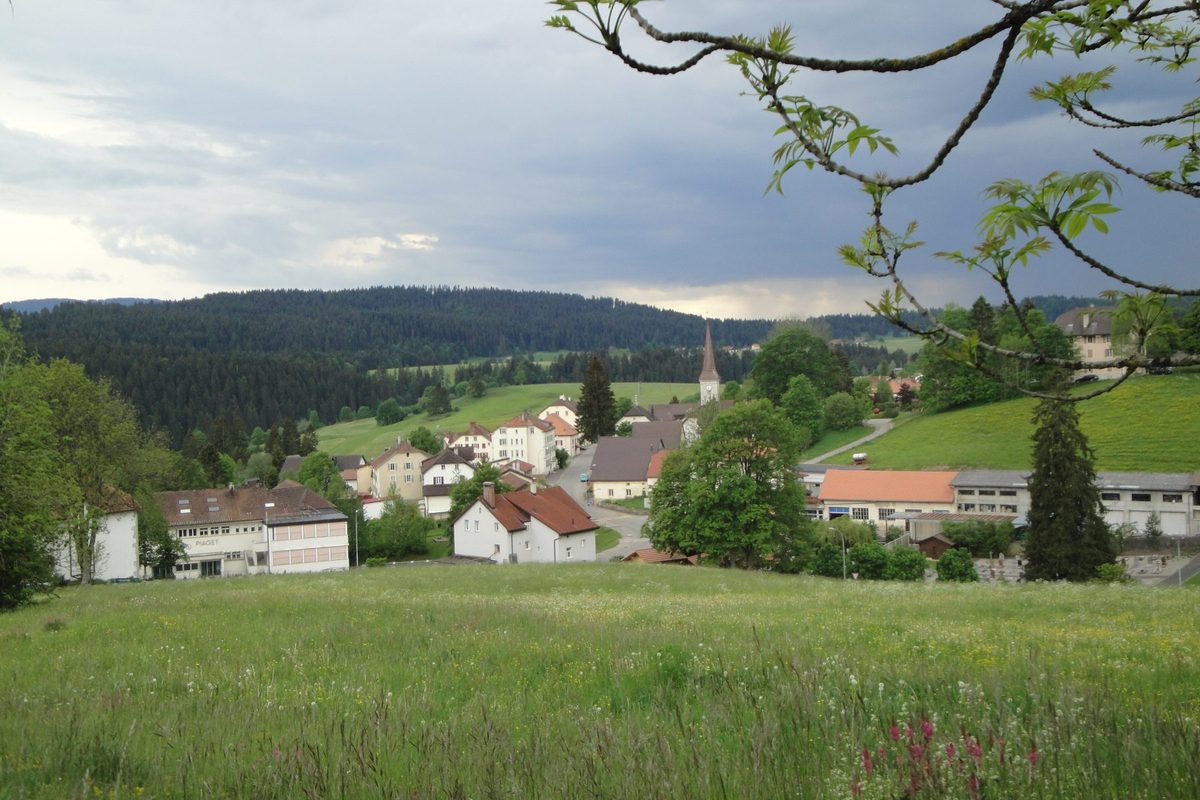
La Côte-aux-Fées
Birthplace of the Piaget watch manufactory, La Côte-aux-Fées probably owes its name not to fairies: « La Costa des Faies » would be the « slope of the ewes ».
Entry based on 10 sources · Our method · Reusable text (CC BY-SA)
Origin of the name La Côte-aux-Fées
The village first appears in writing in 1337, in the form « La Costa des Faies », glossed as « slope of the ewes ». Despite appearances, the name would thus not refer to fairies but to Franco-Provençal « fèa, fèja », ewe.[1]
Coat of arms of La Côte-aux-Fées
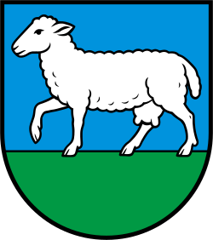
Azure, a ewe passant argent on a mount vert. A white sheep walks on green ground against a blue field.[8]
Founding of La Côte-aux-Fées
La Côte-aux-Fées has no known founder or founding act. La Côte-aux-Fées is a group of about a dozen hamlets, the main one of which, Les Bolles-du-Temple, forms the administrative and economic centre. Made a lordship in 1372, it came under the mairie of Les Verrières for civil matters and the castellany of Val-de-Travers for criminal matters from the 14th century to 1848. From the 15th to the 19th century its inhabitants cooperated with the Générale communauté of Les Verrières, within the bourgeau of Grand-Bourgeau. The locality became a parish in 1672 and obtained municipal status in 1826.[1][2]
History of La Côte-aux-Fées
1337. First written mention, in the form « La Costa des Faies ».[1]
1372. Raised to a lordship.[1]
14th century-1848. The locality comes under the mairie of Les Verrières for civil matters and the castellany of Val-de-Travers for criminal matters. Before the Reformation it belongs to the diocese of Besançon and the parish of Les Verrières.[1][2]
15th-19th century. Cooperation with the Générale communauté of Les Verrières.[1][2]
1658. A church is built.[1]
1671. La Côte-aux-Fées has 250 inhabitants.[1]
1672. La Côte-aux-Fées becomes a parish, separated from that of Les Verrières.[1][2]
17th-19th century. Blast furnaces operate at Noirvaux.[1]
18th century. Farming and forestry are combined with craft watchmaking and lacemaking.[1]
1826. La Côte-aux-Fées obtains municipal status.[1]
1849. Founding of a Free Church.[1]
1874. Founding of the Piaget watch manufactory.[1]
second half of the 19th century. Demographic and economic growth is held back by the lack of any rail link.[1]
late 19th-early 20th century. Holiday tourism.[1]
1987. Opening of a home for the elderly.[1]
2000. Almost half of the working population is employed in the secondary sector, with a high share of commuters from outside.[1]
Population of La Côte-aux-Fées
Sources and references: [1][4]
| 1671 | 250 |
| 1800 | 793 |
| 1850 | 979 |
| 1900 | 1'096 |
| 1950 | 648 |
| 2000 | 529 |
| 2008 | 450 (31 December) |
| 2025 | 467 (31 December) |
Families of La Côte-aux-Fées
Citizen families before 1800. Audétat, Barbezat, Bolle, Bolle-Picard, Bourquin, Contre-Guye, Corlet, Cretenet, Fatton, Grandjean, Guye, Juvet, Lambelet, Leuba, Pétremand and Piaget, with no precise date.[9]
In the 19th century. Forty-three families, twenty-nine of them with no precise date. Several came from neighbouring villages: five from Les Verrières and three from Buttes. The fourteen dated registrations range from 1887 to 1896, and half of them concern Bernese families.[9]
From 1901 to 1962. Nineteen registrations. The Choux family appears with no precise date. Eight Swiss families arrived between 1901 and 1941: Maurer from Adelboden BE (1901), André from Mauborget VD (1903), Maulaz from Fiez VD (1904), Bähler from Uebeschi BE and Steiner from Signau BE (1906), Berset from Villarsiviriaux FR (1908), Burri from Rüschegg BE (1917) and Lachat from Les Verrières NE (1941). The Thévenaz family (1924) has no stated origin. From France came the Blanquet (1922), Klingre (1930), Grandvoinnet (1953) and Picard (1960) families, from Italy the Tha (1933), Gervasio (1955) and Astori (1960) families. The Cerutti and Danesi families, also Italian, were the last registered, in 1961.[9]
Notable people of La Côte-aux-Fées
Georges-Édouard Piaget. In 1874, aged 19, he set up his first workshop on the family farm in La Côte-aux-Fées. There he made precision movements and components. His son Timothée steered the firm towards pocket watches and luxury wristwatches. The brand was registered in 1943 and a larger factory opened in the village in 1945.[10]
Economy of La Côte-aux-Fées, past and present
Land, forest and iron. La Côte-aux-Fées lived from farming and the forest. From the 18th century craft watchmaking and lacemaking were added. From the 17th to the 19th century blast furnaces operated at Noirvaux.[1]
Piaget. The Piaget watch manufacture was founded in the village in 1874. It still makes its movements there, including ultra-thin calibres that became its signature. Its jewellery workshops, by contrast, are at Plan-les-Ouates near Geneva.[1][6]
A village without a railway. With no rail link at all, growth slowed in the second half of the 19th century. From the late 19th to the early 20th century visitors came for holiday stays. In 2000 nearly half of the working population worked in industry, and many commuters came from outside.[1]
Historic sites in La Côte-aux-Fées
Les Bolles-du-Temple. The main one of the municipality's twelve or so hamlets, forming its administrative and economic centre.[1]
Protestant church. The first church dates from 1658. La Côte-aux-Fées became a parish in 1672. The present building is said to date from 1870.[1]
Piaget manufactory. The Piaget watch manufactory was founded at La Côte-aux-Fées in 1874. The brand, now owned by the Richemont group, originates from the municipality.[1][6]
Grotte aux Fées. Cave located about 2.8 km from the village, towards the hamlet of Saint-Olivier.
Legends of La Côte-aux-Fées
The fairies' abode. In 1763 Jean-Jacques Rousseau described this «lost country» above Buttes to the Maréchal de Luxembourg. It was claimed, he wrote, that the place had once been the abode of fairies, hence its name. Their assembly hall was supposedly a cave, the Grotte aux Fées, where a throne and seats carved in the rock could still be seen not long before. Rousseau had not visited it himself. The entrance was almost blocked by rubble and brushwood, and fear of snakes kept the curious away.[7]
Sources
- Dictionnaire historique de la Suisse, « La Côte-aux-Fées »
- Dictionnaire historique de la Suisse, « Les Verrières »
- État de Neuchâtel, arrêté du 21 janvier 2009 portant homologation des résultats du recensement cantonal de la population du 31 décembre 2008
- État de Neuchâtel, arrêté du 4 février 2026 homologuant le recensement cantonal de la population au 31 décembre 2025
- Office fédéral de topographie swisstopo, nomenclature géographique (geo.admin.ch), « Grotte aux Fées »
- Richemont, « Piaget »
- Jean-Jacques Rousseau, lettre au maréchal de Luxembourg du 28 janvier 1763, dans Philippe Godet (éd.), Pages neuchâteloises, Neuchâtel, 1899, p. 172
- IPI, Swissreg, emblems database: coat of arms of La Côte-aux-Fées (no. 102893)
- Register of Swiss Surnames, 3rd edition (1989), search Commune "La Côte-aux-Fées", Canton NE
- Piaget, official page "History"
Published by Sébastien Jörg ·
Localities of the municipality with a page
Other villages near La Côte-aux-Fées
Missing information, or do you have a source? Suggest a correction or addition. Every submission is checked before it's published.
Suggest a change