La Vraconnaz
Its peat bog has grown by about a millimetre a year for more than ten thousand years. In 1911 it became a nature reserve, presented as the first in Switzerland.
Entry based on 7 sources · Our method · Reusable text (CC BY-SA)
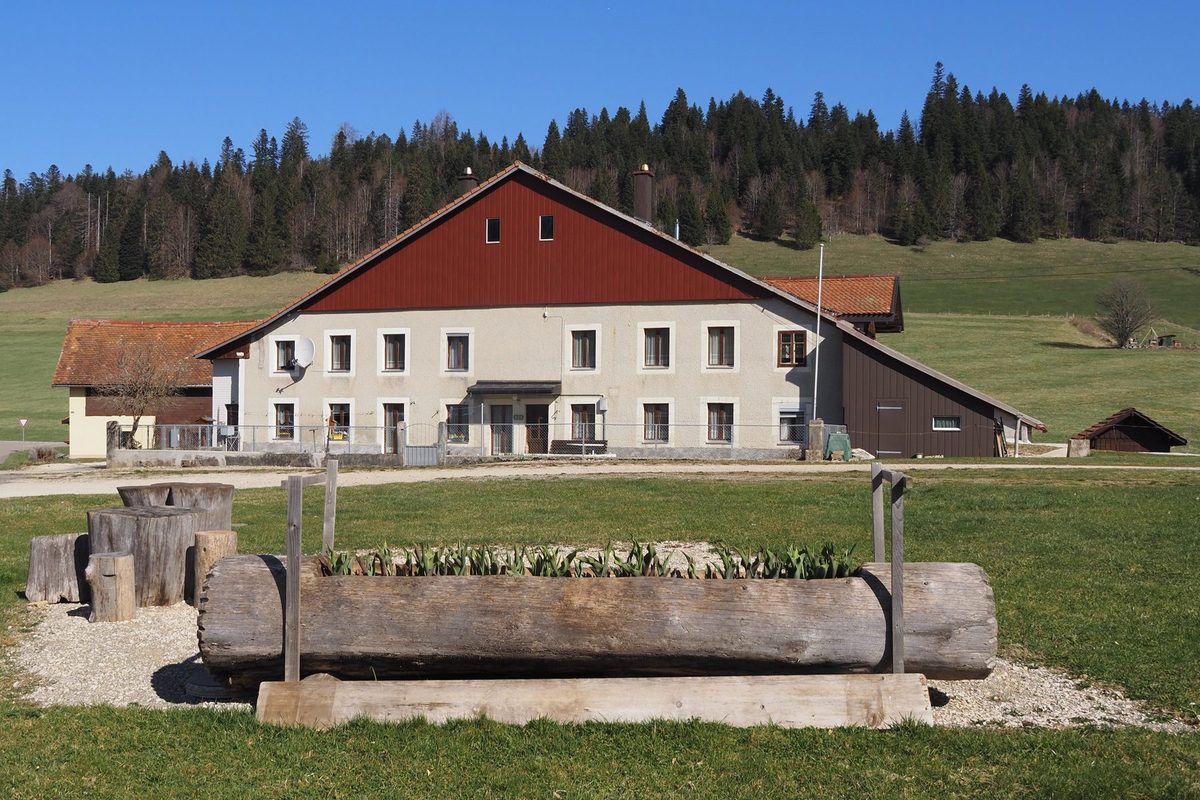
Origin of the name La Vraconnaz
The name « La Vraconnaz » has not yet been explained. The locality is also called « La Vraconne ». It gave its name to the « faune vraconnienne » described in 1868 by the geologist Eugène Renevier, then to the « Vraconnien » stage (1880), now called the La Vraconne Sandstone.[5]
Founding of La Vraconnaz
No founding act or date of settlement is known. The known history of La Vraconnaz is above all that of its raised bog, a peat bog formed since the end of the last ice age and protected from 1911, and that of its geological layers, which have served geologists as a reference since the 19th century. The locality is one of the twenty-seven in the municipality of Sainte-Croix, in the Jura-Nord vaudois district, and among the most important.[1]
History of La Vraconnaz
After the last ice age. The peat bog forms in the hollow from the end of the last ice age, more than ten thousand years ago: sphagnum mosses build up there by about one millimetre a year without decomposing.[2][3]
1868. The geologist Eugène Renevier describes a « faune vraconnienne », typical of the upper Alpine and Jura Gault, from the layers of La Vraconnaz.[5]
1880. Renevier uses the term « Vraconnien ». Later come « grès verts du Vraconnien » (1905) and « Vraconne Beds » in recent literature.[5]
1911. The Swiss League for the Protection of Nature (now Pro Natura) agrees with the Municipalité of Sainte-Croix, owner of the site, to turn the peat bog into a nature reserve. It is reportedly the first in Switzerland, though this is not certain.[2]
1941-1942. During the Second World War, some two hundred square metres of marsh are dug for peat.[2]
1966. Protection of the nature reserve becomes complete.[2]
1987. In September, torrential rain after a dry spell triggers a landslide over about fifteen hectares of the reserve, which scientists have studied ever since.[2][3]
1996. La Vraconnaz is listed as a mire landscape of national importance in the federal inventory.[4]
2001. Pro Natura and Pro Natura Vaud acquire a further plot of thirty-eight hectares.[2]
Historic sites in La Vraconnaz
La Vraconnaz raised bog. Nature reserve whose protection began in 1911 and became complete in 1966, managed by Pro Natura Vaud. A mire landscape, fen and raised bog of national importance, it is one of the last peat bogs in the canton of Vaud. Part of it was upheaved by the landslide of September 1987.[2][3][4]
Sources
- Dictionnaire historique de la Suisse, « Sainte-Croix (commune) »
- Journal de Sainte-Croix et environs, n° 2892, 20 septembre 2019, page 3
- Journal de Sainte-Croix et environs, « La soif des épicéas menace le marais »
- Office fédéral de l'environnement, Inventaire des sites marécageux, objet n° 9 « La Vraconnaz »
- Lexique stratigraphique suisse (strati.ch), « Grès de La Vraconne »
- geo.admin.ch (swisstopo), recherche de lieux
- Statistique Vaud, « Population résidante permanente au 31 décembre 2025 »
Published by Sébastien Jörg ·
Other villages near La Vraconnaz
Missing information, or do you have a source? Suggest a correction or addition. Every submission is checked before it's published.
Suggest a change