Sainte-Croix
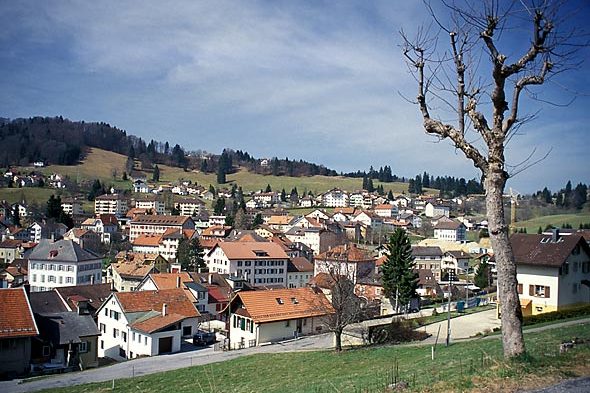
Small town in the Vaud Jura at the foot of the Chasseron, a former lordship of the Grandson family, which became the capital of the music box and of precision mechanics.
Entry based on 12 sources · Our method · Reusable text (CC BY-SA)
Origin of the name Sainte-Croix
The place appears in 1177 as «Sancta Crux», then «Saint Crueyz» in 1317. In German it was formerly called «Heilig Kreuz». The name reportedly refers to the Holy Cross, to which the chapel recorded in 1375 at the place called La Villette was dedicated. Nothing more is known about its origin.[1]
Coat of arms of Sainte-Croix
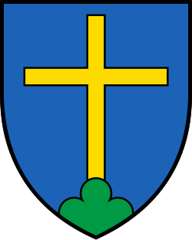
Azure, a Latin cross Or on a mount of three hillocks vert. On a blue field, a yellow cross with a longer lower arm stands on a green hill with three tops. The arms go back to the 17th century. They appear on a stained-glass panel of 1683 and on a seal of the same period.[8][9]
Founding of Sainte-Croix
At the foot of the Chasseron, the territory has yielded Neolithic and Bronze Age remains as well as Roman coins. The place appears in 1177, with two mills, in a document concerning the abbey of the Lac de Joux. The lords of Grandson settled the area from the 12th century. It then belonged to the lordship of Champvent. In the early 14th century Peter II of Grandson formed the lordship of Sainte-Croix and built a castle at the mouth of the Covatanne gorges, to defend himself against his neighbour Hugh of Chalon-Arlay, who built the fortress of Franc Castel on the Col des Étroits. The town grew up on an important route between Yverdon and Pontarlier, the salt road of the Côte de Vuitebœuf, which avoided the Jougne toll. After stock-raising and farming, metalworking, watchmaking, lace-making, then the music box and precision mechanics made its prosperity. The municipality comprises twenty-seven localities in two valleys, that of Sainte-Croix and that of Les Granges.[1]
History of Sainte-Croix
Prehistory. Neolithic and Bronze Age remains. Roman coins have also been found in the municipality.
1177. First mention, «Sancta Crux», with two mills, in a document concerning the abbey of the Lac de Joux.[1]
12th century. The area is settled by the Grandson family and belongs to the lordship of Champvent.[1]
1317. Peter II of Grandson forms the lordship of Sainte-Croix and builds a castle at the mouth of the Covatanne gorges.[1][3]
1375. A chapel dedicated to the Holy Cross is recorded at the place called La Villette. It depends on the parish of Peney (municipality of Vuitebœuf).[1]
1397. After the death of Otto III of Grandson, the lordship passes to the House of Savoy. Sainte-Croix, probably granted franchises by the Grandson family, takes part in the Estates of Vaud as a «bonne ville».
1476. Burgundian Wars: the castle of Sainte-Croix is set on fire.[1]
1536. Bernese conquest: Sainte-Croix belongs to the bailiwick of Yverdon until 1798. Franc Castel is dismantled by Bern. The municipality is divided into twelve «dizaines», run by a Council of Twelve and a Council of Twenty-Four.[1]
1540. The chapel becomes a parish church after the Reformation (parish shared with Bullet until 1663).[1]
late 16th century. Thanks to the extensive forests, blast furnaces (Mouille-Mougnon, Dénériaz-Noirvaux) follow the earlier ironworks. The iron mines belong mostly to burghers of Vallorbe, Yverdon and Neuchâtel.[1]
1744. A fire destroys the parsonage, part of the village and the church. The church is rebuilt between 1745 and 1748.[1]
mid-18th century. Watchmaking and lace-making, often done at home for Neuchâtel merchants, take over from metalworking. Until this time the salt road avoiding the Jougne toll makes Sainte-Croix an important stage between Yverdon and Pontarlier.[1][5]
1798. Sainte-Croix is the third most populous municipality in Vaud, after Lausanne and Vevey. Allied with other municipalities of the Vaud Jura, it tries to resist the new regime and fights for Bern's cause. It belongs to the Grandson district until 31 December 2007. Its prefecture is abolished in 1949.
1811. Start of the music box industry in Sainte-Croix and L'Auberson. The Paillard dynasty appears in 1814, followed by Thorens (1883), Reuge (1886) and Lador (1890).[1]
1843. New road to Vuitebœuf; in 1848 roads are added to Pontarlier via L'Auberson and to the Val-de-Travers through the Noirvaux valley.
1860. First hotel: Sainte-Croix and Les Rasses (municipality of Bullet) turn to tourism.[1]
1893. Opening of the Yverdon-Sainte-Croix railway, which boosts tourism.[1]
1974-1975. The recession causes a sharp fall in population and the closure of several companies; Paillard closes in 1984.
1985. Creation of the Centre international de la mécanique d'art (CIMA).[1]
2008. The new districts come into force on 1 January (law on territorial organisation of 30 May 2006): the Grandson district disappears and Sainte-Croix joins the Jura-Nord vaudois district.[6]
Population of Sainte-Croix
Sources and references: [1][4]
| 1764 | 1'834 |
| 1798 | 2'833 |
| 1850 | 3'541 |
| 1900 | 5'914 |
| 1950 | 6'575 |
| 1960 | 6'925 |
| 1970 | 6'240 |
| 1980 | 4'543 |
| 2000 | 4'333 |
| 2025 | 5'149 |
Families of Sainte-Croix
Citizen families before 1800. Twenty-four families, all with no precise date: Addor, Bahon, Besse, Bornand, Campiche, Cuendet, Geneux, Girard, Gonthier, Gueissaz, Guyon, Jaccard, Jaques, Joseph, Junod, Margot, Martin, Mermod, Mutrux, Paillard, Perrier, Recordon, Simon and Sueur.[10]
In the 19th century. Sixty-six entries, sixty-one of them in the single year 1871. The others are entered with no precise date or between 1875 and 1893.[10]
From 1901 to 1962. One hundred and forty-three entries, fifty-six of them in the single year 1956. Bernese families are the most numerous (40), ahead of those from Italy (24). The Thorens of Concise VD were admitted in 1928 and the Reuge of Buttes NE in 1956.[10]
Notable people of Sainte-Croix
François Junod. An automaton maker and sculptor, he runs a workshop in his native village. He built an automaton of Pushkin in 2010 and the "Fée Ondine" for Van Cleef & Arpels in 2017. His "Fontaine aux oiseaux" won a prize at the Grand Prix d'Horlogerie de Genève in 2022.[12][9]
Economy of Sainte-Croix, past and present
Iron and the salt road. The large forest estate allowed ironworks and then, from the late 16th century, blast furnaces. Sainte-Croix was also a stop between Yverdon and Pontarlier on a salt road linking Franche-Comté with the Pays de Vaud that avoided the Jougne toll.[1]
Watches, lace and music boxes. In the mid-18th century watchmaking and lacemaking took over from metalworking. Watchmaking declined at the end of the 19th century. From 1811 the music box industry grew in Sainte-Croix and L'Auberson, followed by sound and image. The FAO lists phonographs, film projectors and typewriters among its products. Paillard (1814) became Hermes Precisa International SA, in Yverdon, in 1974. Thorens (1883) was absorbed by Paillard in 1964, Lador (1890) by Reuge (1886) in 1986. According to the FAO, Sainte-Croix had become the world capital of music boxes by the early 20th century. Industry provided 49% of jobs in 1985 and still 38% in 2005.[1][9]
Firms and fine watchmaking. According to the FAO, Sainte-Croix is home to more than four hundred micro, small and medium-sized firms. Reuge still makes music boxes there, and De Bethune and Vianney Halter produce grand complication watches.[9]
Tourism. From the mid-19th century Sainte-Croix and Les Rasses turned to tourism. In crisis from 1930, it picked up again in the second half of the 20th century. According to the FAO, the three museums, the CIMA, the Collection Baud and the Musée des Arts et Sciences, together draw more than 20'000 visitors a year.[1][9]
Disasters and major events in Sainte-Croix
The parsonage fires of 1702 and 1744. The parsonage, built in 1661, burned in 1702. It was reduced to ashes again in 1744, in the fire that also destroyed part of the village and the church.[1]
Historic sites in Sainte-Croix
Sainte-Croix Reformed church. Successor to the chapel of the Holy Cross (1375) at La Villette, which became a parish church in 1540. The church of 1569 was replaced in 1642 and moved to the centre of the village, then rebuilt between 1745 and 1748 after the fire of 1744.[1]
Catholic church of Saint-François-de-Sales. Consecrated in 1895, it became a parish church in 1935.[1]
Centre international de la mécanique d'art (CIMA). Founded in 1985, it bears witness to the music box industry, present in Sainte-Croix since 1811.[1]
Musée des arts et des sciences. Museum founded in 1872 in Sainte-Croix.[1]
Musée Baud in L'Auberson. Music box museum opened in 1955 in the village of L'Auberson, within the municipality.[1][5]
Heritage sites of national importance. The village of L'Auberson is listed in the Federal Inventory of Swiss Heritage Sites of national importance (ISOS). The town of Sainte-Croix and the hamlet of La Chaux are reportedly listed too.[5]
La Vraconne nature reserve. Protected raised bogs within the municipality.[1]
Remains in Sainte-Croix
Castle of Sainte-Croix. Castle built after 1317 by Peter of Grandson on a rock above the Covatannaz gorges, to control the road from Yverdon via Vuitebœuf and to defend himself against Hugh of Chalon-Arlay. It was set on fire in 1476 during the Burgundian Wars. In the hamlet of Château de Sainte-Croix few remains survive: the site of the entrance gate on the west, with massive walls on either side, and the base of a tower. Around 1900 the owner discovered a staircase and a corridor, which were filled in without being studied.[1][3]
Franc Castel. Fortress built in 1319 by Hugh of Chalon-Arlay on the Col des Étroits, dismantled by Bern in 1536. Only the ditches remain, visible in a pasture.[1][2]
Rutted road of the Côte. Salt road linking Franche-Comté to Vaud via Vuitebœuf and Sainte-Croix, with ruts cut into the rock dating from its use between the 14th and 18th centuries. Last major repair in 1712, then a new, less steep road built in the mid-18th century (bend of 1760). Popular tradition holds it to be a Roman road.[2]
Protected heritage in Sainte-Croix
Cultural property of national significance (A objects in the PCP inventory)[7]
- Côte de Vuiteboeuf, occupations le long des voies - Age du Bronze - Époque moderne
Cultural property of regional significance (B objects)[7]
- Anciennes fabriques Paillard, Hermes et Bolex
- Franc-Castel, vestiges du château - Moyen Age
- Gorges de Covatannaz, abris-sous-roches / occupations / lieu de culte - Néolithique - Haut Moyen Age
- L'Auberson, Musée Baud
- Maison (Musée des arts et des sciences)
- Musée de boîtes à musique et d'automates (CIMA)
- Musée des arts et des sciences
- Temple
- Vers-chez-Jaccard, ferme bernoise
Traditions and festivals in Sainte-Croix
Music boxes and automata. For a century the industry followed the établissage system: workers made parts at home, and the établisseur supplied the components, assembled and sold the boxes. In 1994 the Confederation recognised Sainte-Croix as the cradle of the music box and a centre of national importance. The boxes are built in workshops, and this craft is listed in the Vaud inventory of intangible heritage.[11]
The art of automaton makers. In 2020 the art of automaton makers was added to UNESCO's Representative List of the Intangible Cultural Heritage of Humanity. The craft is still learned from a master, without formal training.[12]
The carnival. The carnival is one of Sainte-Croix's main events and has its own radio station. The Comptoir trade fair, the Summer Market and the Festival des Terroirs sans Frontière complete the calendar.[9]
Sources
- Dictionnaire historique de la Suisse, « Sainte-Croix (commune) » (Ch. Lafontant, version du 08.02.2011)
- Archeoplus, « Sainte-Croix (VD) »
- Swisscastles, « Le château de Sainte-Croix »
- Statistique Vaud, « Population résidante permanente au 31 décembre 2025 »
- Office fédéral de la culture, ISOS, « L'Auberson » (fiche 4380)
- État de Vaud, communiqué du 12.07.2007, « Organisation des préfectures et adaptation au nouveau découpage territorial »
- Federal Office for Civil Protection (FOCP), Swiss Inventory of Cultural Property (PCP), list for the canton of Vaud (as of 1.1.2026)
- IPI, Swissreg, emblems database: coat of arms of Sainte-Croix (no. 101302)
- Official Gazette of the Canton of Vaud (FAO), "Alphabet des communes vaudoises: Sainte-Croix"
- Register of Swiss Surnames, 3rd edition (1989), search Commune "Sainte-Croix", Canton VD
- State of Vaud, Cantonal inventory of intangible heritage, "Boîtes à musique et automates"
- SWI swissinfo.ch, "Sainte-Croix, écrin d'un art mécanique ancestral", 5 October 2024
Published by Sébastien Jörg ·
Localities of the municipality with a page
Other villages near Sainte-Croix
Missing information, or do you have a source? Suggest a correction or addition. Every submission is checked before it's published.
Suggest a change