Les Verrières
Border street village of the Val-de-Travers, on the old road to France, where the Bourbaki army was interned in Switzerland in February 1871.
Entry based on 8 sources · Our method · Reusable text (CC BY-SA)
Origin of the name Les Verrières
First written mentions in 1311 in the form « Myezour », in 1337 « Mey Joulz », then « Mijoux », and in 1344 « villa de Verreriis ». Several explanations have been put forward for the name Verrières: a derivation from « ferrières » (blast furnaces), a glassworks on the hill, or « vernaies », willow plantations (form « Verreyres » of 1344). Modern historians prefer the last.[1][3]
Founding of Les Verrières
No founder or founding act is known for Les Verrières. The village arose from the clearing of the forest of the upper Val-de-Travers around 1300. Eighty settlers reportedly arrived in 1337. The parish was created between 1294 and 1303. From 1373 to 1413, Les Verrières and Les Bayards formed a lordship created by Count Louis de Neuchâtel for his natural sons Vauthier and Jean. From the end of the 14th century to 1848, Les Verrières was the seat of a mairie, a civil judicial district covering Les Verrières, Les Bayards and La Côte-aux-Fées. From the 15th century, five « bourgeaux » (Meudon, Belle-Perche, Petit Bayard, Grand Bayard and Grand-Bourgeau) joined in a « Générale communauté ». The present municipality was formed in 1878 by the merger of Meudon, Grand-Bourgeau and Belle-Perche.[1][3]
History of Les Verrières
1294-1303. Creation of the parish, which coincides with the territory of the later mairie and belongs to the diocese of Besançon.[1]
around 1300. First inhabitants and start of forest clearing.[3]
1311. First written mention, in the form « Myezour ».[1]
1324. First mention of the church, dedicated to Saint Nicholas.[1]
1344. Mention of the « villa de Verreriis ».[1]
14th century. Toll at the Combette de Mijoux on the road to France. The mills of Les Verrières are located in Saint-Sulpice.[1]
1373-1413. Lordship of Les Verrières and Les Bayards for Vauthier and Jean, natural sons of Count Louis de Neuchâtel.[1]
late 14th century-1848. Les Verrières is the seat of a mairie, a civil judicial district that also includes Les Bayards and La Côte-aux-Fées.[1]
15th century. The five bourgeaux join in a « Générale communauté », led by two governors and a council supervised by the assembly of heads of household.[1]
1476. In February, a vanguard of the army of Charles the Bold tries to enter the country. Part of the village is set on fire.[1][3]
before 1517. Rebuilding of the church of Saint-Nicolas.[1]
1664. The village has 114 hearths, about 570 inhabitants.[1]
1672. La Côte-aux-Fées is separated from the parish.[1]
1712. Les Bayards are in turn separated from the parish.[1]
18th-19th century. Diversified economy: international trade, cheese making, lacemaking, watchmaking, absinthe distilling, printing.[1]
1813-1814. The Allied army passes through in winter.[1]
1850. Opening of a federal customs office.[1]
1860. Opening of the Franco-Suisse railway, which ends the heavy carting traffic on the road to France.[1]
1871. On 1 February, around 3 a.m., General Hans Herzog signs at Les Verrières the convention for the internment of the Bourbaki army. From 1 to 3 February, 87'000 men and 12'000 horses enter Switzerland through Les Verrières.[1][2]
1878. Meudon, Grand-Bourgeau and Belle-Perche merge into the municipality of Les Verrières.[1]
1883. Dissolution of the Générale communauté.[1]
1894-1971. A secondary school operates.[1]
1942. Opening of a Catholic chapel.[1]
1942-1949. Land consolidation.[1]
2005. The primary sector still provides 30 % of jobs.[1]
Population of Les Verrières
Sources and references: [1][5]
| 1664 | 114 hearths (households), about 570 inhabitants |
| 1818 | 1'420 |
| 1850 | 1'635 |
| 1900 | 1'765 |
| 1950 | 1'119 |
| 2000 | 735 |
| 2008 | 673 (31 December) |
| 2025 | 663 (31 December) |
Families of Les Verrières
Citizen families before 1800. Ambrosius, Audétat, Barbezat, Bolle, Bolle-Picard, Bourquin, Breguet, Châtin, Colomb, Corlet, Crétenet, Etienne, Fatton, Ferrier, Gendre, Gras, Griffond, Guillaume, Guye, Haas, Haldenwang, Jeannet, Lambelet, Landry, Munier, Nerdenet, Perroud, Redard, Redard-Jacot, Robert, Robert-Prince and Schnirley, with no precise date.[7]
In the 19th century. Friederichs, Ramel, Ruau and Schulé, along with the Loew (from Benken BL), the Schläfli (from Derendingen SO) and six families from Germany (Ohlmeyer, Schweizer, Seiler, Sorg, Spoerlé and Veeser), with no precise date. Dated registrations began in 1863 with the Fraissard, from France. They were followed by the Finkbeiner from Germany (1873), the Sancey (1878), the Picard (1884), the Paquette (1889) and the Vuillaume (1890), all from France, then the Martin from Sainte-Croix VD (1890), the Ebner from Germany (1892), the Amstutz from Sigriswil BE (1896), the Maier from Germany (1897) and the Coulot from France (1900). Neighbouring France supplied six of the eleven dated families.[7]
From 1901 to 1962. Thirty-nine registrations. Ten families came from Italy (Corsi in 1921, Vagliot in 1927, Tha in 1933, Rota in 1952, Fabbri and Pedroli in 1954, Gervasio in 1955, Antoniotti in 1957, Astori and Percassi in 1960) and nine from France (Janet in 1901, Violette in 1908, Bergdol in 1914, Pagnier in 1917, Grange in 1921, Arnoux in 1944, Curtit in 1953, Roux in 1954, Rossier in 1960). Others came from Germany (Frühwacht, 1924), Belgium (Delbrouck, 1926), Poland (Fiszhaut, 1934) and the Netherlands (Franco, 1947). The Swiss families came mostly from the canton of Bern: Evard from Lamboing (1902), Hiltbrunner from Wyssachen and Zurbuchen from Habkern (1906), Fischer from Lüscherz and Frick from Uebeschi (1917), Jenni from Eggiwil (1921), Berger from Oberlangenegg (1930). They were joined by the Solca from Coldrerio TI (1901), the Biétry from Bonfol JU (1902), the Senn from Liestal BL (1917), the Hegi from Hausen am Albis ZH (1925) and the Chappuis from Develier JU (1932), as well as the Dupré and the Jeanneret (1922), the Chmetz (1924) and the Cartier (1944). The last registrations, in 1960, were those of the Astori, the Percassi and the Rossier.[7]
Notable people of Les Verrières
Jean-Louis Jeannet. His donations paid for the casting of the church bells in 1788.[3]
Economy of Les Verrières, past and present
Land and forest. Farming and forestry have shaped the economy of Les Verrières since the 13th century, and the land still matters. In 2005 the primary sector provided 30% of jobs. Farmland covers 45.8% of the commune.[1][3]
The road to France. From the 14th century carters brought traffic to the road to France, and a toll was levied at the Combette de Mijoux. The opening of the Franco-Suisse railway in 1860 ended this traffic. Many hotels and inns then closed.[1][3]
Disasters and major events in Les Verrières
The Burgundian attack of 1476. In February an advance guard of Charles the Bold's army tried to enter the country and set part of the village on fire.[1][3]
The Meudon fire of 1847. On 2 July fire burned 8 buildings in Meudon.[3]
The Meudon fire of 1866. On 23 May another fire struck Meudon and burned 12 buildings.[3]
The Bourbaki army in 1871. After the internment convention signed in the village on 1 February, General Bourbaki's French soldiers crossed into Switzerland at Les Verrières.[1]
Historic sites in Les Verrières
Protestant church (former church of Saint-Nicolas). Church mentioned from 1324, dedicated to Saint Nicholas and rebuilt before 1517. It was the centre of the original parish, which also included La Côte-aux-Fées and Les Bayards until 1672 and 1712. The temple at Meudon is a cultural property of regional importance (PCP inventory).[1][6]
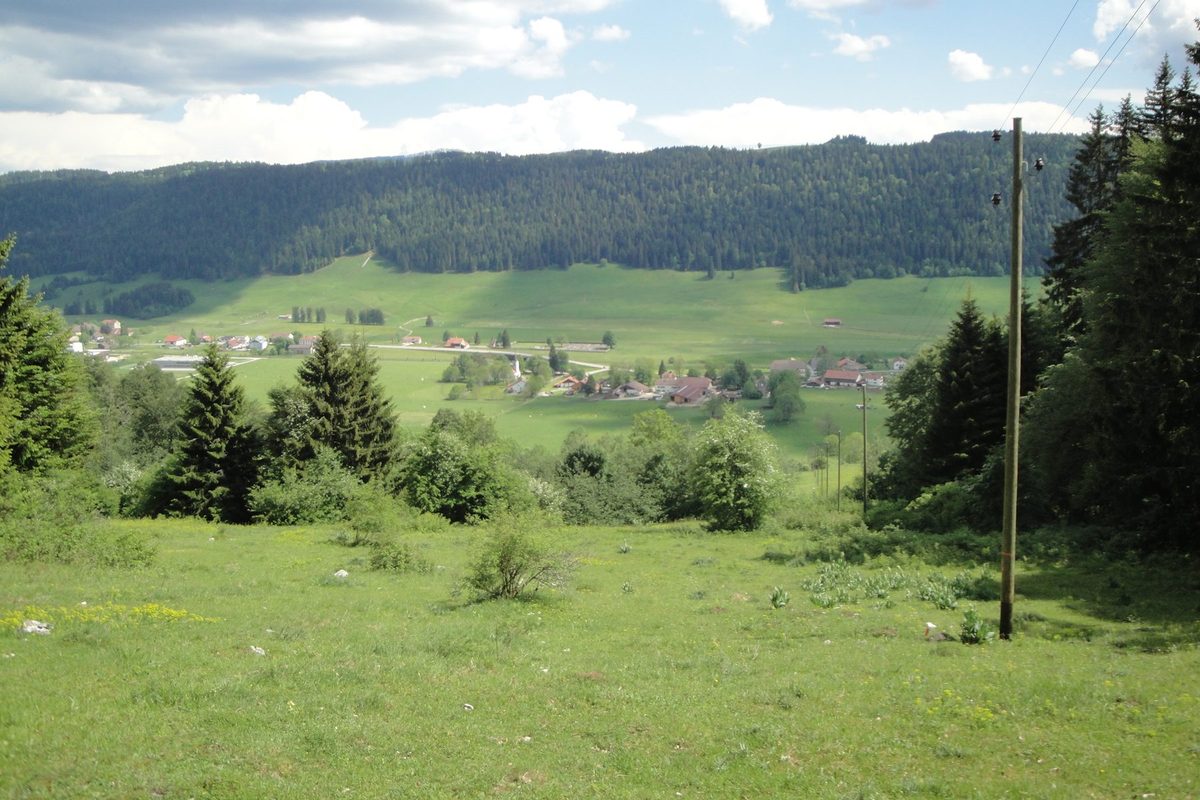
The street village. A 3 km street village made up of the districts of Le Crêt, Belle-Perche, Grand-Bourgeau, Croix-Blanche and Meudon, together with the hamlets of Les Cernets and Mont-des-Verrières, between 910 and 1'286 m above sea level.[1]
Site of the Bourbaki army internment. It was at Les Verrières that General Hans Herzog signed, on 1 February 1871 around 3 a.m., the convention by which the French Army of the East, commanded since 26 January by General Justin Clinchant, laid down its weapons and equipment at the border. The troops entered Switzerland from 5 a.m.: until 3 February, 87'000 men and 12'000 horses passed through Les Verrières. They were repatriated from 13 to 22 March 1871. Switzerland spent more than 12.1 million francs, which France undertook to reimburse.[1][2]
The road to France and the customs. The village long lived from carting on the road to France, with a toll at the Combette de Mijoux from the 14th century, then a federal customs office from 1850, until the opening of the Franco-Suisse railway in 1860.[1]
Catholic chapel. Chapel opened in 1942, reportedly dedicated to Saint Nicholas of Flüe.[1]
Protected heritage in Les Verrières
Cultural property of regional significance (B objects)[6]
- Temple
Traditions and festivals in Les Verrières
Shooting. A first shooting society was formed in Les Verrières in 1613. The shooting society "La Verrisanne" is among the local societies listed by the municipality.[3][8]
Sources
- Dictionnaire historique de la Suisse, « Les Verrières »
- Dictionnaire historique de la Suisse, « Armée Bourbaki »
- Commune des Verrières, « Histoire »
- État de Neuchâtel, arrêté du 21 janvier 2009 portant homologation des résultats du recensement cantonal de la population du 31 décembre 2008
- État de Neuchâtel, arrêté du 4 février 2026 homologuant le recensement cantonal de la population au 31 décembre 2025
- Office fédéral de la protection de la population, Inventaire suisse des biens culturels d'importance nationale et régionale, liste du canton de Neuchâtel (état au 1.1.2026)
- Register of Swiss Surnames, 3rd edition (1989), search Commune "Les Verrières", Canton NE
- Municipality of Les Verrières, "Sociétés" (Societies)
Published by Sébastien Jörg ·
Localities of the municipality with a page
Other villages near Les Verrières
Missing information, or do you have a source? Suggest a correction or addition. Every submission is checked before it's published.
Suggest a change