L'Abergement
Since 1941 the church of L'Abergement has held stained glass by Eugène Grasset, a burgher of the village and creator of Larousse's «La Semeuse». The windows were first intended for Lausanne Cathedral.
Entry based on 10 sources · Our method · Reusable text (CC BY-SA)
Origin of the name L'Abergement
The name comes from an old term of feudal law: land «given en abergement» was granted by contract to be cultivated, in return for an agreed price and annual dues in money, wine or kind. The date of the first written mention is not known.[2][4]
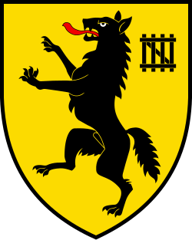
Coat of arms of L'Abergement
Or, a wolf rampant sable, in sinister chief a hurdle of the same. On a yellow field, a black wolf stands on its hind legs. At top right is a black hurdle, a panel of woven branches. The design comes from the stained-glass window given to the church by a citizen of the village.[4][8]
Founding of L'Abergement
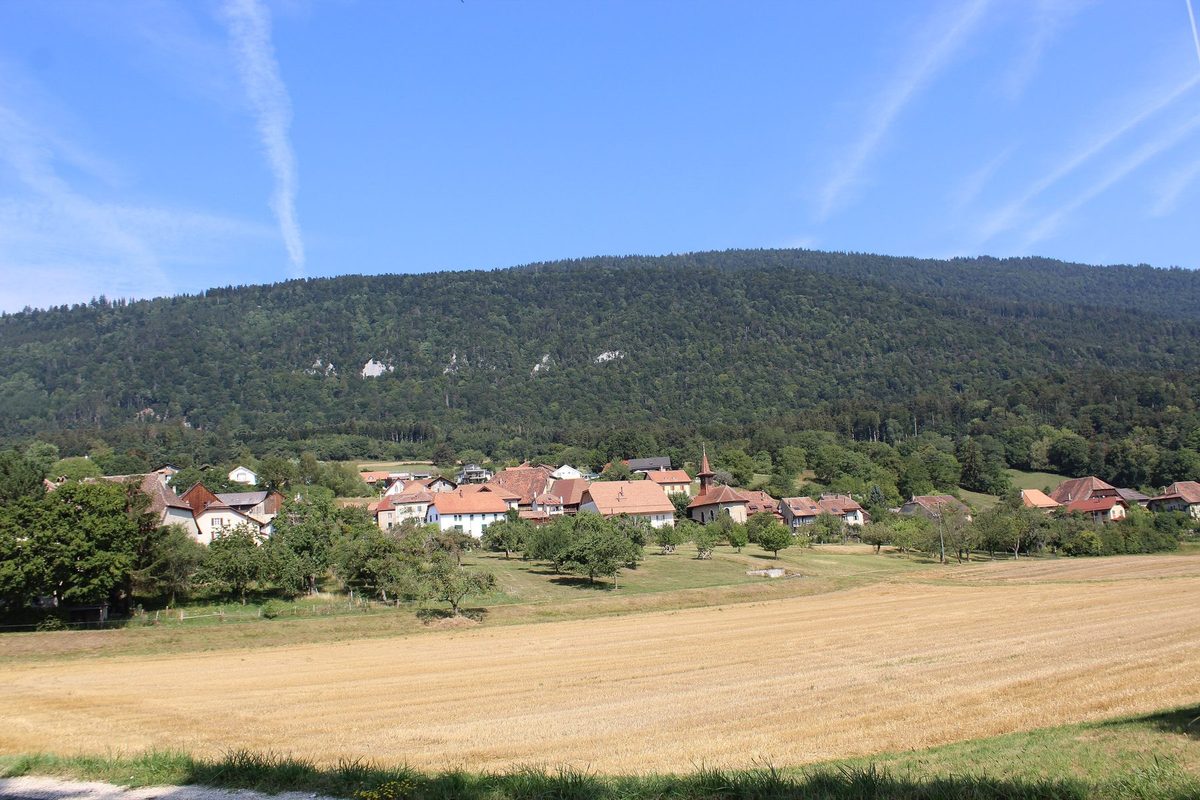
No founder is known, but the name tells the village's origin: land granted «en abergement», that is, entrusted to tenants who were to clear and farm it in return for dues. Megaliths at the place called Planche Permis show an older human presence. In the Middle Ages L'Abergement belonged to the lordship of Les Clées. This street village at the foot of the Jura, which also includes the hamlet of Vailloud, covers 572 hectares, from the farming plain (620 to 780 metres) to the forests and pastures of the Jura (1'200 to 1'460 metres). It has always kept an agricultural and craft character.[1][2][4]
History of L'Abergement
date unknown. Megaliths stand at the place called Planche Permis. Their date is not known.[1]
Middle Ages. L'Abergement is part of the lordship of Les Clées.[1]
1536. Bernese conquest of Vaud: the village is attached to the bailiwick of Yverdon and the castellany of Les Clées (until 1798). It comes under the court of Rances and Valeyres and is governed by a council made up of one third of the commune's burghers, rotating every year.[1]
17th century. Construction of a few houses still standing in the village.
1621. The Fribourg family Boccardier owns land and quitrents in L'Abergement.[1]
1699. The village has 180 inhabitants.[1]
1798. In February L'Abergement is one of the communes that reject Peter Ochs's constitution. It then becomes part of the district of Orbe (until the end of 2007).[1][6]
1845. Birth in Lausanne of Eugène Grasset (1845-1917), burgher of L'Abergement, later a painter and creator of «La Semeuse», the emblem of the Larousse publishing house.[2][4]
1856. A monthly service begins to be held in the schoolroom.[5]
1900. On 1 March the General Council votes to build a church.[5]
1902. Construction of the village church.[1][2][3][4]
1929-1931. Two designs for the arms are proposed. One appears in 1931 in the Armorial of the Communes of Vaud, but is replaced by the one a resident donates to the church as a stained-glass window: Or, a wolf ravissant sable, accompanied in sinister chief by a hurdle of the same.[2][4]
1941. The church receives stained glass by Eugène Grasset, originally intended for Lausanne Cathedral and adapted by Robert Grasset.[1][2][4]
1950s. Land consolidation.[1]
1970. Construction of a community hall.
1991-1992. Complete renovation of the municipal building.[3][4]
2000. The village moves from the parish of Rances to that of Ballaigues-Lignerolle.[1]
2008. On 1 January the new division into districts takes effect: L'Abergement moves from the district of Orbe to that of Jura-Nord vaudois.[6]
2017. The municipal shelter is destroyed by fire, then rebuilt.[3][4]
Population of L'Abergement
Sources and references: [1][2][7]
| 1699 | 180 |
| 1764 | 182 |
| 1850 | 318 |
| 1900 | 227 |
| 1980 | 146 |
| 1988 | 165 |
| 2000 | 235 |
| 2022 | 260 |
| 2025 | 267 |
Families of L'Abergement
Citizen families before 1800. Besse, Besuchet, Bezuchet, Chapuis, Chevailler, Chevalier, Chevallier, Flaction, Gauthey, Grasset, Herbez, Meylan, Pahux and Paux, with no precise date. The Perriraz, from Savoy, are admitted in 1728.[10]
From 1901 to 1962. Only three entries: the Bulle, from France, in 1915, the Berthoud in 1931 and the Erb, from Germany, in 1940.[10]
Notable people of L'Abergement
Eugène Grasset (Lausanne 1845 - Sceaux 1917). Citizen of L'Abergement. After unfinished architecture studies at ETH Zurich, he settles in Paris in 1871 and turns to the decorative arts: posters, illustrations, furniture, stained glass, jewellery and the typeface that bears his name. A pioneer of Art Nouveau, he becomes a French citizen in 1891.[9][4]
Economy of L'Abergement, past and present
Fields and sawmill. L'Abergement still lives from farming and crafts. A sawmill processes timber there.[1]
Craftsmen and shops. A carpentry firm is known far and wide for the quality of its work. The village also has a plastering and painting business, a logging and earthworks firm, a soap maker, a tree nursery and a baker. A small self-service grocery opened in 2020.[4]
Historic sites in L'Abergement
L'Abergement church and the Eugène Grasset windows. Church built in 1902 (or 1901, date uncertain), whose construction the General Council had voted in 1900. Since 1941 it has had stained-glass windows designed by the painter Eugène Grasset (1845-1917), burgher of L'Abergement, originally intended for Lausanne Cathedral. They depict among others Jeremiah, St John the Baptist, Christ in Glory and St Paul, and were made by the glassmakers Guignard and Schmit.[1][2][3][4][5]
Street village and old houses. The village stretches along its main street and preserves a few 17th-century houses, a fountain with wash-house and the municipal building, renovated in 1991-1992.[1][3][4]
Remains in L'Abergement
Megaliths of Planche Permis. Megaliths are recorded at the place called Planche Permis. Neither their date nor their purpose is known.[1]
Pierre de Bonchâteau. Erratic boulder, left by the glaciers, on the municipal territory.[1]
Legends of L'Abergement
The Wolves. The inhabitants are nicknamed the Wolves, reportedly «lè Lâo» in patois. Villagers are said to have met these animals near the forests of the area, but neither this explanation nor the patois form is confirmed. A wolf also appears in the municipal arms.[2][4]
Traditions and festivals in L'Abergement
The Abbaye des Chasseurs. Founded in 1803, it organises the village abbaye every two years, including a walking rally.[4]
The Ourloups. The shooting society combines in its name the Ours, the nickname of the people of Sergey, and the Loups of L'Abergement. Its range has four targets at 300 metres.[4]
Le Chant des Bois. The mixed choir gives its round of concerts every year. It celebrates its 50th anniversary in 2025.[4]
Sources
- Dictionnaire historique de la Suisse (DHS), « Abergement, L' », version du 23.06.2009
- Commune de L'Abergement, « Le village de l'Abergement »
- Commune de L'Abergement, « Bâtiments »
- Feuille des avis officiels du canton de Vaud, « Alphabet des communes vaudoises : L'Abergement »
- EERV, paroisse de Ballaigues-Lignerolle, « L'église du village : quelle histoire ! »
- État de Vaud, communiqué du 12.07.2007, « Organisation des préfectures et adaptation au nouveau découpage territorial »
- Statistique Vaud, « Population résidante permanente au 31 décembre 2025 »
- IPI, Swissreg, emblems database: coat of arms of L'Abergement (no. 101264)
- Anne Murray-Robertson-Bovard, "Grasset, Eugène", Historical Dictionary of Switzerland (HDS), version of 17.07.2007
- Register of Swiss Surnames, 3rd edition (1989), search Commune "L'Abergement", Canton VD
Published by Sébastien Jörg ·
Other villages near L'Abergement
Missing information, or do you have a source? Suggest a correction or addition. Every submission is checked before it's published.
Suggest a change