Les Clées
In 1134 Pope Innocent II forbade, in vain, the rebuilding of the castle of Les Clées because of its bad reputation. The castle controlled the road over the Jougne pass by means of a toll.
Entry based on 9 sources · Our method · Reusable text (CC BY-SA)
Origin of the name Les Clées
The name is attested in 1134 in the form «Clees». No etymology is known for «Les Clées».[1]
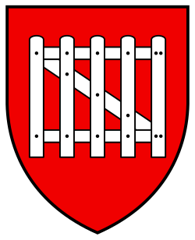
Coat of arms of Les Clées
Gules, a hurdle argent. On a red field stands a white hurdle, an open slatted barrier. The hurdle was used to pen livestock. The word comes from the Latin cleta, which also gave the Vaud dialect word clédar. The red and white recall the colours of the priory of Romainmôtier, which the lord of Les Clées was bound to protect.[7][8]
Founding of Les Clées
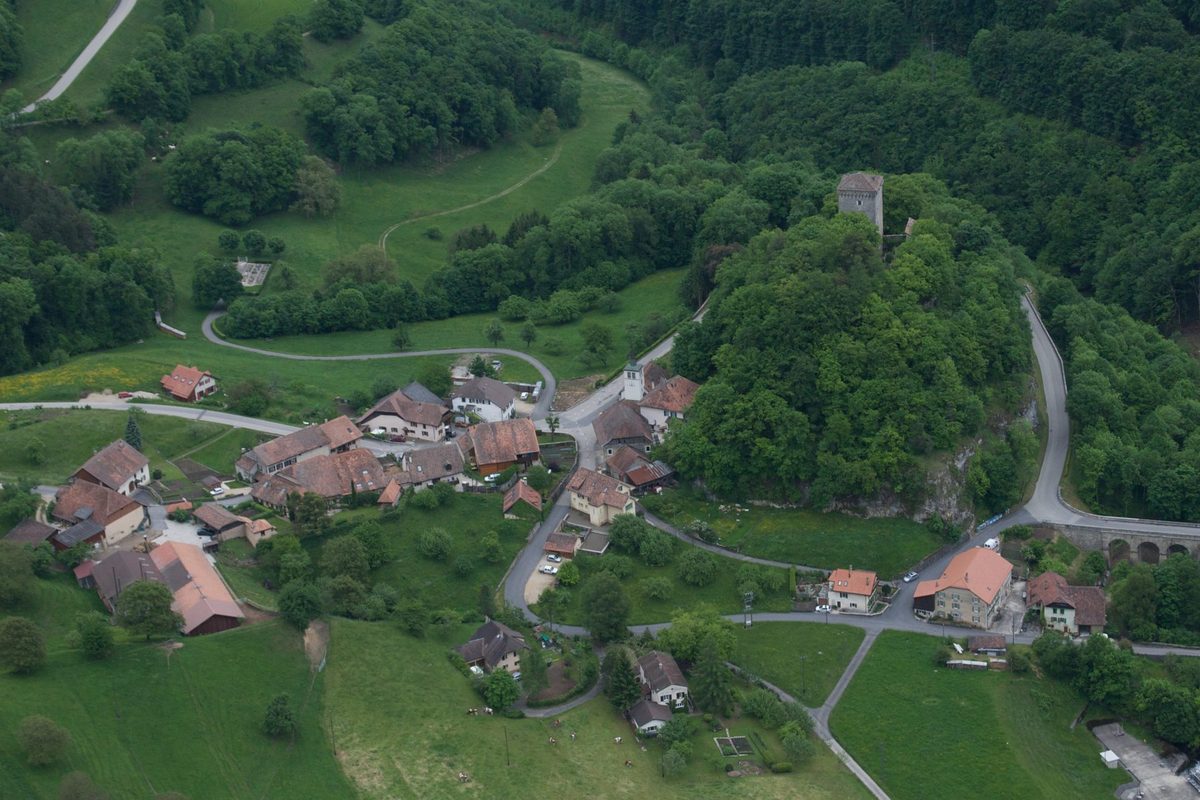
Nobody knows who founded Les Clées. The settlement grew up at the foot of a castle built on a rocky spur above the Orbe. By means of a toll, the castle controlled the road over the Jougne pass, a major Jura crossing between Pontarlier and Lausanne, and it already existed in 1134. In the Middle Ages Les Clées was a town, granted franchises by the Count of Savoy around 1272, which owed its prosperity to the traffic over the pass. It was the centre of a seigneury of eight other villages, to which the Vallée de Joux was attached from the 15th century until 1566.[1][2][3]
History of Les Clées
1134. First mention, in the form «Clees». Pope Innocent II forbids, in vain, the rebuilding of the castle because of its bad reputation.[1]
around 1150. The castle is rebuilt despite the papal ban.[2][3]
1232. The Duke of Burgundy Hugh IV enfeoffs the seigneury to the Count of Geneva William II.[1]
1237. Hugh IV renounces his overlordship in favour of Jean de Chalon, who is unable to hold on there.[1]
1260. Defeated by Peter of Savoy, the Count of Geneva cedes Les Clées to him.[1][2][3]
around 1272. The Count of Savoy grants franchises to the town of Les Clées.[1]
1272. Count Philip I of Savoy and the prior of Romainmôtier conclude an agreement entrusting the protection of the convent and its land to the castle of Les Clées.[1]
1326. Louis of Savoy reportedly grants the weighhouse of Les Clées, where bales of wool in transit to Italy were weighed.
14th century. A chapel, a daughter church of Lignerolle, is attested.[1]
15th century-1566. The Vallée de Joux is attached to the seigneury of Les Clées.[1]
22 October 1475. During the Burgundian Wars, the Confederates take and destroy the town and the castle. The garrison of the castellan Pierre de Cossonay is massacred. The decline becomes irreversible.[1]
late 15th-early 18th century. An ironworks and a refining forge are in operation.[1]
1536. Bernese conquest: Les Clées belongs to the bailiwick of Yverdon. The castellany has three courts of justice, one of them at Les Clées.[1]
1738-1740. Rebuilding of the chapel, an annex of Lignerolle since the Reformation.[1]
1764. The town, now insignificant, has only a council of six members. The bridge near the castle reportedly dates from this year.[1]
1798. The municipality is attached to the district of Orbe. The ruined castle becomes national property.[1][3]
1831. The castle is bought for 800 francs by Sir Walter Stevenson Halliday, who makes the keep habitable.[2][3]
1990. The opening of the Lausanne-Vallorbe motorway cuts the municipality in two.[1]
2003. The castle and its ruins are recognised as a site of national importance and listed at grade 1 in the inventory of historic monuments.[2][3]
Population of Les Clées
Sources and references: [1][5]
| 1764 | 149 |
| 1798 | 158 |
| 1850 | 222 |
| 1900 | 228 |
| 1950 | 148 |
| 1970 | 115 |
| 2000 | 154 |
| 2025 | 195 |
Families of Les Clées
Burgher families before 1800. Besse, Besuchet, Blanchet, Conod, Dubois, Pellis and Valloton, with no precise date. The Nicoulaz were registered in 1554, the Bolle from Les Verrières NE and the Jaccard from Sainte-Croix VD in 1714.[9]
In the 19th century. The Weidmann from Dättlikon ZH in 1844.[9]
From 1901 to 1962. The Perret from France in 1940, then in 1956 the Fahrni from Unterlangenegg BE and the Zumstein from Herzogenbuchsee BE, the last registered.[9]
Economy of Les Clées, past and present
The Jougne pass toll. In the Middle Ages the town owed its prosperity to traffic over the Jougne pass, which its castle controlled through a toll. According to the FAO, it was the bridge that made the place rich, thanks to the dues levied on those crossing.[1][8]
From iron to farming. After the ironworks and finery forge, active until the early 18th century, the largely wooded territory was worked by a few farmers at the end of the 20th century. The FAO counts two farms. Forest covers two thirds of the commune and most residents work elsewhere.[1][8]
Power and small firms. Romande Energie runs a hydroelectric plant at Les Clées, open to visitors on request. The commune also has a commune-owned inn, an earthworks company and a few workshops, according to the FAO.[8]
Historic sites in Les Clées
Château des Clées. Fortress on a rocky spur above the Orbe, which controlled the road over the Jougne pass by means of a toll. Destroyed by the Confederates on 22 October 1475 and left in ruins, only its keep was restored in the 19th century. Cultural property of national significance.[1][3][4]
Bridge over the Orbe. Bridge near the castle, at an old crossing point in the Orbe gorges. It reportedly dates from 1764.
Temple. Former chapel attested in the 14th century, a daughter church and then an annex of Lignerolle, rebuilt from 1738 to 1740.[1]
Orbe gorges. Deep gorges of the Orbe, overlooked by the rocky spur of the castle of Les Clées.
Remains in Les Clées
Ruins of the town and castle. Of the small medieval town and its castle destroyed in 1475, only the keep, restored in the 19th century, and ruins remain. The ruins of the castle and of the abandoned town are a cultural property of national significance (federal PCP inventory).[3][4]
Protected heritage in Les Clées
Cultural property of national significance (A objects in the PCP inventory)[6]
- Les Clées, ruines du château et ville abandonnée - Moyen Age
Cultural property of regional significance (B objects)[6]
- Bois de Chassagne, pierres à cupules - période inconnue
Legends of Les Clées
The «Bourdons». The inhabitants are nicknamed the «Bourdons» (bumblebees). The nickname reportedly comes from the situation of the municipality, lying in a hollow like a bumblebees' nest.
Sources
- Dictionnaire historique de la Suisse, « Clées, Les » (Guy Le Comte, version du 02.02.2011)
- Château des Clées, « History »
- Château des Clées, « Histoire »
- Office fédéral de la protection de la population, Inventaire PBC, liste du canton de Vaud (état au 1.1.2026)
- Statistique Vaud, « Population résidante permanente au 31 décembre 2025 »
- Federal Office for Civil Protection (FOCP), Swiss Inventory of Cultural Property (PCP), list for the canton of Vaud (as of 1.1.2026)
- IPI, Swissreg, emblems database: coat of arms of Les Clées (no. 101262)
- Official Gazette of the Canton of Vaud (FAO), "Alphabet des communes vaudoises: Les Clées"
- Register of Swiss Surnames, 3rd edition (1989), search Commune "Les Clées", Canton VD
Published by Sébastien Jörg ·
Localities of the municipality with a page
Other villages near Les Clées
Missing information, or do you have a source? Suggest a correction or addition. Every submission is checked before it's published.
Suggest a change