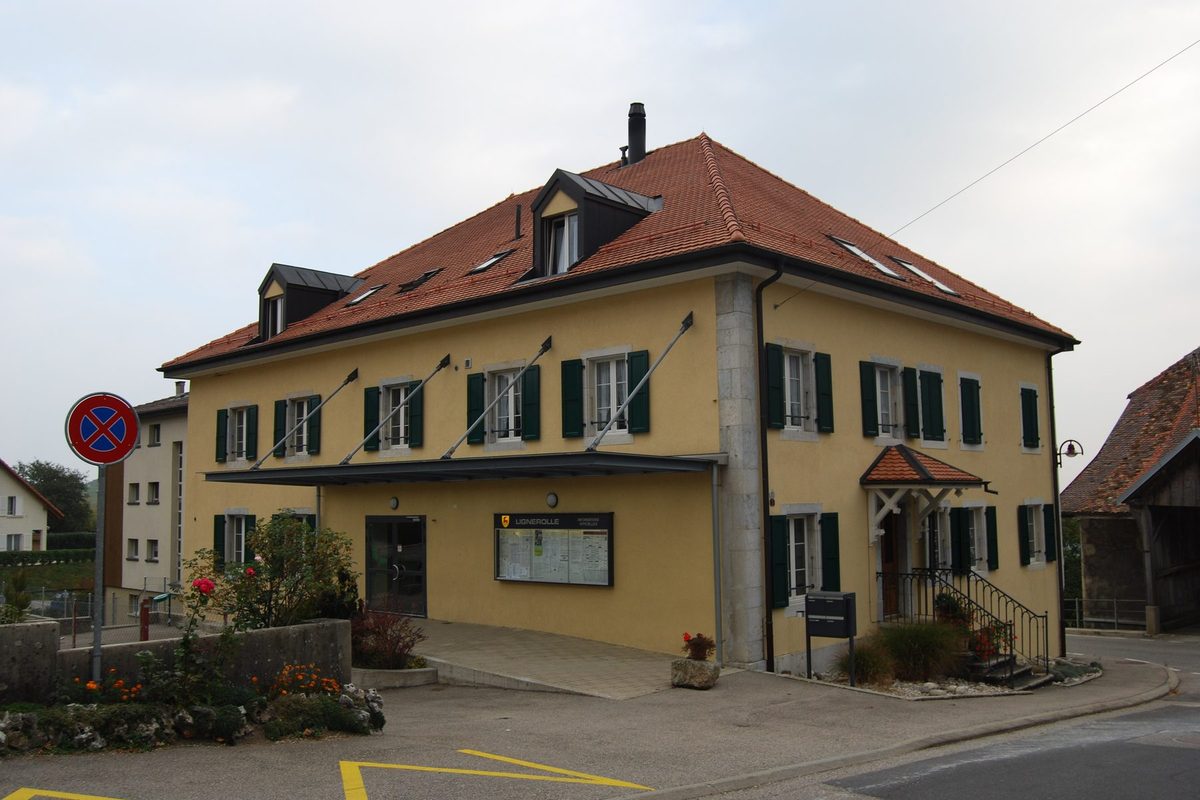
Lignerolle
The last anti-tank barrier built in Switzerland went up at Lignerolle in the mid-1980s, next to small forts disguised as chalets.
Entry based on 10 sources · Our method · Reusable text (CC BY-SA)
Origin of the name Lignerolle
First mentioned in 1160-1164 as «de Lineroles», then «Linnierules», «Ligniroles» in 1282 and «Lignieroles» in 1453. The name comes from «lignière», a small flax field, recalling the flax once grown in the village.[1][3][4]
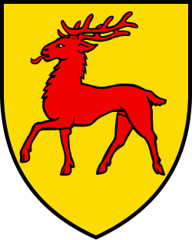
Coat of arms of Lignerolle
Or, a stag passant gules. On a yellow field walks a red stag. Adopted in 1928, these arms take up the stag of the de Cerjat family.[9][4]
Founding of Lignerolle
Nobody knows who founded Lignerolle. The village grew up on the slopes of the Suchet, along the old Jougne road that linked the Plateau with Franche-Comté, and its origin is tied to its church. Tradition places the foundation of a first sanctuary dedicated to St Vitus (Saint Vit, Saint Guy) between 760 and 840. The present 13th-century church succeeds buildings dating back to the 9th century. In the Middle Ages Lignerolle was part of the land of Les Clées. Its regional importance shows in the career of Nicolas, the village mayor, who became lord of Ballaigues. After the decline of the Jougne road, farming remained the main activity. In the uplands the municipality owns the La Bessonaz estate, in a wood-pasture zone.[1][2][3][4]
History of Lignerolle
760-840. Presumed foundation of a first sanctuary dedicated to St Vitus.[5]
1160-1164. First mention of the village, as «de Lineroles».[1]
1228. The church of Saint-Vit is attested as a parish church.[1][5][7]
1282. The name appears as «Ligniroles».[3][4]
late 13th century. Construction of the present nave of the church of Saint-Vit.[5]
1302. Nicolas, mayor of Lignerolle, becomes lord of Ballaigues: Lignerolle and Ballaigues form a lordship detached from the land of Les Clées, held by a vassal of Louis of Savoy. It later passes to the Champvent, Champion, Besson, Asperlin and finally Cerjat families.[1][2][4][7]
1416. The village has 60 hearths.[1]
early 15th century. Construction of the church choir.[5]
1453-1475. After a fire, the nave of the church is vaulted and the west portal rebuilt. In 1453 only 40 hearths remain.[1][5]
1536. Bernese conquest of Vaud: Lignerolle belongs to the bailiwick of Yverdon (until 1798). The commune is governed by a Council of Five.[1]
1604. Lignerolle becomes a lordship separate from Ballaigues.[2][4]
17th century. Construction of the manor house known as the château of Lignerolle.[3][4][7]
1798. Under the Helvetic Republic, Lignerolle is attached to the district of Orbe (until the end of 2007).[1]
1803-1838. The village's stone fountains are built: the first in 1803, others in 1809, 1812, 1819, 1822 and 1838.[4]
1928. The municipality adopts its arms, Or, a stag passant gules, recalling the de Cerjat family, lords of the place in the 18th century.[4]
1950-1952. Complete restoration of the church of Saint-Vit.[5]
1980. Creation of a land improvement syndicate.[1][4]
mid-1980s. The last anti-tank barrier built in Switzerland is constructed on the municipal territory, completing a set of small forts disguised as chalets and concrete obstacles («toblerones»).[3][4]
1989. Construction of the motorway between Ballaigues and Orbe, which relieves the village of heavy through traffic.[7]
2008. On 1 January the district of Orbe disappears with the entry into force of the new Vaud districts: Lignerolle joins the district of Jura-Nord vaudois.[8]
Population of Lignerolle
Sources and references: [1][6][7]
| 1416 | 60 hearths (households) |
| 1453 | 40 hearths (households) |
| 1764 | 218 (54 hearths) |
| 1850 | 306 |
| 1900 | 308 |
| 1950 | 244 |
| 1960 | 365 |
| 1980 | 262 |
| 2000 | 334 |
| 2025 | 452 |
Families of Lignerolle
Citizen families before 1800. Twelve families, with no precise date: Bastard, Bâtard, Besson, Buricod, Carey, Flaction, Languetin, Mayor, Nicolet, Peytermann, Peytremann and Reuge. The Chapuis, from Sumiswald BE, were registered in 1696.[10]
In the 19th century. The Guignard, from Vaulion VD, the Maillefer, from Ballaigues VD, and the Vuillemin, with no precise date.[10]
From 1901 to 1962. Six registrations. The Bulle, from France, in 1915. Then four families in 1956: the Cattin of Cornol JU, the Dubach of Niederstocken BE, the Poncet of Neyruz FR and the Trachsel of Jaberg BE. The last registered, in 1960, are the Zanoli, from France.[10]
Economy of Lignerolle, past and present
From flax to cereals. After the Jougne pass lost its importance, farming remained Lignerolle's only economic activity. The village mainly rears cattle. Flax growing, which gave the commune its name, disappeared with the arrival of cotton. Cereals and rapeseed have replaced it.[1][4]
Milk, timber and energy. Just under ten farmers work 507 hectares of farmland. The cooperative turns about 2.6 million litres of milk into Gruyère wheels. The 499 hectares of forest supply 2'400 m³ of timber a year. At the end of 2013, a solar park with 2'970 m² of panels went into service. In June 2014, the company AGROGAZ Lignerolle SA opened an agricultural biogas plant.[4]
Historic sites in Lignerolle
Church of Saint-Vit. Attested as a parish church in 1228, it succeeds earlier sanctuaries. The nave dates from the late 13th century, the choir from the early 15th century. After a fire, the nave was given rib vaults and the west portal was rebuilt between 1453 and 1475. The bell tower dates from 1696 and was raised in 1741. The church was restored in 1950-1952.[1][5][7]
Château de Lignerolle. 17th-century manor house at the heart of the village, around which the village grew up together with the church.[3][4][7]
Heritage site of national importance. The whole village of Lignerolle is listed in the Federal Inventory of Swiss Heritage Sites of national importance (ISOS).[7]
Stone fountains. A series of fountains built between 1803 and 1838.[4]
La Languetine pasture. Pasture known for its sycamore maple, more than a hundred years old, already mentioned in geography textbooks of the early 20th century.[3]
Remains in Lignerolle
Military fortifications. Forts and small forts disguised as chalets, once armed with guns and machine guns, and reinforced-concrete anti-tank obstacles («toblerones») survive on the municipal territory. The last anti-tank barrier built in Switzerland was erected here in the mid-1980s.[3][4]
Legends of Lignerolle
The Pierre à glissoir. According to legend, barren women went to the Pierre à glissoir on certain nights in the hope of becoming fertile.[3][4]
Traditions and festivals in Lignerolle
The Abbaye du Cerf. Every two years, in June, the Abbaye du Cerf livens up the village with a three-day shooting festival.[4]
The village societies. The L'Echo du Joran men's choir brings together singers from the region. Lignerolle also has a youth society and a shooting range society.[4]
Sources
- Dictionnaire historique de la Suisse, « Lignerolle »
- Dictionnaire historique de la Suisse, « Ballaigues »
- Commune de Lignerolle, « La Commune »
- Feuille des avis officiels du canton de Vaud, « Alphabet des communes vaudoises : Lignerolle »
- EERV, paroisse de Ballaigues-Lignerolle, « L'église du village : quelle histoire ! »
- Statistique Vaud, « Population résidante permanente au 31 décembre 2025 »
- Inventaire fédéral des sites construits d'importance nationale à protéger en Suisse (ISOS), fiche n° 4623 « Lignerolle »
- État de Vaud, communiqué du 12.07.2007, « Les préfètes et les préfets sont attribués aux nouveaux districts »
- IPI, Swissreg, emblems database: coat of arms of Lignerolle (no. 101337)
- Register of Swiss Surnames, 3rd edition (1989), search Commune "Lignerolle", Canton VD
Published by Sébastien Jörg ·
Other villages near Lignerolle
Missing information, or do you have a source? Suggest a correction or addition. Every submission is checked before it's published.
Suggest a change