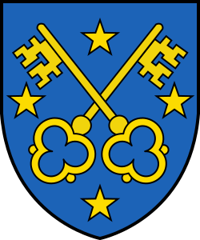
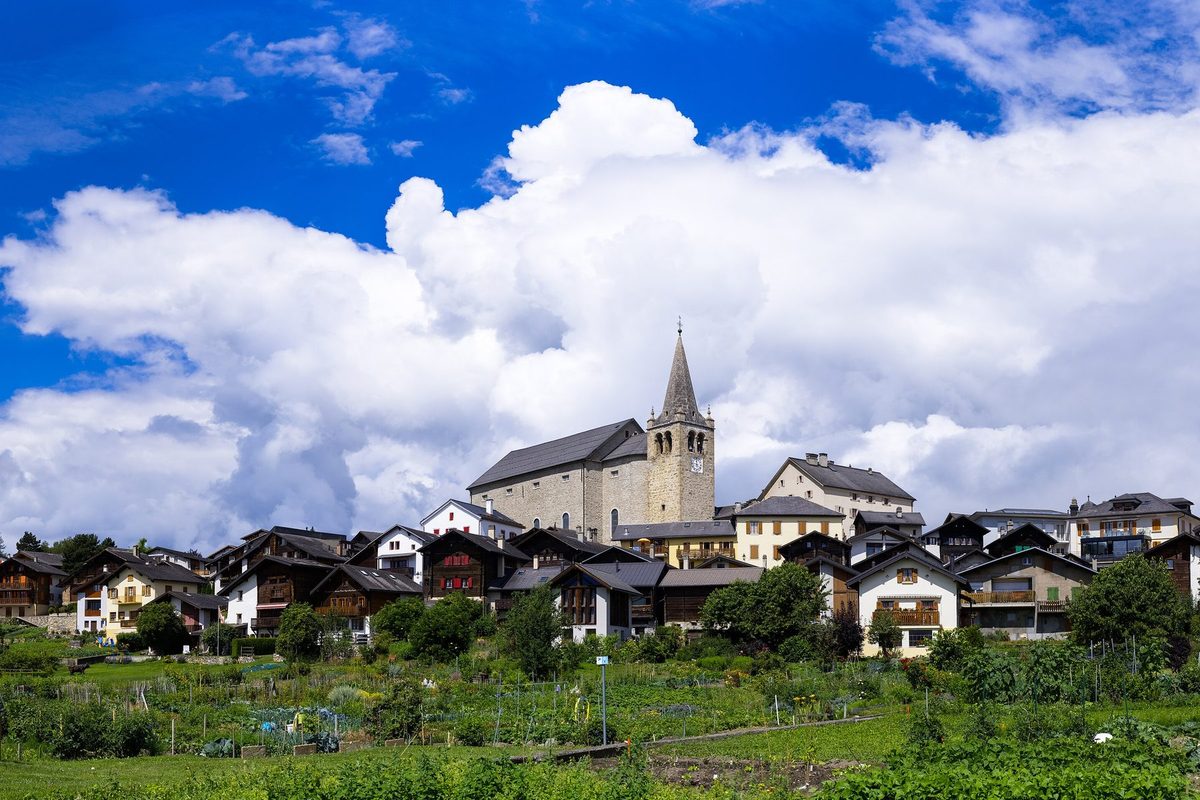
Lens
Origin of the name Lens
The name appears in 1177 as « de Lenz ». Where does the name come from? That is still unknown.[1]
Founding of Lens
Nobody knows who founded Lens. The village stretches along the right bank of the Rhône, and the municipality includes Lens, Chelin, Flanthey, Vaas, Saint-Clément and Valençon, as well as part of Crans-Montana. The Mont de Lens belonged to the castellany of Granges before passing to the bishop of Sion. The bishop owned numerous fiefs there, and many families held rights: d'Albi, de la Tour, Morestel, d'Ayent, d'Anniviers, de Rarogne, Tavelli, de Platea of Sierre. A castellan administered justice, first appointed by the bishop, later elected by the commoners. In the 14th century procurators managed the affairs of the « louable communauté de Lens », while its four quarters kept wide autonomy. Long devoted to farming and wine-growing, Lens turned to tourism from the second half of the 20th century and helped develop Crans-Montana.[1]
History of Lens
1177. Mentioned as « de Lenz ». A papal bull confirms the church among the possessions of the house of Mont-Joux (Great St Bernard).[1]
1221. Vaas is reportedly first mentioned this year.
1226. The castellany of Granges, to which the Mont de Lens belongs, passes to the bishop of Sion.[1]
1286. The church of Lens is dedicated to Saint Peter.[1]
1300. Foundation of the confraternity of the Holy Spirit.[1]
14th century. Lens becomes an autonomous community including Icogne, Chermignon and Montana.[1]
1575. Mathieu Luyter reportedly remodels the manor of Vaas, whose façades are decorated with hunting and farming scenes.
around 1842. Last enlargement of the parish church, after several earlier ones.[1]
1851. A decree of the Grand Council unites the quarters into a single municipality.[1]
1863. Montana separates from the priory of Lens.[1]
1905. Lens, Icogne, Chermignon and Montana become separate municipalities.[1]
1935. The statue of Christ the King is erected on the Châtelard hill, overlooking the Rhône plain.[1]
1948. Chermignon separates from the parish of Lens.[1]
2000. The service sector provides more than two thirds of jobs. More than half of the working population are commuters.[1]
Population of Lens
Sources and references: [1][3]
| 1687 | 567 inhabitants |
| 1850 | 688 inhabitants |
| 1910 | 1'111 inhabitants |
| 1950 | 1'660 inhabitants |
| 2000 | 3'357 inhabitants |
| 2025 | 4'586 |
Historic sites in Lens
Church of Saint-Pierre. Church formerly under the chapter of Sion, confirmed in 1177 among the possessions of the house of Mont-Joux and dedicated to Saint Peter in 1286. Enlarged several times, last around 1842. Montana (1863) and then Chermignon (1948) broke away from its large parish.[1]
Statue of Christ the King. Statue erected in 1935 on the Châtelard hill above the village, from where it overlooks the Rhône plain.[1]
Manor of Vaas. At the foot of the municipality, the manor in the hamlet of Vaas is an example of 16th-century rural architecture with painted façades. Mathieu Luyter reportedly remodelled it in 1575 and decorated it with hunting and farming scenes. It now houses a museum devoted to the Cornalin grape.[2]
Sources
- Dictionnaire historique de la Suisse, « Lens » (Serge Praplan, version du 13.03.2017)
- Crans-Montana Life (magazine), pages 79 à 86, « Château de Vaas » (architecture rurale du XVIe siècle aux façades peintes, musée du cornalin)
- Office fédéral de la statistique (OFS), STATPOP, chiffres provisoires au 31.12.2025, via citypopulation.de
- geo.admin.ch, recherche de lieux (coordonnées)
Localities of the municipality with a page
Other villages near Lens
Missing information, or do you have a source? Suggest a correction or addition. Every submission is checked before it's published.
Suggest a change