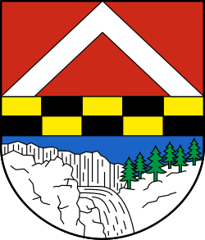
Les Brenets
The only Neuchâtel village on the northern slope of the Jura, on the Doubs and its lake, rebuilt on a geometric plan after the fire of 1848.
Entry based on 10 sources · Our method · Reusable text (CC BY-SA)
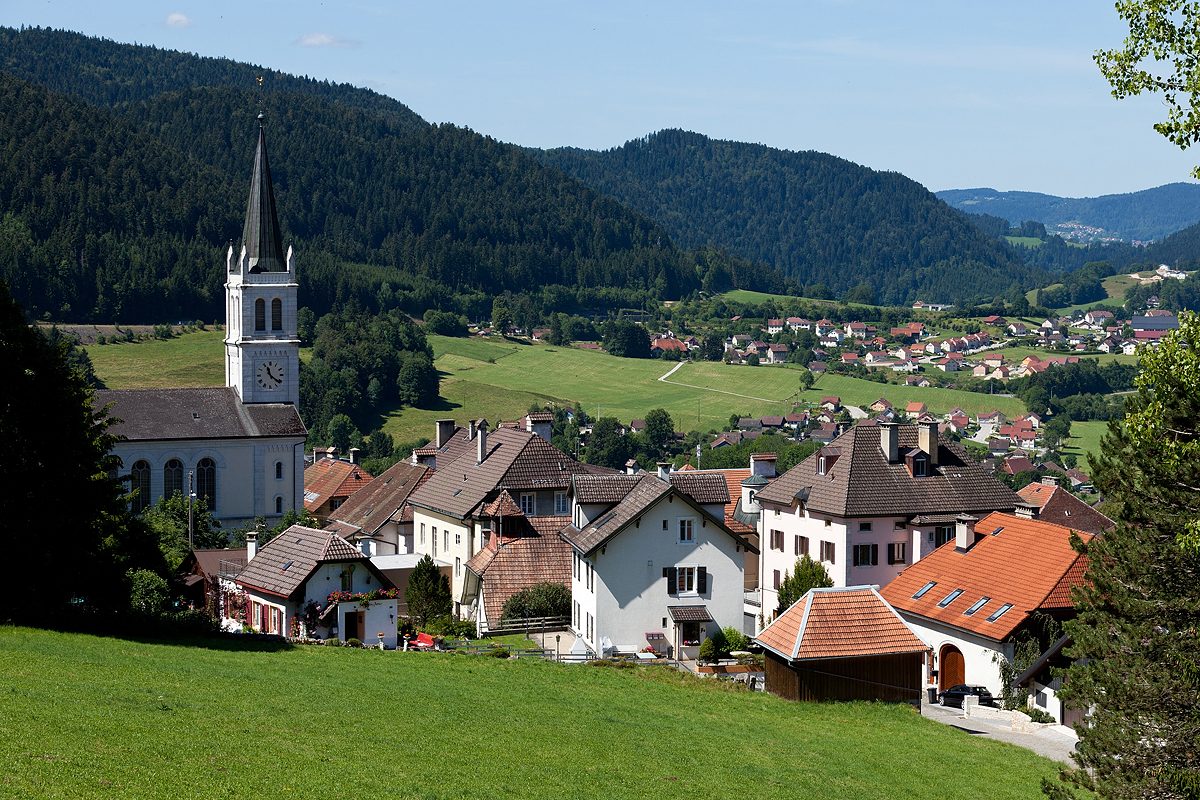
Origin of the name Les Brenets
The place first appears in 1325 as « chiez le Bruignet ». The etymology of « Les Brenets » has yet to be found.[1]
Founding of Les Brenets
There is no known founder or founding act for Les Brenets. Les Brenets were at first a dependency of the priory of Morteau, in Franche-Comté, which Jean III d'Aarberg, lord of Valangin, sought to acquire. From the start, people lived from farming, livestock and the forest, and the water power of the Doubs made it possible to set up sawmills and forges. The Reformation of 1534 tied the village to the lordship of Valangin for good. In 1539 it gained its own mairie, separated from that of Le Locle. In the 17th century its inhabitants formed their own community while remaining members of the « Mère commune ». The only Neuchâtel municipality on the northern slope of the Jura, Les Brenets has the Doubs as its border with France. Since 1 January 2021 the village has been part of the municipality of Le Locle.[1][2]
History of Les Brenets
1325. First written mention, in the form « chiez le Bruignet ».[1]
1511-1512. Claude d'Aarberg has a church built at Les Brenets, which becomes a parish church.[1]
1519. A mayor is already recorded at Les Brenets.[1]
1520. The parish passes from the diocese of Besançon to that of Lausanne.[1]
1534. The Reformation definitively seals the belonging of Les Brenets to the lordship of Valangin.[1]
1539. By an act of 16 July, the mairie of Les Brenets is separated from that of Le Locle.[1]
17th century. The inhabitants leave the community of Le Locle to found their own community, while remaining members of the « Mère commune ».[2]
1694. Fire in the church, followed by repairs.[1]
1702. End of the dependence of Les Planchettes on the jurisdiction of Les Brenets.[1]
18th century. Watchmaking, home lace-making and stocking factories are booming.[1]
around 1780. The optician Pierre-Louis Guinand becomes a citizen of Les Brenets. Around 1805 he develops a process for stirring molten glass that produces a very pure flint glass for optical instruments.[3]
1806. Opening of the road from Le Locle to Les Brenets.[1]
early 19th century. The first watchmaking comptoirs open, with a few workers.[1]
1824. Pierre-Louis Guinand dies at Les Brenets on 13 February.[3]
1830. Larger watchmaking workshops appear (Perret, Quartier, Ryser, Guinand).[1]
1848. On 19 September the village is almost entirely destroyed by fire. It is rebuilt on a geometric plan.[1]
1872-1922. The Jürgensen family, watchmakers of Danish origin, own the Le Châtelard estate, where they reportedly had a tower built around 1880.
1890. Opening of the Régional des Brenets railway, linking the village to Le Locle.[1][2]
2021. On 1 January, Les Brenets merge with the municipality of Le Locle.[2]
Population of Les Brenets
Sources and references: [1][4]
| 1531 | 31 hearths (households) |
| 1750 | 846 |
| 1850 | 1'172 |
| 1900 | 1'420 |
| 1950 | 1'381 |
| 2000 | 1'164 |
| 2020 | 1'014 (31 December, last census before the merger) |
Families of Les Brenets
Citizen families before 1800. Bersot, Billon, Cartier, Clodot-Billon, Guinand, Guinand-Samson, Jean-Cartier, Jeanmaire, Jeanmaire-dit-Cartier, Jeanmaire-dit-Quartier, Jeannot, Jeanquartier, Quartier, Quartier-dit-Maire and Quartier-la-Tente, with no precise date. The names Cartier, Jeanmaire and Quartier recur in several compound forms.[9]
In the 19th century. Belperrin and Quellet, along with the Goettler (from Austria), the Honer, Mayer, Müller and Thum (from Germany), the Lecoultre (from Le Chenit VD) and the Pape (from France), with no precise date. The Haldimann, from Walkringen BE, were registered in 1821. They were followed by the Noz (from Germany) in 1891, the Rickli (from Thunstetten BE) in 1892 and the Hirschi (from Schangnau BE) in 1898.[9]
From 1901 to 1962. Thirty-two registrations. Six families came from Italy (Bosquet in 1918, Gioria in 1922, Tabasso in 1927, Barzé in 1943, Bianchin in 1945, Stocco in 1957) and five from France (Baverel in 1901, Rigoulot in 1917, Rognon in 1921, Prenot in 1933, and the Maillard, registered in 1921, 1927 and 1939). Others came from Germany (Schulze in 1902, Schwarz in 1917, Mahyère in 1920), Austria (Seidel in 1916, Breguet in 1938) and the Soviet Union (Michaïloff in 1922). The Swiss families came from many cantons: Fragnière from Gumefens FR and von Känel from Reichenbach im Kandertal BE (1904), Buchs from Jaun FR and Hochstrasser from Hägglingen AG (1908), Inäbnit from Grindelwald BE (1909), Bähler from Uebeschi BE and Perrin from Champéry VS (1916), Eisenring from Jonschwil SG (1917), Sieber from Reichenbach im Kandertal BE (1921), Simoni from Medeglia TI (1925), Villard from Daillens VD (1926), Flaig from Monterschu FR (1927), Billieux from Fregiécourt JU (1928) and Clerc from Estavayer-le-Gibloux FR (1930). The Scheurer were registered in 1938. The last registration, in 1957, was that of the Stocco.[9]
Notable people of Les Brenets
Pierre-Louis Guinand (La Corbatière 1748 - Les Brenets 1824). The son of a joiner, he made watch cases and other watch parts and taught himself the basics of optics. From 1784 to 1790 he studied molten glass, before developing the process that bears his name. From 1805 to 1814 he worked in Bavaria, at Benediktbeuern, with the optician Joseph von Fraunhofer.[3]
Economy of Les Brenets, past and present
Land, forest and the power of the Doubs. Farming, livestock and forests have supported the village since its beginnings. The water power of the Doubs drove sawmills and forges.[1]
Watchmaking. In the 18th century watchmaking grew alongside lace made at home and stocking factories. In 1900 many watchmaking workshops were operating in Les Brenets. A small industry remains in watchmaking, electronics, mechanics and sheet metal work. Its large factories stand south of the old village.[1][8]
The lake and tourism. Rockfalls dammed the Doubs and formed the Lac des Brenets, which allowed the hotel trade to develop. In winter the lake can turn into one of the largest natural ice rinks in Europe.[1][8]
Disasters and major events in Les Brenets
The fire of 19 September 1848. Fire destroyed the village. Only a few buildings escaped the flames, among them the 16th-century church. Les Brenets was rebuilt on a geometric alignment plan inspired by the neighbouring towns.[1][8]
Historic sites in Les Brenets
Lac des Brenets. Formed when landslides dammed the Doubs, this border lake, also called Lac de Chaillexon, allowed the hotel trade to grow at Les Brenets. Reportedly about 3.7 km long, it is said to be the remnant of a prehistoric lake.[1]
Saut du Doubs. Waterfall of the Doubs about 27 metres high, on the French-Swiss border, downstream of the Lac des Brenets. On the French side, the basins and the Saut du Doubs have been a protected site (site classé) since 20 September 2001.[5][6]
Village rebuilt after 1848. Almost entirely destroyed by the fire of 19 September 1848, the village was rebuilt on a geometric plan that still shapes its centre.[1]
Church of Les Brenets. Built in 1511-1512 at the initiative of Claude d'Aarberg, it became a parish church. Burned in 1694, it was later repaired. The old church reportedly now houses the municipal office and the grave of Pierre-Louis Guinand, which still needs confirming.[1]
Tour Jürgensen. Tower built around 1880 by the Jürgensen family, owners of Le Châtelard from 1872 to 1922, and restored in 1995-1996. These dates still need confirming.
Protected heritage in Les Brenets
Cultural property of regional significance (B objects)[7]
- Usine électrique de la Rançonnière
Traditions and festivals in Les Brenets
Skating on the Doubs. In winter the frozen Doubs becomes a natural rink stretching from the Saut-du-Doubs to Chaillexon. No official calendar sets the season. An old Les Brenets family tests the ice using an ancestral technique, and when it puts on its skates, the village follows. Depending on the weather, the season lasts from one to forty days a year. Photographs from the 1930s to the 1950s already show skaters, hockey players and traders on the river.[10]
Sources
- Dictionnaire historique de la Suisse, « Brenets, Les »
- Dictionnaire historique de la Suisse, « Locle, Le »
- Dictionnaire historique de la Suisse, « Guinand, Pierre Louis »
- État de Neuchâtel, arrêté du 10 février 2021 portant homologation des résultats du recensement cantonal de la population du 31 décembre 2020
- DREAL Bourgogne-Franche-Comté, « Liste des 46 sites classés dans le Doubs (25) » (mise à jour le 24 juin 2026)
- Montagnes du Jura (tourisme régional), « Les bassins et le Saut du Doubs »
- Federal Office for Civil Protection (FOCP), Swiss Inventory of Cultural Property (PCP), list for the canton of Neuchâtel (as of 1.1.2026)
- Federal Inventory of Swiss Heritage Sites (ISOS), sheet « Les Brenets »
- Register of Swiss Surnames, 3rd edition (1989), search Commune "Les Brenets", Canton NE
- Federal Office of Culture, Living Traditions in Switzerland, "Le patinage sur le Doubs" (Skating on the Doubs)
Published by Sébastien Jörg ·
Other villages near Les Brenets
Missing information, or do you have a source? Suggest a correction or addition. Every submission is checked before it's published.
Suggest a change