Moulins souterrains du Col-des-Roches
Around 1660 Jonas Sandoz had the cave where the Bied disappears, at the Col-des-Roches, dug out to install five water wheels. Ruined, he sold the site in 1690.
Entry based on 4 sources · Our method · Reusable text (CC BY-SA)
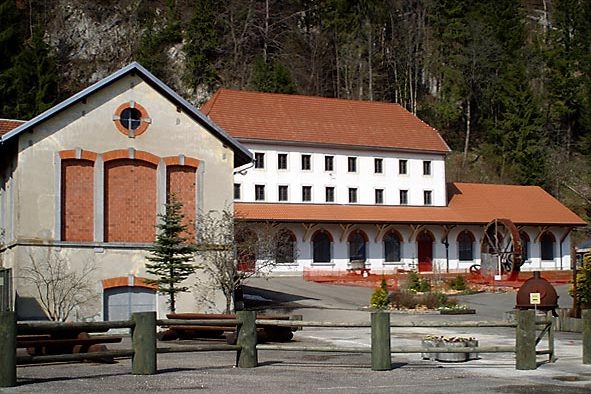
Origin of the name Moulins souterrains du Col-des-Roches
The site is named after the Col-des-Roches, west of Le Locle near the French border, where it lies. The origin of the pass's name has not yet been explained.
Founding of Moulins souterrains du Col-des-Roches
The mills lie at the Col-des-Roches, in the municipality of Le Locle, where the Bied, the river of the Le Locle valley, disappears into a sinkhole with a drop of several metres. In 1652 the Council of State granted three millers, Daniel Renaud, Isaac Vuagneux and Balthazard Calame, the right to use the last stretch of the Bied. They installed two water wheels driving a mill and a rebatte (crushing mill). Around 1660 Jonas Sandoz, a wealthy tax collector, obtained the concession for the whole course of the Bied between Le Locle and the Col-des-Roches, compensated the first operators and had the cave dug out to install five water wheels: mills, sawmill, rebatte and oil press, with underground channels and galleries for maintaining the machinery.[1]
History of Moulins souterrains du Col-des-Roches
1652. The Council of State authorises Daniel Renaud, Isaac Vuagneux and Balthazard Calame to use the last stretch of the Bied. Two water wheels drive a mill and a rebatte (crushing mill).[1]
1660. Jonas Sandoz obtains the concession for the Bied from Le Locle to the Col-des-Roches and installs five water wheels in the cave (mills, sawmill, rebatte, oil press).[1][3]
1690. Ruined, Jonas Sandoz sells the site.[1]
1780s. Successive owners have simplified the installation, reduced from five to three wheels.[1]
Early 19th century. The Bied is channelled as far as the Col-des-Roches, where it drives the underground mills.[2]
1844. Jean-Georges Eberlé, a baker from Württemberg, buys the mills and modernises them (mills, grain cleaning and bolting).[1]
around 1854. Eberlé replaces a water wheel with a turbine and drives a relocated sawmill through a 50-metre transmission shaft.[1]
1884. The municipality of Le Locle buys the mills from Eberlé's heirs.[1]
1898. End of milling; the site is converted into a border slaughterhouse for veterinary inspection of livestock, and the cave is used as a dump.[1][2]
1966. The slaughterhouse closes; the sinkhole is heavily polluted.[1]
1973. A group of history and caving enthusiasts begins cleaning the cave and partly restoring the mills. After fifteen years of voluntary work, the Confrérie des Meuniers opens the site to the public.[1]
2001. The permanent exhibition opens.[1]
2007. A working hydraulic circuit is put into service.[1]
Economy of Moulins souterrains du Col-des-Roches, past and present
Mills, sawmill and oil press. In the 18th century the water wheels in the cave dropped from five to four, then to three. The mills' website links this decline to the retreat of grain mills, which faced competition from imported flour. In 1844 Jean-Georges Eberlé added grain cleaning, a bolting machine and a sack hoist.[1]
The border slaughterhouse. From 1898 the federal slaughterhouse checked the health of imported cattle. It was enlarged in the early 20th century. Until it closed in 1966, it dumped meat waste and sewage into the sinkhole.[1]
Visitors. The site is open to the public. The Le Locle branch of Tourisme neuchâtelois moved in in 2004. In 2018 the courtyard was redesigned and the old sawmill showcased.[1]
Historic sites in Moulins souterrains du Col-des-Roches
The mill cave. Natural cave said to stay at a constant temperature of about 7 degrees, where visitors see the remains of 17th, 18th and 19th century installations and a multi-level flour mill driven by water power. The site is listed as a Swiss cultural property of national significance.[3][4]
The museum. The permanent exhibition covers agriculture, milling, baking, water power, electricity and the border.[3]
The prehistoric rock shelter of the Col-des-Roches. Nearby, the Col-des-Roches rock shelter yielded the first known pottery of the canton of Neuchâtel and many tools.[2]
Remains in Moulins souterrains du Col-des-Roches
Wheels, channels and galleries. The underground installations dug from 1660 (channels, maintenance galleries, wheel pits) and the machinery restored since 1973 show three centuries of harnessing the Bied.[1]
Protected heritage in Moulins souterrains du Col-des-Roches
Cultural property of national significance (A objects in the PCP inventory)[4]
- Moulins souterrains du Col-des-Roches
Cultural property of regional significance (B objects)[4]
- Col-des-Roches, abri mésolithique - néolithique
- Gare du Col-des-Roches
Sources
- Moulins souterrains du Col-des-Roches, « Histoire »
- Dictionnaire historique de la Suisse, « Locle, Le »
- Musées suisses, « Moulins souterrains du Col-des-Roches »
- Office fédéral de la protection de la population (OFPP), Inventaire suisse des biens culturels d'importance nationale et régionale, liste du canton de Neuchâtel (état au 1.1.2026), objet 4037
Published by Sébastien Jörg ·
Other villages near Moulins souterrains du Col-des-Roches
Missing information, or do you have a source? Suggest a correction or addition. Every submission is checked before it's published.
Suggest a change