La Chaux-du-Milieu
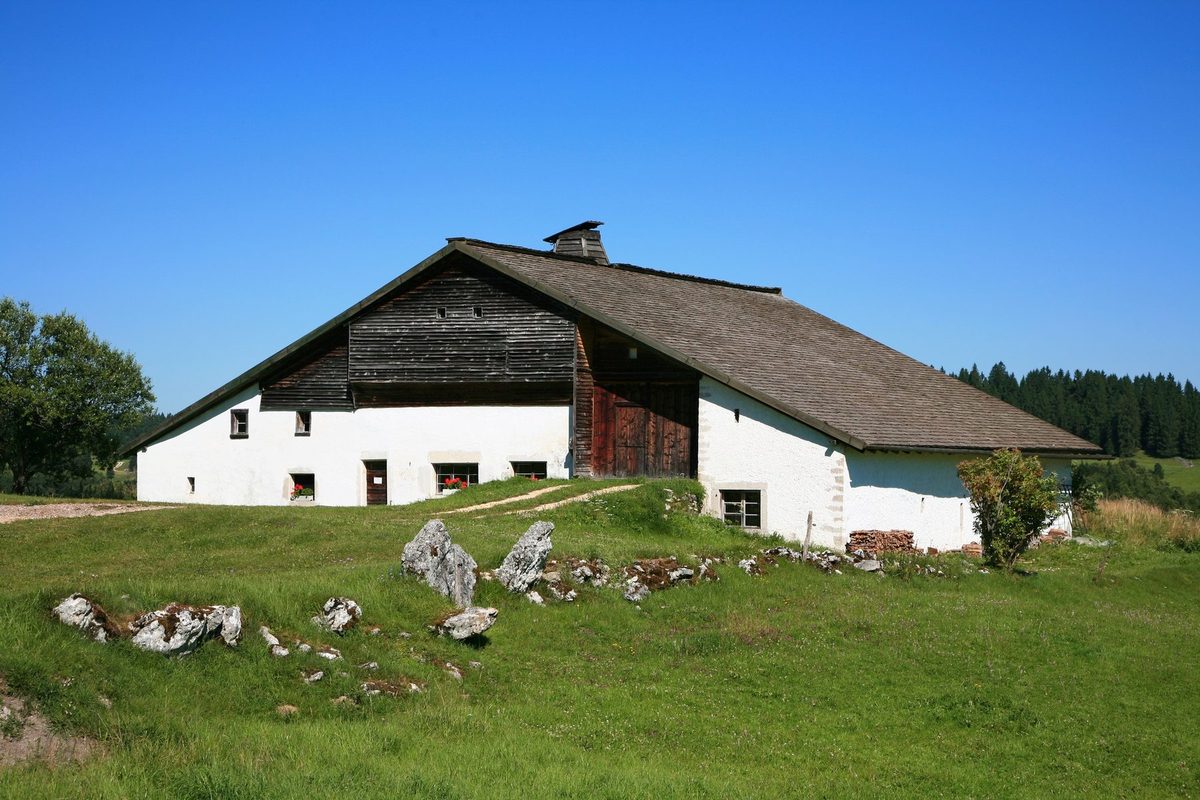
Granted as a fief in 1310 to people from Morteau and later settled from Le Locle, La Chaux-du-Milieu keeps the Grand-Cachot-de-Vent, a wooden double farmhouse built in 1530-1531.
Entry based on 11 sources · Our method · Reusable text (CC BY-SA)
Origin of the name La Chaux-du-Milieu
The first written mention, in 1310, gives the form « calvum de Escoblon ». « Chaux de Cachot » and « Chaux Baussan » follow. The origin of the present name is uncertain.[1]
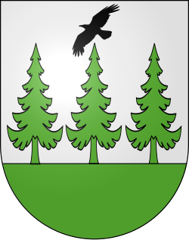
Coat of arms of La Chaux-du-Milieu
Argent, on a mount vert three fir trees of the same, the middle one surmounted by a crow rising sable. On a white field three green firs grow from green ground, and a black crow takes flight above the middle one.[6]
Founding of La Chaux-du-Milieu
In 1310 the count of Neuchâtel granted land at La Chaux-du-Milieu as a fief to inhabitants of Morteau, in Franche-Comté. Lasting settlement then came from Le Locle: from the early 16th century, inhabitants of Le Locle settled this part of the valley of La Brévine. They remained attached to the parish of Le Locle until 1716, the year the parish of La Chaux-du-Milieu was founded and the church built. The locality belonged to the jurisdictions of Travers and Rochefort until 1821, then to that of La Brévine until 1848, and finally to the district of Le Locle. The municipality was founded in 1825.[1]
History of La Chaux-du-Milieu
1310. The count of Neuchâtel grants land at La Chaux-du-Milieu as a fief to inhabitants of Morteau. First mention, in the form « calvum de Escoblon ».[1]
early 16th century. Inhabitants of Le Locle settle the area. They belong to the parish of Le Locle.[1]
1530-1531. Construction of the wooden double farmhouse of Grand-Cachot-de-Vent.
early 17th century. The wooden façades of the Grand-Cachot-de-Vent farmhouse are replaced by masonry.
1716. Foundation of the parish of La Chaux-du-Milieu and construction of the church.[1]
1821. End of its belonging to the jurisdictions of Travers and Rochefort. La Chaux-du-Milieu passes to the jurisdiction of La Brévine.[1][2]
1825. Foundation of the municipality.[1]
1848. End of the jurisdiction of La Brévine. La Chaux-du-Milieu now belongs to the district of Le Locle.[1]
1860. The population reaches its highest known level, with 954 inhabitants.[1]
early 20th century. Two watch factories employ the farmers who previously worked at home (lace, watchmaking).[1]
around 1960. The Grand-Cachot-de-Vent farmhouse is abandoned, before being saved and turned into a museum and gallery.
2000. The population remains essentially agricultural, with about half of the jobs.[1]
Population of La Chaux-du-Milieu
Sources and references: [1][3]
| 1850 | 805 |
| 1860 | 954 |
| 1900 | 893 |
| 1910 | 661 |
| 1950 | 462 |
| 1970 | 336 |
| 1990 | 422 |
| 2000 | 398 |
| 2025 | 494 (31 December) |
Families of La Chaux-du-Milieu
Citizen families before 1800. Huguenin, Huguenin-Bergenat, Huguenin-Dezot, Huguenin-Dumittan, Huguenin-Virchaux, Huguenin-Vuillemin, Jacot, Jacot-Descombes, Jeanneret, Jeanneret-Gris, Jeanneret-Grosjean, Matthey, Matthey-Dupraz, Montandon, Montandon-Varoda, Racine and Robert-Nicoud, with no precise date.[7]
In the 19th century. Thirty-seven families, the largest group. Février, Gindraux, Lutz, Perrenoud and Perrenoud-André, as well as the Junot from Travers NE, appear with no precise date. Dated registrations began in 1812 with the Grether family. In 1814 came the Nagel and the Naguel, from Germany, in 1815 the Perrot, the Vust and the Widmann (from Germany), in 1825 the Eberth and in 1829 the Aubée. The year 1830 brought the Burmann, the Scherf and the Favre-Bulle from Le Locle NE, 1832 the Clemmer and the Klemmer, 1833 the Gunther and the Benoît from La Sagne NE, 1834 the Grellet from Neuchâtel. Then came the Berthe and the Georget (1838), the Fiedler from Germany (1839), the Henry and the Zutter from Wahlern BE (1840), the Sennwald (1845), the Brandt from Le Locle NE (1847), the Calame from Le Locle NE (1859) and the Kopp (1862). At the end of the century the Guibelin from France (1887), the Brunner from Iseltwald BE and the Drouël from France (1888), the Droxler from Germany (1891), then the Musy from France and the Sauser from Sigriswil BE (1898) were registered.[7]
From 1901 to 1962. Seventeen registrations. Italy supplied six: Strigiotti (1920), Rigotti (1929), Perotti (1931), Melli and Préti (1953), Carlini (1959), the last family registered. France supplied five: Barthoulot (1901), a second branch of the Musy (1907), Balanche (1908), Portal (1927) and Lambert (1916 and 1928). Five families came from Switzerland: the Favre from Provence VD (1901), the Savary from Sâles (Gruyère) FR (1904), the Nussbaum from Bolligen BE (1909), the Tschantz from Sigriswil BE (1915) and the Hasler from Männedorf ZH (1934). The Zumkehr (1921) have no stated origin.[7]
Notable people of La Chaux-du-Milieu
André Grisel (1911-1990). A jurist born in La Chaux-du-Milieu, he presided over the Neuchâtel cantonal court before sitting on the Federal Supreme Court from 1956 to 1978, presiding over it in 1977-1978. A professor at the University of Neuchâtel, he received the Walther Hug Prize in 1984, notably for his Traité de droit administratif.[9]
Alphonse Jeannet (1883-1962). A geologist born in La Chaux-du-Milieu and a student of Maurice Lugeon, he wrote a remarkable thesis on the Tours d'Aï. A professor in Neuchâtel and then at ETH Zurich, where he was also curator of the geological collection, he specialised in invertebrate palaeontology and fossil sea urchins.[10]
Edouard Huguenin (1856-1926). Born in La Chaux-du-Milieu, he started as a station clerk in Le Locle and joined the Turkish railways in 1879. General director of the Anatolian Railways from 1908, he also sat on the boards of several lines, including the Baghdad railway, and managed to reconcile German, French and Ottoman interests.[11]
Economy of La Chaux-du-Milieu, past and present
Lace and watchmaking. For a long time the valley's farmers also worked at home, making lace and watches. In the early 20th century two watch factories gave them work.[1]
Farming. Around 2000 farming still provided about half of all jobs. To slow the fall in population, in the 1970s and 1980s the municipality opened new building land, first reserved for local people, then open to others.[1]
Historic sites in La Chaux-du-Milieu
Grand-Cachot-de-Vent farmhouse. Wooden double farmhouse built in 1530-1531 for two families and two farms, characteristic of the architecture of the high Jura with its front gable and post-supported roof frame. Its façades were rebuilt in masonry in the early 17th century and the living quarters enlarged in the 18th century. Abandoned around 1960, it was saved as a witness to this type of architecture and houses a museum and a gallery. It is listed in the Swiss Inventory of Cultural Property of National Significance.
Church of La Chaux-du-Milieu. Church built in 1716, when the parish was founded, ending the inhabitants' attachment to the parish of Le Locle.[1]
Protected heritage in La Chaux-du-Milieu
Cultural property of national significance (A objects in the PCP inventory)[5]
- Ferme du Grand Cachot
Cultural property of regional significance (B objects)[5]
- Temple
Traditions and festivals in La Chaux-du-Milieu
The Corbak Festival. A group of music-loving friends founded this festival in 1993 to bring life to a region away from the main routes. It takes place over the Whitsun weekend in the village's multi-purpose hall. French songs with strong lyrics come first, with established artists and young talents.[8]
Sources
- Dictionnaire historique de la Suisse, « Chaux-du-Milieu, La »
- Dictionnaire historique de la Suisse, « Brévine, La »
- État de Neuchâtel, arrêté du 4 février 2026 homologuant le recensement cantonal de la population au 31 décembre 2025
- Société d'histoire de l'art en Suisse, Guide artistique de la Suisse, notice « Ferme du Grand-Cachot-de-Vent » (Inventaire PBC 3983)
- Federal Office for Civil Protection (FOCP), Swiss Inventory of Cultural Property (PCP), list for the canton of Neuchâtel (as of 1.1.2026)
- IPI, Swissreg, emblems database: coat of arms of La Chaux-du-Milieu (no. 102901)
- Register of Swiss Surnames, 3rd edition (1989), search Commune "La Chaux-du-Milieu", Canton NE
- Republic and Canton of Neuchâtel, Service de la cohésion multiculturelle, fact sheet "Corbak festival" ("4 saisons" series)
- Dictionnaire historique de la Suisse, « Grisel, André », version du 30.01.2006
- Dictionnaire historique de la Suisse, « Jeannet, Alphonse », version du 09.02.2007
- Dictionnaire historique de la Suisse, « Huguenin, Edouard », version du 24.11.2006
Published by Sébastien Jörg ·
Localities of the municipality with a page
Other villages near La Chaux-du-Milieu
Missing information, or do you have a source? Suggest a correction or addition. Every submission is checked before it's published.
Suggest a change