Les Ponts-de-Martel
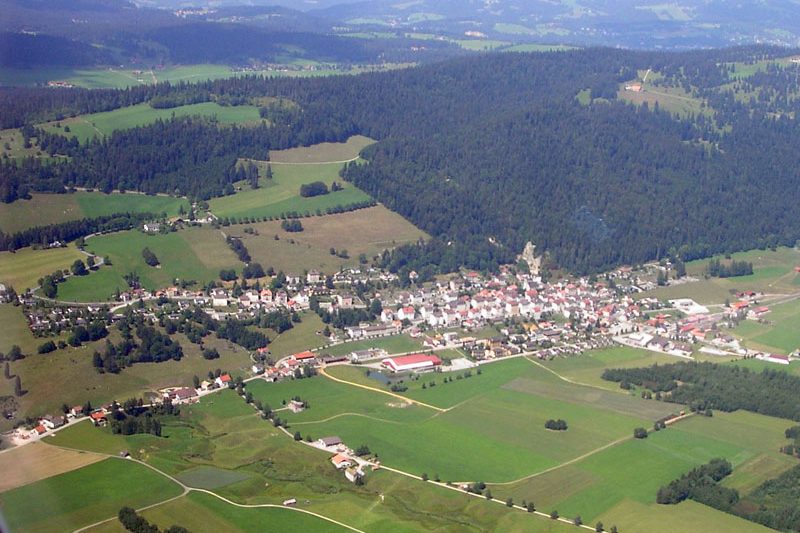
Born of land clearance on the edge of the marshes, the village's name recalls the bridges over the marsh, mentioned in 1376. It grew in the 19th century with its watch factories.
Entry based on 8 sources · Our method · Reusable text (CC BY-SA)
Origin of the name Les Ponts-de-Martel
The name « Martel » appears in 1360. The bridges crossing the marsh and the path to Morteau are mentioned in 1376. The place name recalls them. The etymology of « Martel » has not yet been explained.[1]
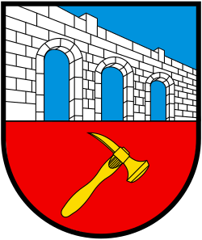
Coat of arms of Les Ponts-de-Martel
Per fess azure, a bridge of three arches argent, and gules, a hammer bendwise sinister Or. Above, a white three-arched bridge on blue. Below, a yellow hammer set diagonally on red.[6]
Founding of Les Ponts-de-Martel
A Roman coin of Claudius II Gothicus was found in the area. The village grew out of the clearing, in the 15th century, of the north side of the valley of La Sagne and Les Ponts, on the edge of the marshes. Its first inhabitants are mentioned in the 16th century. It was people from La Sagne living in the area who obtained the right to build a chapel in 1614, before a parish and then a municipality took shape. There is no known founder or founding act for Les Ponts-de-Martel.[1]
History of Les Ponts-de-Martel
1360. First mention of « Martel ».[1]
1376. The bridges crossing the marsh and the path to Morteau are mentioned.[1]
15th century. Clearance of the region.[1]
16th century. Mention of the first inhabitants. In church matters the region depends on Pontareuse.[1]
1614. People from La Sagne living in the area obtain the right to build a chapel.[1]
1636. The chapel is moved.[1]
1652. Formation of a parish; end of the church dependence on Pontareuse.[1]
1786. The parish community is made a municipality.[1]
1832-1848. Les Ponts-de-Martel are the seat of a civil jurisdiction.[1]
1844. Rebuilding of the chapel.[1]
19th century. The village grows with the establishment of watch factories.[1]
1914-1918. During the First World War the marsh is worked for peat.[1]
1922. Le Joratel leaves the municipality of Les Ponts-de-Martel to join Brot-Plamboz, in 1922 (or 1920).[1][2][4]
1939-1945. During the Second World War the marsh is again worked for peat.[1]
2005. The primary sector provides 22 % of jobs, the secondary sector 18 %.[1]
Population of Les Ponts-de-Martel
Sources and references: [1][3]
| 1793 | 695 |
| 1850 | 1'687 |
| 1870 | 2'189 |
| 1900 | 1'957 |
| 1950 | 1'508 |
| 2000 | 1'297 |
| 2025 | 1'234 (31 December) |
Families of Les Ponts-de-Martel
Citizen families before 1800. Fifty-eight families, with no precise date, among them the Perrenod. Sixteen of them bear a compound name.[7]
In the 19th century. Breitling, Collier, Dieu-de-Bellefontaine, Gauret, Gostely, Jeannin, Oehl and Sonrel, with no precise date. Other families, also registered without a date, came from Neuchâtel municipalities (Barbezat from Les Verrières, Bergeon and Borel from Neuchâtel, Brandt and Droz-dit-Busset from Le Locle), from the canton of Bern (Brunner from Iseltwald, Schläppy from Gadmen, Schneider from Brügg, Schorer from Uebeschi, Schwab from Radelfingen, Schwitzguebel from Saanen, Spahr from Spiez, Stauffer from Schwendibach), from the canton of Vaud (Chappuis from Carrouge, Chapuis from Romanel-sur-Lausanne) and from Pont-la-Ville FR (Amey). The Lardy, from Auvernier NE, were registered in 1845. Dated registrations multiplied at the end of the century: Erb from Röthenbach im Emmental BE and Zaugg from Trub BE (1889), Feuz from Lauterbrunnen BE and Hofschneider from Germany (1890), Dänzer from Frutigen BE (1891), Götschmann and Meylan from Le Chenit VD (1893), Bader from Austria (1894), Tschantz from Sigriswil BE (1895) and Dornier from France (1897).[7]
From 1901 to 1962. Forty-seven registrations, from 1904 to 1961. Italy supplied fifteen, France five and Germany three. Other families came from Austria, Belgium, Greece, Poland and Czechoslovakia. Eleven were Swiss, eight of them from Bern. The last registrations, in 1961, were those of the Josting and the Mathys.[7]
Notable people of Les Ponts-de-Martel
Louis Zutter (Les Ponts-de-Martel 1865 - Boudry 1946). Gymnast. At the Athens Olympic Games in 1896, he won gold on the pommel horse and silver in the vault and on the parallel bars.[8]
Economy of Les Ponts-de-Martel, past and present
Clearing and farming. Land grants issued by the counts of Neuchâtel in 1444 and 1473 bear witness to the clearing of the area. In the 19th century the hamlets remained agricultural. In 2005 the primary sector still provided 22% of jobs.[1]
Watchmaking. The village grew in the 19th century as watch factories set up there. In 2005 the secondary sector provided 18% of jobs.[1]
Peat. During both world wars the marsh was worked for peat. An educational trail opened in 2000 tells the story of this activity.[1]
Historic sites in Les Ponts-de-Martel
Temple (former chapel). Chapel whose construction was authorised in 1614, moved in 1636 and rebuilt in 1844. It became the centre of the parish formed in 1652.[1]
The Les Ponts marsh. Marsh on whose edge the village grew up. The bridges crossing it are mentioned in 1376 and its peat was worked during both World Wars.[1]
Martel-Dernier and Petit-Martel. Hamlets of the municipality which, like the village, bear the name Martel.[1]
Remains in Les Ponts-de-Martel
Roman coin. A Roman coin of Emperor Claudius II Gothicus was discovered in the municipal territory.[1]
Legends of Les Ponts-de-Martel
The devil of Les Ponts, 1809. Early in 1809, word spread through the Neuchâtel mountains that evil spirits had taken over Moïse Perrenod's house at the Combe-des-Glottes. Candlesticks, the Bible and watchmaker's tools fell by themselves, windowpanes shattered, and a stone struck the old man on the head. Onlookers flocked there every night, and healers came to lift the spell with herbs. After about ten days, Lieutenant Huguenin of Le Locle saw the household's godson, a 13-year-old servant boy, secretly throw a stone. The boy confessed everything. The Travers court sentenced him to a whipping and six months in prison, half of which the Council of State remitted. People went on calling him the Devil of Les Ponts.[5]
Sources
- Dictionnaire historique de la Suisse, « Les Ponts-de-Martel »
- Dictionnaire historique de la Suisse, « Brot-Plamboz »
- État de Neuchâtel, arrêté du 4 février 2026 homologuant le recensement cantonal de la population au 31 décembre 2025
- Commune de Brot-Plamboz, « Histoire »
- Dr Guillaume, « Le diable des Ponts », Musée neuchâtelois, 1865, p. 289-299
- IPI, Swissreg, emblems database: coat of arms of Les Ponts-de-Martel (no. 102896)
- Register of Swiss Surnames, 3rd edition (1989), search Commune "Les Ponts-de-Martel", Canton NE
- Olympedia, "Louis Zutter"
Published by Sébastien Jörg ·
Other villages near Les Ponts-de-Martel
Missing information, or do you have a source? Suggest a correction or addition. Every submission is checked before it's published.
Suggest a change