Les Charbonnières
On the night of 10 to 11 September 1900, an oil lamp fell into sawdust and started a fire that destroyed 15 houses in Les Charbonnières.
Entry based on 11 sources · Our method · Reusable text (CC BY-SA)
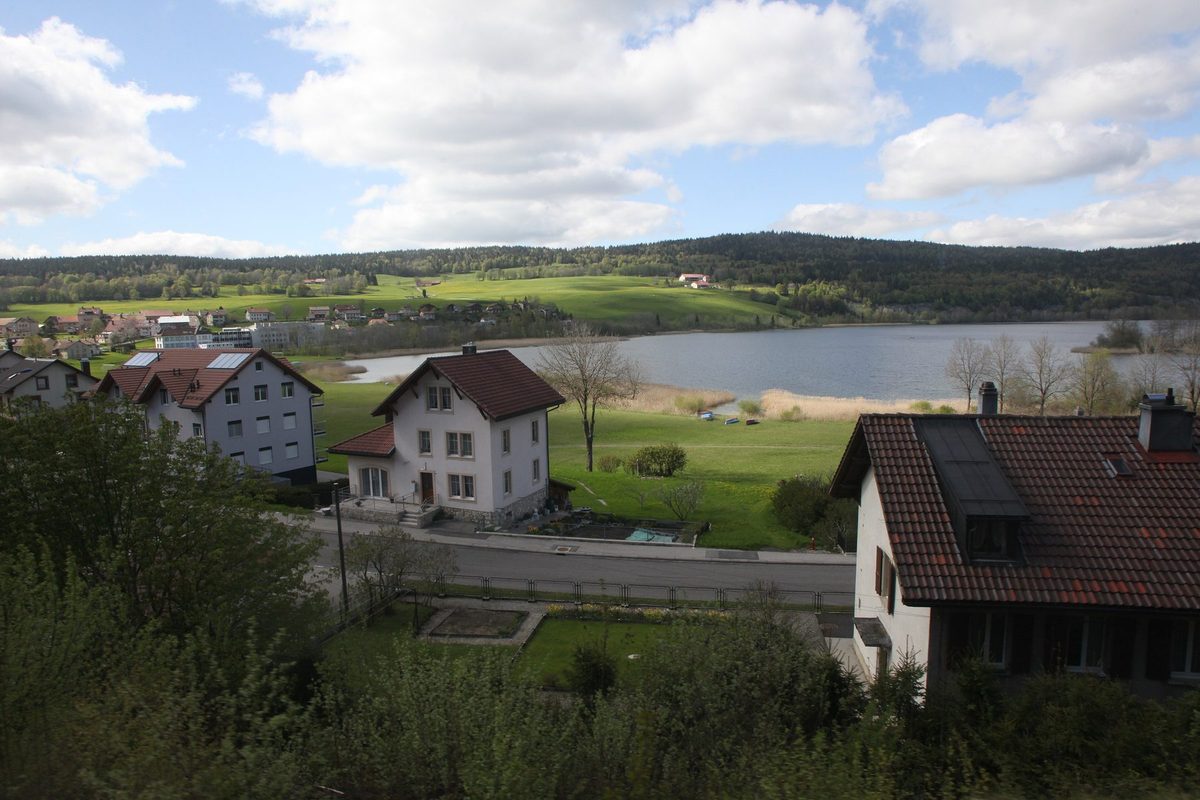
Origin of the name Les Charbonnières
The village first appears in 1489. Its name is linked to the production and storage of charcoal, notably for the people of neighbouring Vallorbe, whose forges consumed it.[1][2]
Coat of arms of Les Charbonnières
Arms of the former commune section of Les Charbonnières: azure, a mount sable inflamed gules, charged with a millwheel argent. On a blue field rises a black mount with red flames coming out of it. A white millwheel is set on the mount.[9]
Founding of Les Charbonnières
Shortly before 1489 the Rochat family settled on the site of Les Charbonnières, where the mill of La Sagne, at which the people of Le Lieu had their grain ground, had stood. They developed the land extensively. Part of the family later settled beyond the bridge of La Goille, forming the «Petites Charbonnières», while the original core became the «Grandes Charbonnières». The village belongs to the commune of Le Lieu and was its oldest commune fraction, attested from the early 16th century.[2][5]
History of Les Charbonnières
1489. First mention of the village. The Rochat family has just settled there.[1][2]
early 16th century. Les Charbonnières form a commune fraction, the oldest in the commune of Le Lieu.[5]
1514. The ironworks of Les Charbonnières start operating. They run until around 1740.[1]
1674. The inhabitants build their first place of worship, a small chapel.[3]
1780. A bell is installed in the chapel's small bell tower.[3]
1833-1834. Construction of the village church, dedicated in 1834, which obtains a monthly service.[3]
early 19th century. Birth of Vacherin Mont-d'Or in the Vallée de Joux. The cheese was sold at Les Charbonnières.[6]
1882. The village hands over its church to the commune of Le Lieu.[3]
1899. Opening of the Pont-Brassus railway line, which serves Les Charbonnières.[1][7]
1900. On the night of 10 to 11 September a fire started by a paraffin lamp that fell into sawdust destroys 15 houses. The village is partly rebuilt by the contractors Poget and Fantoli.[4]
2010. The commune fraction of Les Charbonnières disappears.[5]
Economy of Les Charbonnières, past and present
Charcoal. The village's name is directly linked to the making and storing of charcoal. Les Charbonnières also had its own ironworks, active from 1514 until around 1740.[2][1]
Wood, milk and watches. In the commune of Le Lieu, woodenware making supplemented incomes until the late 19th century, and dairy farming, with its vacherin cheeses, still did so in the 20th century. Small-scale metalworking gave way to stone cutting, then to watchmaking, dependent on Geneva and still dominant. In 2000 industry provided just over two thirds of the commune's jobs.[1]
Vacherin cheese. The village presents itself as the birthplace of Vacherin Mont-d'Or. It houses the museum devoted to this cheese and hosts the Vacherin Festival each early autumn, whose 27th edition took place in 2025.[10]
Disasters and major events in Les Charbonnières
The fire of 1900. The fire broke out in a very old building where vacherin boxes were made. Forgotten embers rekindled it during the night. It destroyed the house, then much of the upper village.[10]
Historic sites in Les Charbonnières
Church of Les Charbonnières. Built in 1833-1834 and dedicated in 1834 to replace the chapel of 1674, it was handed over to the commune in 1882. A second bell was installed in 1896 thanks to a village subscription, the clock was replaced in 1892, the interior was restored in 1960 after a Christmas tree fire in 1957, and an organ replaced the harmonium in 1968. Its architect is said to be Henri Perregaux of Lausanne.[3]
Musée du Vacherin Mont-d'Or. Located at Les Charbonnières, it presents a collection of objects and documents on the making of Vacherin Mont-d'Or, a soft cheese born in the Vallée de Joux in the early 19th century and protected by an AOP since 2003.[6]
Traditions and festivals in Les Charbonnières
The Vacherin Mont-d'Or Festival. Every year at the end of September, the producers and ripeners of Vacherin Mont-d'Or AOP invite the public to Les Charbonnières to taste the first vacherins of the season. The day also features the return of the herds from their summer pastures, stalls run by local craftspeople and folk entertainment.[11]
Sources
- Dictionnaire historique de la Suisse, « Lieu, Le » (Olivier Pichard, version du 24.03.2009)
- Archives culturelles de la Vallée de Joux, « 48. Du côté des Charbonnières, un village pas tout à fait comme les autres »
- Archives culturelles de la Vallée de Joux, « 4. La chapelle et l'église des Charbonnières »
- Archives culturelles de la Vallée de Joux, « 1900. Un village brûle. Les Charbonnières, dans la nuit du 10 au 11 septembre »
- Archives culturelles de la Vallée de Joux, « 47. Bref historique des fractions de commune de la Vallée »
- Vallée de Joux Tourisme, « Musée du Vacherin Mont-d'Or »
- État de Vaud, Direction générale de la mobilité et des routes, carte de la ligne R4 (RER Vaud)
- Statistique Vaud, « Population résidante permanente au 31 décembre 2025 »
- IPI, Swissreg, emblems database: coat of arms of Les Charbonnières (no. 102149)
- Official Gazette of the Canton of Vaud (FAO), "Alphabet des communes vaudoises: Le Lieu"
- Interprofession du Vacherin Mont-d'Or, press release of 25.08.2022, "Fête du Vacherin Mont-d'Or" (via Agir)
Published by Sébastien Jörg ·
Other villages near Les Charbonnières
Missing information, or do you have a source? Suggest a correction or addition. Every submission is checked before it's published.
Suggest a change