
L'Abbaye
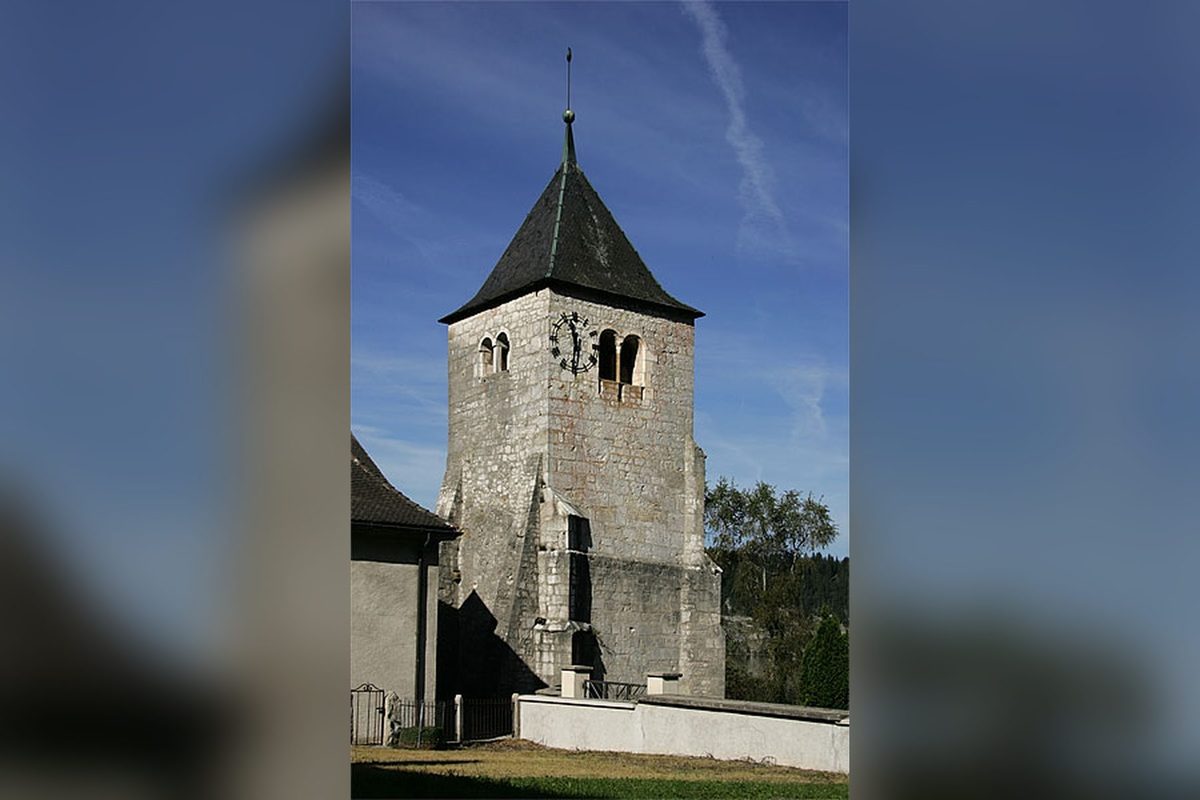
The Aymon tower, a 14th-century bell tower, is all that can still be seen of the Premonstratensian abbey around which L'Abbaye grew up, on the Lac de Joux.
Entry based on 16 sources · Our method · Reusable text (CC BY-SA)
Origin of the name L'Abbaye
The municipality and its main village take their name from the abbey of Premonstratensian canons of the Lac de Joux, around which the locality formed after the Reformation. The abbey was also known as «Domus Dei» or the abbey of Cuarnens. No early mention specific to the village name is known. The inhabitants are called the «Bayets».[2][3][4]
Coat of arms of L'Abbaye
Or, a bear's head affronty sable, overall a bend gules charged with three escallops of the field. On a yellow field, a black bear's head seen from the front is crossed diagonally, from upper left to lower right, by a red band bearing three yellow scallop shells. The arms first appear in 1731. The band with three shells comes from the arms of the lords of Grandson, founders of the abbey of Lac de Joux.[4][15]
Founding of L'Abbaye
It all begins with the abbey of the Lac de Joux, founded between 1126 and 1134 on the initiative of Bishop Barthélemy de Laon, a friend of Saint Norbert (founder of the Premonstratensian order), with the help of his brother Ebal de Grandson-La Sarraz. A daughter house of Saint-Martin de Laon, the convent stood on the bank of the Lionne. At first it was a double monastery housing canons and nuns, until the nuns moved to Rueyres (municipality of Chardonne). The territory depended on the abbey until the Bernese conquest, which ended conventual life and secularised its property. The village then grew up gradually around the former abbey church. The valley at that time formed a single community, Le Lieu, from which L'Abbaye separated to become an independent municipality. Today it includes the villages (fractions) of L'Abbaye, Le Pont and Les Bioux.[1][2][4][6]
History of L'Abbaye
1126-1134. Foundation of the Premonstratensian abbey of the Lac de Joux by Bishop Barthélemy de Laon with the help of his brother Ebal de Grandson-La Sarraz; originally a double monastery.[2][3][4][6]
around 1141. The nuns are separated from the canons and moved to Rueyres, near Chardonne.[2]
1155-1204. Conflicts with the Benedictines of Le Lieu (1155), then directly with the abbey of Saint-Claude (1157). The long dispute ends in 1204 with mutual concessions.[2]
1324. Economic and spiritual crisis of the abbey. A reform is carried out under Abbot Aymon de Montferrand-La Sarraz.[2]
14th century. Construction of the tower, bell tower of the abbey church, called the «tour Aymon». Dates vary between the first third and the middle of the 14th century.[3][4][5][6]
late 15th century. Beginning of industrial activity on the banks of the Lionne (forges, trip hammers, sawmills). Metalworking is attested there from 1481.[1]
1480. Arrival in L'Abbaye of the Rochat family, who came from France and later spread to Les Charbonnières and Le Pont.[8]
1536. Bernese conquest and introduction of the Reformation: the abbey disappears and its property is secularised.[1][2][3][4][6]
1543. The former abbey church becomes the parish temple.[1]
1566. The territory is attached to the Bernese bailiwick of Romainmôtier.[1]
1571. L'Abbaye separates from the municipality of Le Lieu and becomes an independent municipality.[1]
1654 or 1663. The tower and church burn and the bells melt, on 10 September 1654 or in 1663; the date is uncertain. New bells are installed in 1681.[3][4][5][6]
around 1710-1712. The municipal fractions of L'Abbaye, Le Pont and Les Bioux reportedly emerged at this time.[7]
1731. First appearance of the municipal coat of arms, on communion flagons.[3][4]
1741-1742. Another fire in the tower destroys the bells and clock. A new bell is cast and the roof timbers rebuilt in 1742.[3][4][5]
mid-18th to late 19th century. Watchmaking is practised as home work in the municipality.[1]
1798-2007. The municipality belongs to the district of La Vallée, then to that of Jura-Nord vaudois once the new division takes effect on 1 January 2008.[1][12]
1865. Complete rebuilding of the church, of which only the medieval bell tower is kept. Restorations in 1909 and 1951.[1][6]
1966. Fire in the old village of L'Abbaye; the tower is spared.[1]
1971. Twinning with the municipality of Yvorne.[3][4]
2024-2027. Merger with Le Chenit and Le Lieu into a municipality «La Vallée de Joux», approved by popular vote on 22 September 2024, validated by the Grand Council on 25 November 2025, planned to take effect on 1 January 2027.[4]
Population of L'Abbaye
Sources and references: [1][13]
| 1764 | 917 (of whom 266 in the village of L'Abbaye) |
| 1850 | 1'018 |
| 1900 | 1'350 |
| 2000 | 1'304 |
| 2010 | 1'297 |
| 2020 | 1'459 |
| 2025 | 1'599 |
Families of L'Abbaye
Citizen families before 1800. Aubert, Authier, Autier, Berney, Cart, Chaillet, Dunand, Golaz, Guignard, Mouquin, Perreaud, Reymond, Rochat and Rochaz, with no precise date.[16]
In the 19th century. A single family, the Dupuis, with no precise date.[16]
From 1901 to 1962. 28 entries, often of foreign families. From France come the Guy (1901), Mercet (1912), Cunin (1953), Pesenti (1954) and Christin (1954 and 1959), from Germany the Lauffenburger (1908), from Austria the Riedel (1929) and from Italy the Carlin (1936), Carrara and Vuillermoz (1953), Favero (1957) and Borgnana (1961). The Assimacopoulo, entered in 1955, come from Greece. The Marti (1920), Rentsch (1930), Baudin (1945) and Schär (1955) are entered with no stated origin. Swiss families arrive mostly after 1955: Frioud of Rossens FR, Gander of Saanen BE, Pillet of La Tour-de-Trême FR, Ruffieux of St. Silvester FR and Weibel of Grossaffoltern BE in 1956, Lanthemann of Tafers FR in 1957, Lavenex of La Tour-de-Trême FR and Zeender of Köniz BE in 1958, Kehrli of Innertkirchen BE and Misteli of Aeschi SO in 1960. The Schenkel, of Diemerswil BE, are entered in 1961, the same year as the Borgnana.[16]
Economy of L'Abbaye, past and present
Forges and sawmills on the Lionne. From the late 15th century forges, trip hammers, stamping mills and sawmills lined the Lionne. A blast furnace worked from 1557 to the early 18th century, and small-scale metalworking grew from 1650. Of all these works, only the sawmills still run.[1]
Watchmaking. Done at home until the end of the 19th century, watchmaking then moved into factories. The Vallée de Joux offers more than 8'000 jobs, three quarters of them in industry.[1][4]
Ice and hotels at Le Pont. The Vallorbe to Le Pont railway, opened in 1886, was linked to ice harvesting. It also brought tourists to the shores of Lac de Joux and Lac Brenet. Hotels, guesthouses and shops opened at Le Pont, including the Grand-Hôtel du Lac de Joux, completed in 1901. From the mid 20th century tourism lost this leading role.[8]
Historic sites in L'Abbaye
Tower of L'Abbaye (tour Aymon). Massive bell tower of the former abbey church, built in the 14th century, at the earliest from 1324, by Abbot Aymon de Montferrand de La Sarraz. Base of 7 m by 7, about 12 m of masonry. Burnt several times (17th century and 1741), it received a roof structure in 1742 and has been restored with support from the canton, the municipality, patrons and the ARTA association.[5]
Temple of L'Abbaye. Former abbey church that became the parish temple in 1543, entirely rebuilt in 1865 while keeping the medieval bell tower, then restored in 1909 and 1951. The building belongs to the State of Vaud.[1][6]
Le Pont. Village of the municipality, between the Lac de Joux and Lac Brenet, listed in the Federal Inventory of Swiss Heritage Sites (ISOS). It is home to the manoir de Haute-Roche, a cultural property of national importance.[10][11]
Chapel of Les Bioux. Small temple of 1698 in the village of Les Bioux, presented as the oldest period religious building still standing in the Vallée de Joux.[9]
Remains in L'Abbaye
Bell tower of the Premonstratensian abbey. The 14th-century bell tower, known as the «tour Aymon», is the only visible remnant of the Premonstratensian monastery founded between 1126 and 1134 and gone with the Reformation in 1536.[1][2]
Protected heritage in L'Abbaye
Cultural property of national significance (A objects in the PCP inventory)[14]
- Le Pont, manoir de Haute Roche
Cultural property of regional significance (B objects)[14]
- Clocher et arc du cloître de l'ancien couvent
- Les Bioux, temple
Legends of L'Abbaye
The Silver Bell (La Cloche d'Argent). According to a locally transmitted tale, the monks leaving the abbey in 1536 are said to have taken a silver bell with them, which is said to have been lost in the Lac de Joux.[5]
Traditions and festivals in L'Abbaye
The L'Echo des Forêts brass band. Founded in 1922, the band also takes part in music teaching in the commune.[3][4]
The abbayes. Two shooting societies bear the name abbaye: "La Jeune Suisse" and the Abbaye des Grenadiers.[4]
The Givrés du Pont. At Le Pont the Givrés, who grew out of the rowing club, swim in the lake every day of the year.[3][4]
The Le Pont festivals. Le Pont hosts the Hors Norme festival in April and Jazz en Rade in August. Outdoors on the lakeshore, Rock am Wind holds its 15th edition on 22 and 23 June 2018.[3][4]
Sources
- Rémy Rochat, « Abbaye, L' », Dictionnaire historique de la Suisse (DHS), version du 25.08.2022
- Dictionnaire historique de la Suisse, « Lac de Joux » (abbaye prémontrée)
- Commune de L'Abbaye, « Présentation »
- Feuille des avis officiels du canton de Vaud, « Alphabet des communes vaudoises : L'Abbaye »
- Association pour la restauration de la tour de L'Abbaye du Lac de Joux, « La Tour de L'Abbaye »
- Archives culturelles de la Vallée de Joux, « L'Abbaye, couvent, tour et église »
- Archives culturelles de la Vallée de Joux, « Bref historique des fractions de commune de la Vallée »
- Promenade Belle Epoque (Le Pont), panneau 11 « Le village du Pont »
- Archives culturelles de la Vallée de Joux, « La chapelle des Bioux »
- Office fédéral de la protection de la population, Inventaire suisse des biens culturels d'importance nationale et régionale, liste du canton de Vaud (état au 1.1.2026), L'Abbaye : Le Pont, manoir de Haute Roche (A, n° 05885) ; clocher et arc du cloître (B, n° 14623) ; temple des Bioux (B, n° 05886)
- Office fédéral de la culture, ISOS, « Le Pont » (commune de L'Abbaye, relevé 2011)
- État de Vaud, communiqué du 12.07.2007, « Organisation des préfectures et adaptation au nouveau découpage territorial »
- Statistique Vaud, « Population résidante permanente au 31 décembre 2025 »
- Federal Office for Civil Protection (FOCP), Swiss Inventory of Cultural Property (PCP), list for the canton of Vaud (as of 1.1.2026)
- IPI, Swissreg, emblems database: coat of arms of L'Abbaye (no. 102139)
- Register of Swiss Surnames, 3rd edition (1989), search Commune "L'Abbaye", Canton VD
Published by Sébastien Jörg ·
Localities of the municipality with a page
Other villages near L'Abbaye
Missing information, or do you have a source? Suggest a correction or addition. Every submission is checked before it's published.
Suggest a change