Le Lieu
The oldest village in the Vallée de Joux, Le Lieu grew out of a monastic community attested in 1155. For a long time its commune covered the whole valley.
Entry based on 14 sources · Our method · Reusable text (CC BY-SA)
Origin of the name Le Lieu
The village is mentioned in 1155 in the form «loco dompni Poncii heremite» («the place of Dom Pons the hermit»), then in 1408 in the form «le Lieu Poncet». The name comes from the Latin «locus», «place», which here reportedly refers to the site of a hermitage or religious settlement, though this meaning is not confirmed. Originally it was completed by the name of the hermit Poncet (Pontius), which also survives in several neighbouring place names (Combe à Poncet, fontaine à Poncet, bois à Poncet).[1][6]
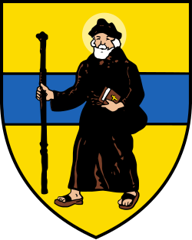
Coat of arms of Le Lieu
Or, a fess azure, overall the figure of Saint Poncet clad sable. The yellow shield is crossed by a blue horizontal band. Over it stands Saint Poncet, dressed in black, the monk whom tradition places at the origin of the village.[11][12]
Founding of Le Lieu
Le Lieu was born of a religious settlement: a monastic community, following an unknown rule, is attested there in 1155. An old hypothesis, never verified, attributes its foundation to the hermit Poncet, between the 5th and the 9th century, as a staging post between the abbey of Saint-Oyend (Saint-Claude) and Romainmôtier. The community disappeared before 1204 and its property passed to the Premonstratensian abbey of Lac de Joux. With the earliest known abergement (grant of land to settlers), the village became the centre of the clearing of the whole valley, and its commune covered the entire Vallée de Joux until L'Abbaye and then Le Chenit broke away. The neighbouring hamlets, such as Le Séchey and Les Charbonnières, were settled mainly from the 16th century onwards.[1]
History of Le Lieu
1155. First written mention («loco dompni Poncii heremite»): a monastic community following an unknown rule is established at Le Lieu.[1]
before 1204. The monastic community disappears; the abbey of Lac de Joux receives its property.[1]
1304. Earliest known abergement: the village becomes the centre of the clearing of the Vallée de Joux.[1]
1334-1536. Le Lieu is part of the castellany of Les Clées.[1]
1396. The commune of Le Lieu is attested. At that time it extends over the whole Vallée de Joux.[1]
1416. The chapel of Saint-Théodule, in the heart of the village, is visited by delegates of the diocese of Lausanne (another visit in 1453). It is served by the neighbouring abbey.[1][2]
1489. First mentions of the villages of Les Charbonnières and Le Séchey, which are part of the commune.[1]
1504. The road to Franche-Comté (the «salt road») becomes passable for carts for a short period.[1]
1514. The ironworks of Les Charbonnières start operating, followed by that of Bonport in 1524. They operate until around 1740.[1]
1536. Bernese conquest: Le Lieu passes to the bailiwick of Yverdon, then to that of Romainmôtier in 1566.[1]
1571. L'Abbaye breaks away from the commune of Le Lieu.[1][9]
1612. Creation of the parish of Le Lieu, which also includes Le Chenit until 1705.[1]
1646. Le Chenit in turn separates from the commune of Le Lieu.[1][9]
1708. The commune buys from Colonel de May a building which it converts into a commune house, the present town hall.[5]
1719. Creation of five commune fractions. In the 18th century the commune is governed by the Councils of the XII and the XXIV.[1]
1798-1802. The village's old church, four centuries old, is destroyed in 1798 and replaced by the present church.[2]
1858. On 18 July a fire destroys 34 houses and the church and damages the parsonage and the town hall; 169 people are affected. The village is rebuilt with better aligned houses.[3][4][5]
1899. Le Lieu becomes a station on the Pont-Brassus railway line.[1]
1939. The number of commune fractions is reduced to three, then to two in 2004, with the abolition of that of Le Lieu.[1]
2024-2027. On 22 September 2024 the communes of Le Lieu, Le Chenit and L'Abbaye approve their merger into a commune «La Vallée de Joux», validated by the Grand Council on 25 November 2025. It is due to come into force on 1 January 2027.[9][10]
Population of Le Lieu
Sources and references: [1][8]
| 1382 | 30 hearths (households) |
| 1483 | 13 hearths (households) |
| 1550 | 43 hearths (households) |
| 1764 | 980 |
| 1850 | 999 |
| 1900 | 1'161 |
| 1930 | 917 |
| 1950 | 1'020 |
| 1980 | 703 |
| 2000 | 795 |
| 2025 | 926 |
Families of Le Lieu
Burgher families before 1800. Twenty families are listed without a precise date: Aubert, Bonard, Cart, Chouet, Dépraz, Ethénoz, Golay, Guignard, Humberset, Longchamp, Lugrin, Maréchaux, Maylan, Mayland, Meylan, Nicole, Piguet, Reymond, Rochat and Simond.[13]
In the 19th century. A single registration, that of the Monastier from Savoy, in 1855.[13]
From 1901 to 1962. Thirty-two registrations. The first are the Bonardi from Italy (1906), the Decompoix from France (1914), the Gozel (1915), the Berney and the Frête (1921), the Rentsch from Büchslen FR (1930) and the Erhardt from Lithuania (1932). They are followed by the Albertano from Italy and the Meyer from France (1942), the Ritter (1944), the Mora (1946) and the Piccinin (1947) from Italy, the Goël (1948) and the Paltani from Italy (1950 and 1954). In 1953 come the Battilotti, the Tintori and the Zaco from Italy and the Cunin from France, then the Fantoli from Italy (1954), the Assimacopoulo from Greece and the Schär (1955). Next are the Pillet from La Tour-de-Trême FR and the Schopfer from Gsteig BE (1956), the Favero from Italy, the Julmy from Jaun FR, the Ramseyer from Lauperswil BE and the Stalder from Sumiswald BE (1957), the Cornu from France and the Magistris from Italy (1958), the Probst from Ins BE and the Salvi from Italy (1959). The last family registered, in 1961, is the Borgnana from Italy.[13]
Economy of Le Lieu, past and present
Milk, vacherin and gentian. Dairy farming long supplemented the village's income and was still producing vacherin cheese in the 20th century. According to the FAO, in 2026 the municipality's milk went mainly into Vacherin Mont-d'Or and Gruyère AOP. There are also the Le Séchey cheese dairy, two gentian distillers, a craft brewery and a professional fisherman.[1][12]
From iron to gemstones. After the ironworks, small-scale metalworking kept the village busy from 1650 to 1750. Gem cutting replaced it. Until the late 19th century woodenware making provided extra income.[1]
Watchmaking. Dependent on Geneva, watchmaking became the dominant activity. It mainly made components. In 2000 industry provided just over two thirds of jobs, about two fifths of them held by commuters, cross-border workers included. Tinsmiths, roofers, joiners, cabinetmakers and installers round out local crafts.[1][12]
Forests, heat and visitors. The municipality owns 2'042 hectares of forest. In 2015 Ecobois SA, in which it is the majority shareholder, set up a first district heating network. Les Charbonnières hosts the Fête du Vacherin, whose 27th edition took place in 2025, and the Musée du Vacherin.[12]
Disasters and major events in Le Lieu
The fire of 18 July 1858. The fire mainly hit the upper part of the village, where nearly half of the houses were affected. Forty-five households were left homeless. Donations came from all over the canton and partly helped the victims get back on their feet. The village burned several more times afterwards, but on a much smaller scale.[3][12]
The Les Charbonnières fire of 1900. During the night of 10 to 11 September 1900, fire broke out in a very old building in Les Charbonnières where vacherin boxes were made. Forgotten embers rekindled the blaze during the night. Fifteen houses were destroyed, a large part of the upper village.[12]
Historic sites in Le Lieu
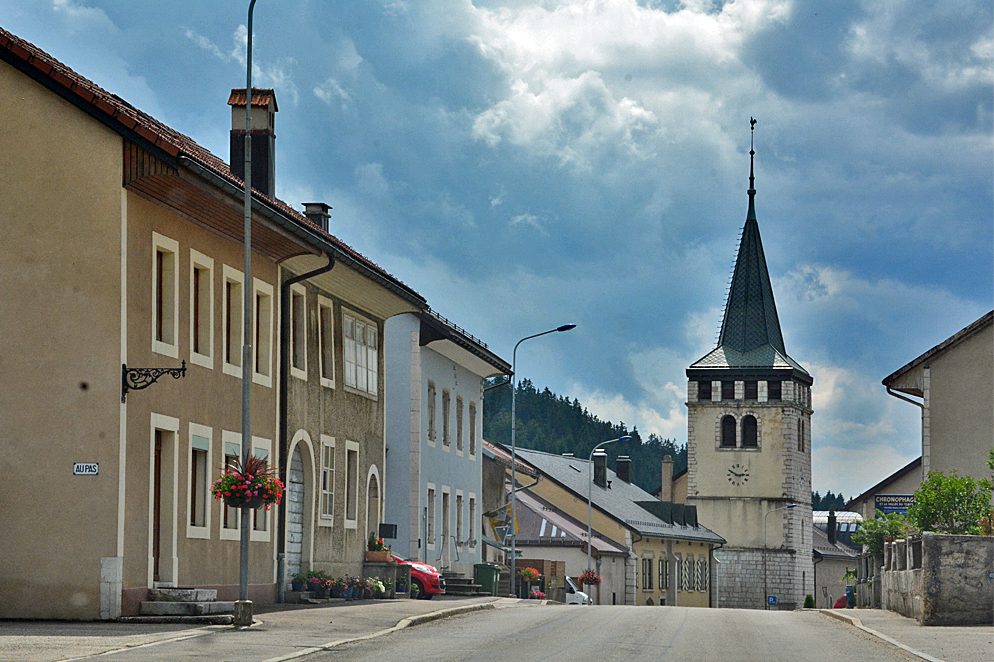
Reformed church of Le Lieu. Built from 1798 to 1802 to replace the village's medieval church, destroyed in 1798. Ravaged by the fire of July 1858, it received an entirely rebuilt roof structure and bell tower, new bells and a new clock. Its octagonal plan and its architect, Henri Exchaquet, remain to be confirmed.[2][4]
Town hall. Building bought by the commune from Colonel de May on 15 October 1708 and converted into a commune house at the end of the same month. Damaged by the fire of 1858 and restructured in the 1960s and 1970s, it has served the commune for more than three centuries. Its sign evokes Dom Poncet.[5]
The village, a site of national importance. The village of Le Lieu is reportedly listed in the Federal Inventory of Swiss Heritage Sites of national importance (ISOS). Rebuilt after successive fires, notably that of 1858, it has almost no very old houses left, even though it is the oldest village in the valley.
The Dom Poncet walk. Heritage discovery trail around the village created in 2013-2014. It links in particular the churches of Le Lieu, the bread oven, the stream, La Frasse, the Fontaine aux Allemands and Combenoire. It recalls that the first timekeeper (clock) in the whole valley is said to have been built at Le Lieu.[7]
Legends of Le Lieu
Dom Poncet, the founding hermit. Tradition traces the origin of Le Lieu to a hermit named Poncet (Pontius), who is said to have founded the community between the 5th and 9th centuries as a staging post between the abbey of Saint-Oyend (Saint-Claude) and Romainmôtier. This hypothesis has never been verified: nothing is known of the man, neither where he came from nor what he actually achieved. The only certainty is that his name appears from 1155 in that of the village («place of Dom Poncet») and survives in several neighbouring place names (Combe à Poncet, fontaine à Poncet, bois à Poncet).[1][6]
Traditions and festivals in Le Lieu
The Vacherin Mont-d'Or festival. Every year at the end of September, Les Charbonnières celebrates on the village square the return of the herds from their summer pastures. The day opens the Vacherin Mont-d'Or season and brings together a market of regional products, tastings, a tug-of-war tournament and a dance. The 28th edition takes place in 2026.[14][12]
Sources
- Dictionnaire historique de la Suisse, Olivier Pichard, « Lieu, Le », version du 24.03.2009
- Archives culturelles de la Vallée de Joux, « 9. Les églises du Lieu »
- Archives culturelles de la Vallée de Joux, « 1858. L'incendie du Lieu de 1858 »
- Archives culturelles de la Vallée de Joux, « Les églises de la Vallée de Joux »
- Archives culturelles de la Vallée de Joux, « Hôtel de Ville du Lieu » (PDF)
- Archives culturelles de la Vallée de Joux, « En souvenir de dom Pontius », par T.-F. Golay (1926)
- Patrimoine Vallée de Joux, « 8. La balade de dom Poncet »
- Statistique Vaud, « Population résidante permanente au 31 décembre 2025 »
- Conseil d'État du canton de Vaud, exposé des motifs et projet de décret sur la fusion des communes de L'Abbaye, Le Chenit et Le Lieu (24_LEG_213), mars 2025
- Site officiel de la fusion des communes de la Vallée de Joux, page 2025
- IPI, Swissreg, emblems database: coat of arms of Le Lieu (no. 101359)
- Official Gazette of the Canton of Vaud (FAO), "Alphabet des communes vaudoises: Le Lieu" (FAO no. 86, 27.10.2026)
- Register of Swiss Surnames, 3rd edition (1989), search Commune "Le Lieu", Canton VD
- Interprofession du Vacherin Mont-d'Or, "The festival" (28th Fête du Vacherin Mont-d'Or AOP, 2026)
Published by Sébastien Jörg ·
Localities of the municipality with a page
Other villages near Le Lieu
Missing information, or do you have a source? Suggest a correction or addition. Every submission is checked before it's published.
Suggest a change