Les Diablerets
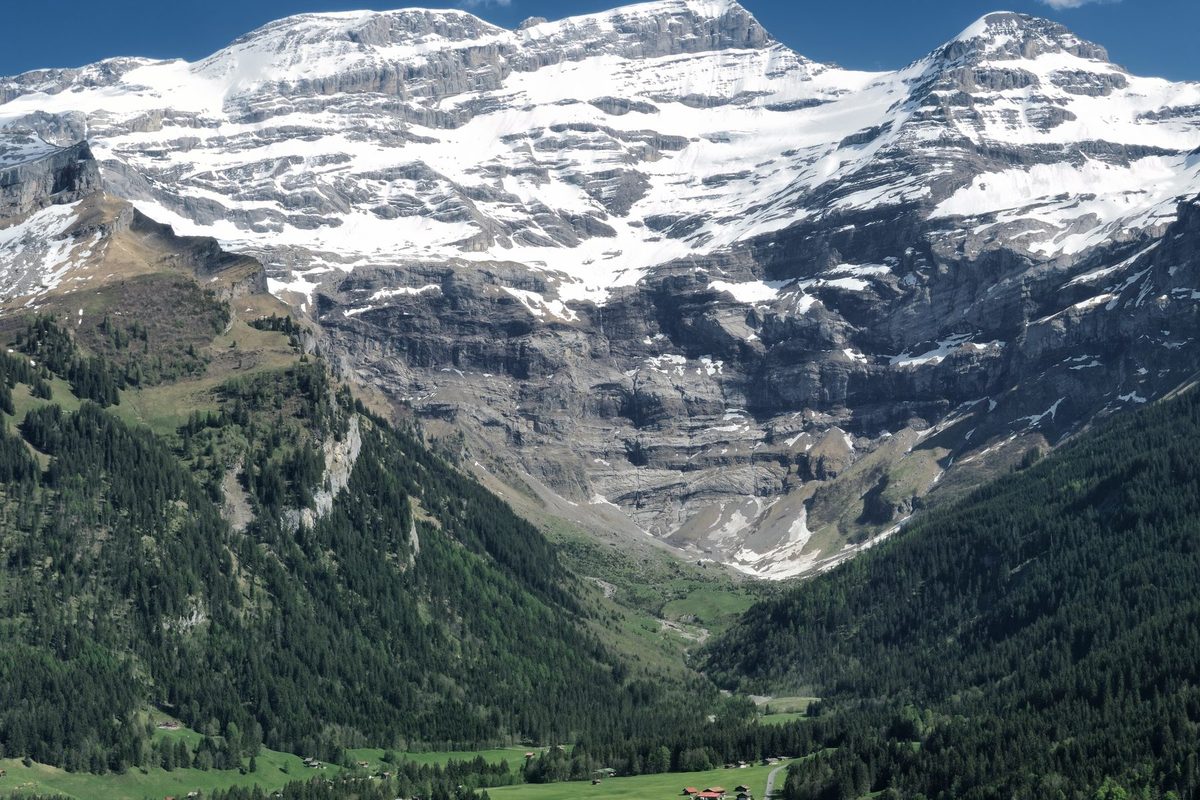
At the foot of the highest point in the canton of Vaud (3'210 m), Les Diablerets built a cable car in 1964 that allows skiing on the glacier even in summer.
Entry based on 9 sources · Our method · Reusable text (CC BY-SA)
Origin of the name Les Diablerets
The village bears the name of the neighbouring massif, formerly called « Rochers » or « Scex de Champ ». The present name Les Diablerets comes from the Valais and reflects the idea that these mountains were haunted by demons. Since the end of the 19th century, the name has also designated the former hamlet of « Plan des Isles », which became a resort.[1]
Founding of Les Diablerets
Neither the founding date of Les Diablerets nor a founder is known. The locality, at an altitude of about 1'200 m, belongs to the municipality of Ormont-Dessus and lies at the foot of the massif of the same name (3'210 m, the highest point of the canton of Vaud). Under the Ancien Régime it formed the Seyte-d'Enhaut, one of the three administrative units of the municipality. The present village grew out of the hamlet of Le Plan des Isles, where the building of the Grand Hôtel des Diablerets launched the tourist boom. At the end of the 19th century the resort took the name of the massif.[1][2]
History of Les Diablerets
1714. First of two devastating rockfalls in the Diablerets massif.[1]
1749. Second devastating rockfall in the massif.[1]
1850. First ascent of the summit of the Diablerets.[1]
1856. Construction of the Grand Hôtel des Diablerets at Le Plan des Isles, the start of the resort's tourist boom.[2]
1863. Founding of the Lausanne section of the Swiss Alpine Club, which would later build a hut in the massif.[1]
1869. A tourist office opens in Les Diablerets.[1]
1871. The Hôtel des Diablerets reportedly takes the name Grand Hôtel, and the road between Le Sépey and Les Diablerets is said to be completed.
1879-1885. The carriage road reaches the Col du Pillon in 1879, the Bernese border in 1882 and Gsteig in 1885.[3]
1904. The Lausanne section of the Swiss Alpine Club builds the Cabane des Diablerets.[1]
1914. The Aigle-Le Sépey-Les Diablerets railway line reaches the village.[1]
1942. The first ski lift was reportedly built at Les Vioz.
1953. Construction of a two-seat gondola to the Isenau ski area, replaced in 1974 by a four-seat installation about 2'400 m long.[5]
1964. Construction of the cable car that makes skiing on the glacier possible even in summer.[1]
1969. First «Journées du cinéma suisse de montagne», on an idea by Jacques Lavenex. From 1970 they become the Festival international du film alpin des Diablerets, held every year.[7]
2017. The concession of the Isenau gondola expires on 30 April; the installation remains closed.[5][6]
2020. Les Diablerets hosts the alpine skiing events of the Lausanne 2020 Winter Youth Olympic Games.
Economy of Les Diablerets, past and present
Livestock, timber and cattle trade. In the 19th century the commune of Ormont-Dessus lived mainly from livestock farming and the timber and cattle trade. Its high pastures on the Chaussy range were worked by private cooperatives. Alpine farming is declining: it counted 21 farms in 2008.[2]
Tourism. The Société d'embellissement et d'utilité publique of Ormont-Dessus was founded in 1888. In 2005 the tertiary sector provided 72% of the commune's jobs, mainly in tourism.[2]
Historic sites in Les Diablerets
Diablerets massif. Glacier massif where the cantons of Vaud, Valais and Bern meet, rising to 3'210 m, the highest point of the canton of Vaud. It played a part in the history of Alpine geology and interested naturalists, including Albrecht von Haller.[1]
Le Plan des Isles and the Grand Hôtel. Former hamlet where the Grand Hôtel des Diablerets was built in 1856, the birthplace of the resort.[2]
Col du Pillon. Pass at 1'546 m, reached by the carriage road in 1879, giving access to the Bernese Oberland (Gsteig) and the starting point of the glacier cable car.[3][4]
Cabane des Diablerets. Hut built in 1904 by the Lausanne section of the Swiss Alpine Club.[1]
Legends of Les Diablerets
The demons of the mountain. The name Les Diablerets, which came from the Valais, reflects an old tradition that these mountains were haunted by demons.[1]
Traditions and festivals in Les Diablerets
The International Alpine Film Festival. An amateur filmmaker, mountaineer and skier, Jacques Lavenex launched the "Journées du cinéma suisse de montagne" in 1969. Requests from abroad turned them into the Festival international du film alpin des Diablerets from 1970. On 5 February 2000, in Turin, the festival was one of the eight founders of the International Alliance for Mountain Film.[7]
Sources
- Dictionnaire historique de la Suisse, « Diablerets, Les » (Mary-Claude Busset-Henchoz, version du 31.03.2004)
- Dictionnaire historique de la Suisse, « Ormont-Dessus » (Mary-Claude Busset-Henchoz, version du 07.12.2010)
- Dictionnaire historique de la Suisse, « Pillon, col du » (Gilbert Coutaz, version du 20.01.2011)
- Alpes vaudoises, « Glacier 3000 » (départ au col du Pillon)
- Remontées-mécaniques.net, « Télécabine débrayable 4 places (TCD4) Les Diablerets-Isenau »
- Journal Le Cotterg, « La télécabine d'Isenau, ainsi que les installations sommitales du domaine, resteront fermées cet hiver 2017-2018 » (08.09.2017)
- FIFALP, Festival international du film alpin des Diablerets, « Historique »
- Diablerets Alpine Centre, « Lausanne 2020 »
- Statistique Vaud, « Population résidante permanente au 31 décembre 2025 »
Published by Sébastien Jörg ·
Other villages near Les Diablerets
Missing information, or do you have a source? Suggest a correction or addition. Every submission is checked before it's published.
Suggest a change