Ormont-Dessus
The Ormonans fought the revolutionary troops in 1798. At Les Diablerets their municipality has hosted the International Alpine Film Festival since 1970.
Entry based on 13 sources · Our method · Reusable text (CC BY-SA)
Origin of the name Ormont-Dessus
The old name is « Ormont », in German « Ormund ». In the charters of 1277 the locality appears as « Joria de Hormont ». The upper valley was reportedly called Joux d'Ormont, then Outre Joux in the 15th century and finally Ormont-Dessus from the 16th century. The origin of the name Ormont has not yet been explained.[1]
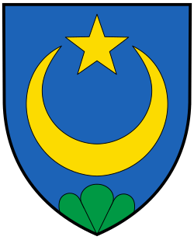
Coat of arms of Ormont-Dessus
Azure a crescent or, surmounted by a mullet of the same, on a mount of three hills vert in base. On a blue field, a yellow crescent moon with a yellow star above it rests on a green three-peaked mountain at the bottom of the shield.[11]
Founding of Ormont-Dessus
Nobody knows when the municipality came into being or who founded it. In the Middle Ages the Ormonts valley depended on the abbey of Saint-Maurice, then on various vassals of the House of Savoy. Among them, the lords of Saillon held rights over part of the territory. The inhabitants obtained a first charter of franchises in the 13th century. Under the Ancien Régime the municipality was divided into three « seytes »: Seyte-d'Enbas (Rosé), Seyte-du-Milieu (Vers-l'Eglise) and Seyte-d'Enhaut (Les Diablerets).[1]
History of Ormont-Dessus
1277. Charters in which the locality appears as « Joria de Hormont »; first charter of franchises.[1]
1396. A church building is recorded at Vers-l'Eglise.[1]
15th century. Around the middle of the century the chapel of Saint-Théodule replaces the 1396 building. It depends on the church at Cergnat.[1][5]
1475. The Bernese take possession of the region. Ormont-Dessus henceforth belongs to the Ormonts mandement of the government of Aigle (1475-1798).[1][2]
1480. The valley splits into the parishes of Ormont-Dessus and Ormont-Dessous, a separation made final at the Reformation.[2]
1529. The Reformation is imposed despite strong resistance from the population.[2]
1749. A devastating avalanche; others follow in 1793, 1923 and 1984.[1]
1798. The Ormonans fight the revolutionary troops.[2]
1852. A chapel of the Free Church (Église libre) is built.[1]
1856. The Grand Hôtel des Diablerets is built at Plan des Isles, the start of tourist development.[1]
1871. The road from Aigle is extended from Le Sépey to Les Diablerets.[2]
1873-1874. The municipal hall is built, to plans attributed to the architect François Jaquerod.
1881. An English chapel is built.[1]
1882. The Col du Pillon road, which had reached the pass in 1879, reaches the Bernese border. It reaches Gsteig in 1885.[6]
1888. The Société d'embellissement et d'utilité publique is founded.[1]
1902. A Catholic church is built.[1]
1914. Les Diablerets station is connected to the Aigle-Le Sépey-Les Diablerets line.[2]
1969. The Journées du cinéma suisse de montagne are created at Les Diablerets. From 1970 they become the Festival international du film alpin (FIFAD).[7]
1971. The Col de la Croix road links Les Diablerets with Villars-sur-Ollon.[2]
2008. The Musée des Ormonts opens at Vers-l'Eglise.[8]
Population of Ormont-Dessus
Sources and references: [1][3]
| 1850 | 935 |
| 1900 | 1'092 |
| 1950 | 994 |
| 1980 | 1'000 |
| 2000 | 1'307 |
| 2025 | 1'440 |
Families of Ormont-Dessus
Citizen families before 1800. Allaman, Allamand, Ansermet, Ansermoz, Baillif, Berruex, Busset, Culand, Dormond, Dormont, Dougoz, Duplan, Favre, Fromentin, Gallaz, Genillard, Girod, Gottraux, Guigon, Isabel, Jaquerod, Jordan, Margueron, Mermier, Moillen, Mollien, Morerod, Moulin, Nicolet, Nicolier, Nicollier, Pernet, Pichard and Rosset.[12]
In the 19th century. The Perrod family, with no precise date, then in 1896 the Treina family, from Italy.[12]
From 1901 to 1962. Twenty-four entries. The Bauer family, from Germany, opens the series in 1904, followed by the Broyon (1910) and the Ducret, from France (1915). Six families came from Italy, from Locatelli (1938) to Peppicelli (1959), and two from Belgium, the Verrun (1935) and the Renirkens (1953). In 1956 nine families were admitted, most of them from the Bernese Oberland: Christen of Heimiswil BE, Hauswirth and Schwenter of Saanen BE, Perreten of Lauenen BE, Schaefer of Oberthal BE and Stäger of Lauterbrunnen BE, along with Laufer of Kloten ZH, Weber of Zurich ZH and Masson of Bagnes VS. The Pfund family of Lenk BE and the Prudent family, from France, close the list in 1960.[12]
Notable people of Ormont-Dessus
Edouard Eugène Scherrer (1890-1972). Born in Ormont-Dessus, he worked as a postman in Leysin, a woodcutter and then a trade union secretary. A Communist Party member from 1921, he sat on its central committee (1924-1930) and led Red Aid in French-speaking Switzerland. In 1924 he won a gold medal at the Chamonix Olympic Games as captain of the Swiss bobsleigh team.[13]
Economy of Ormont-Dessus, past and present
Cattle, timber and alpine pastures. In the 19th century the main resources of Ormont-Dessus were livestock and the trade in timber and cattle. The high pastures of the Chaussy range, worked by private cooperatives, keep groups of 17th- and 18th-century chalets. Alpine farming is declining, with 21 farms in 2008.[1]
Tourism. The Grand Hôtel des Diablerets, built in 1856 at the Plan des Isles, launched the growth of the resort. In 2005 the service sector provided 72% of jobs, mostly in tourism.[1]
Disasters and major events in Ormont-Dessus
The avalanches of 1749, 1793, 1923 and 1984. The high pastures of the Chaussy range were struck four times by devastating avalanches.[1]
Historic sites in Ormont-Dessus
Saint-Théodule church at Vers-l'Eglise. Mid-15th-century chapel that replaced a building recorded in 1396. First dependent on the church at Cergnat, it became the parish church at the Reformation. It is listed as a Swiss cultural property of national significance.[1][4][5]
Municipal hall and Musée des Ormonts. The municipal hall was reportedly built in 1873-1874 to plans by the architect François Jaquerod. It reportedly houses the Musée des Ormonts, opened in 2008.
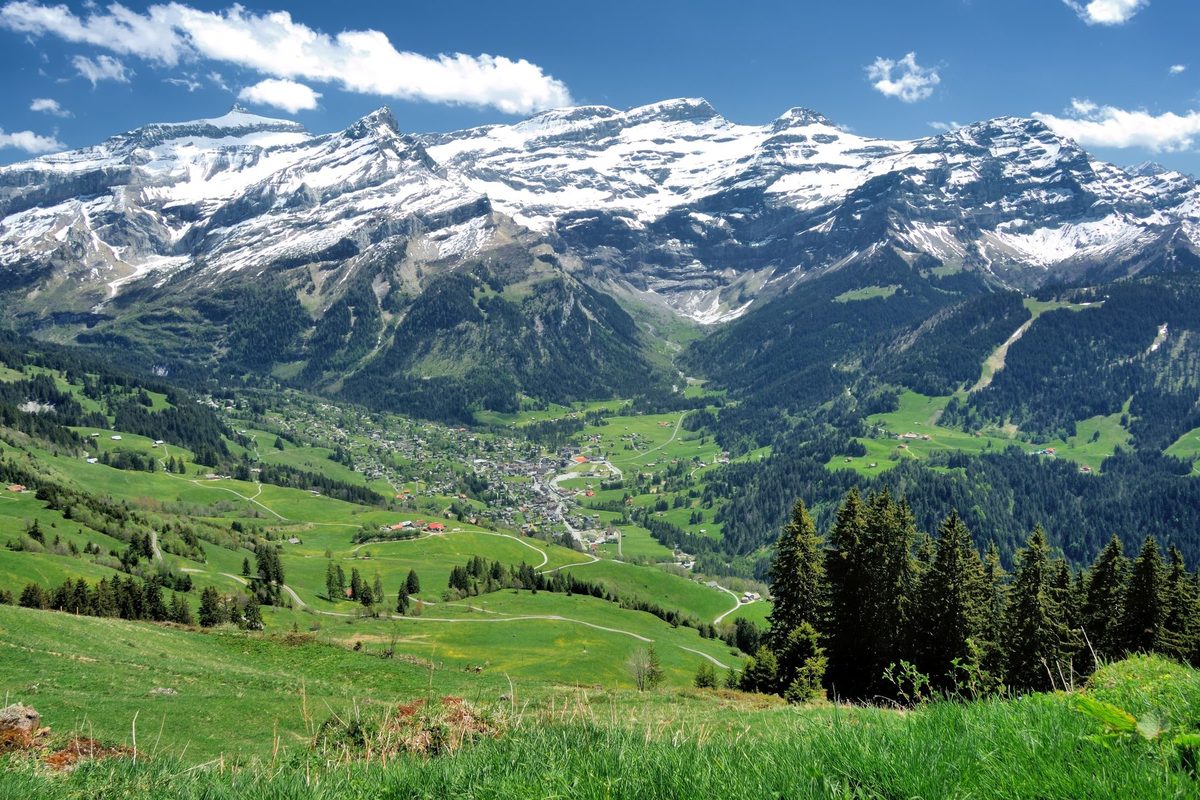
Les Diablerets. Village at the foot of the massif of the same name, seat of the Seyte-d'Enhaut, which became a resort after the Grand Hôtel was built in 1856.[1][5]
Col du Pillon. Pass reached by a road in 1879, which reaches the Bernese border in 1882 and Gsteig, in the Bernese Oberland, in 1885.[6]
Les Planches sawmill. Sawmill listed as a Swiss cultural property of national significance.[4]
Remains in Ormont-Dessus
Alpine chalets of the Chaussy range. The mountain pastures of the Chaussy range, worked by private cooperatives, preserve old groups of chalets from the 17th and 18th centuries.[1]
Protected heritage in Ormont-Dessus
Cultural property of national significance (A objects in the PCP inventory)[10]
- Eglise réformée Saint-Théodule
- Scierie
Cultural property of regional significance (B objects)[10]
- Alpage des Traverses, La Dix (7 chalets d'alpage et une grange-écurie)
- Alpage des Traverses, La Première (6 chalets d'alpage et une écurie)
- Alpage des Traverses, Marnex (6 chalets d'alpage et une écurie)
- Alpage des Traverses, Métreille (4 chalets d'alpage et une grange-écurie)
- Archives communales
- Vers-l'Eglise, cure
- Vers-l'Eglise, Musée des Ormonts
Legends of Ormont-Dessus
The sprites and fairies of Isenau. At Ayerne and Isenau, sprites and fairies watched over the cows: the herdsman would say «go where I go» and no animal ever fell from the rocks. A pail of milk was set out for them on the chalet roof. But thoughtless people spoiled that milk, and since then, an old herdsman said, they have never been seen again.[9]
Traditions and festivals in Ormont-Dessus
The mountain film festival. In 1969 J. Lavenex founded the Journées du cinéma suisse de montagne at Les Diablerets to showcase the work of mountain filmmakers. On 5 February 2000, in Turin, the festival was one of the eight founders of the International Alliance for Mountain Film. In 2005 it was renamed Festival du Film des Diablerets. In 2010 it drew more than 8'000 people.[7]
Sources
- Dictionnaire historique de la Suisse, « Ormont-Dessus »
- Dictionnaire historique de la Suisse, « Ormonts, Les »
- Statistique Vaud, « Population résidante permanente au 31 décembre 2025 »
- Office fédéral de la protection de la population, Inventaire PBC, liste du canton de Vaud (état au 1.1.2026)
- Inventaire fédéral des biens culturels (PBC), fiche 10601 « Église réformée Saint-Théodule », texte de la Société d'histoire de l'art en Suisse
- Dictionnaire historique de la Suisse, « Pillon, col du » (Gilbert Coutaz)
- État de Vaud, Inventaire du patrimoine immatériel, « Film de montagne »
- Association des musées suisses (museums.ch), « Musée des Ormonts »
- Alfred Cérésole, Légendes des Alpes vaudoises, ill. Eugène Burnand, Lausanne, 1885, p. 43-45
- Federal Office for Civil Protection (FOCP), Swiss Inventory of Cultural Property (PCP), list for the canton of Vaud (as of 1.1.2026)
- IPI, Swissreg, emblems database: coat of arms of Ormont-Dessus (no. 101267)
- Register of Swiss Surnames, 3rd edition (1989), search Commune "Ormont-Dessus", Canton VD
- Dictionnaire historique de la Suisse, « Scherrer, Edouard Eugène », version du 15.06.2010
Published by Sébastien Jörg ·
Localities of the municipality with a page
Other villages near Ormont-Dessus
Missing information, or do you have a source? Suggest a correction or addition. Every submission is checked before it's published.
Suggest a change