Les Mosses
In 1475 the Bernese crossed the Col des Mosses to seize Aigle: the oldest written record of a crossing of this pass, already used in the Bronze Age.
Entry based on 8 sources · Our method · Reusable text (CC BY-SA)
Origin of the name Les Mosses
The pastures of Les Mosses are mentioned from the 14th century. The name refers to a marshy plateau, edged by the pastures of the Commun des Mosses and the Pleines-Mosses.[2][6]
Founding of Les Mosses
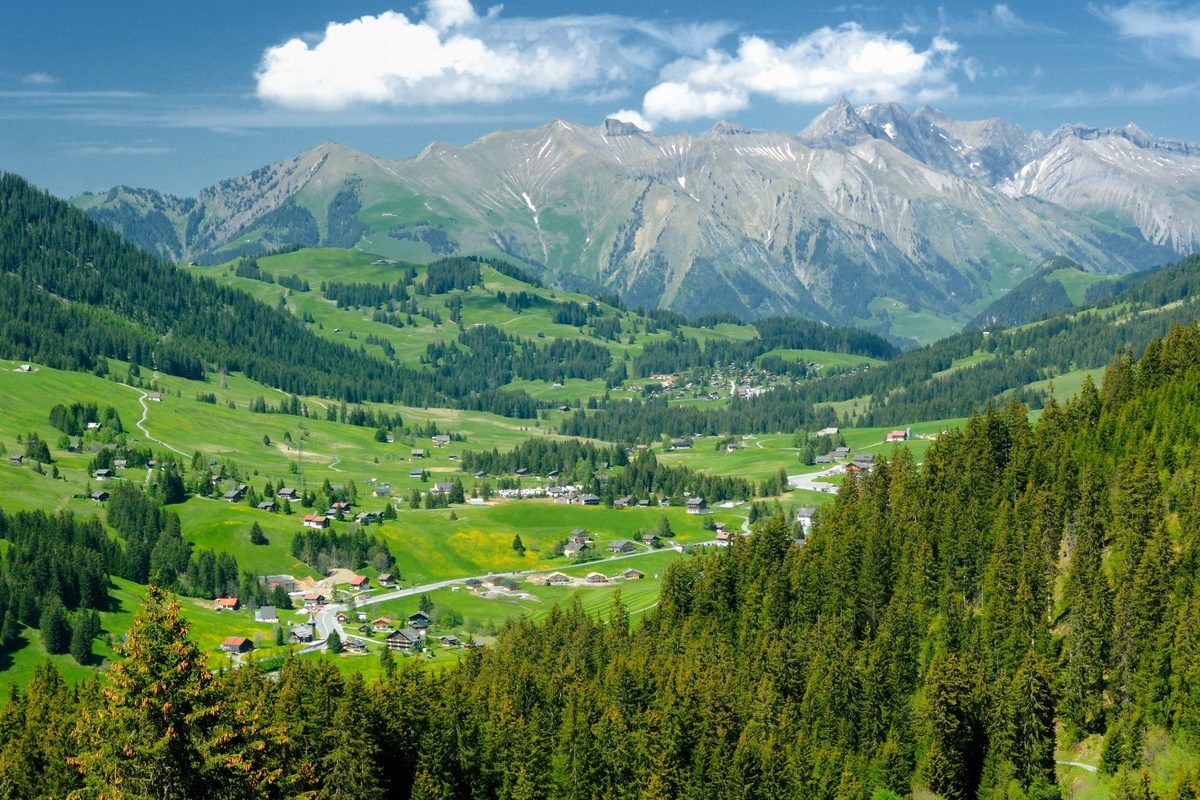
Les Mosses lies in the Vaud Prealps on a plateau straddling the Col des Mosses (1'445 m), which links Aigle to Château-d'Œx, in the municipality of Ormont-Dessous. The place was first an area of pastures. Les Fontaines, the main hamlet, later held cattle fairs. The carriage road and then winter sports turned it into a resort, which forms a ski area together with La Lécherette.[1][2]
History of Les Mosses
Bronze Age. A Bronze Age axe found at the Col des Mosses shows that the pass was used in prehistoric times.[2]
14th century. The pastures of Les Mosses are mentioned. The lords of Pontverre watch over the area from their castle of Aigremont and own land there, as do the counts of Gruyère, which leads to frequent quarrels.[2][6]
1328. To end the disputes, it is agreed that the Hongrin brook will mark the boundary between the two lords.[6]
1429. A large landowner of Les Mosses acknowledges that he owes taxes and labour to the count of Gruyère.[6]
1475. The Bernese cross the pass to seize Aigle: this is the oldest written record of a crossing of the pass.[2]
1476. Bern confirms the privileges of the people of the Ormonts. The quarrel with Château-d'Œx over the use of the Mosses forests and pastures flares up again at once.[6]
1502. In August, 300 young men from Château-d'Œx cross the pass, attack the Ormonts people and kill six men. Bern does not punish them, so the men of the Ormonts cross Les Mosses in turn and plunder the banks of the Sarine. They have to return their loot.[6]
16th century. The main hamlet, Les Fontaines, holds cattle fairs.[2]
1832. The Ormonts call for a carriage road over the pass.[2]
1868-1869. Construction of the carriage road over the Col des Mosses.[2]
1870. A school opens.[2]
Around 1900. The hamlet of Les Fontaines has a school and a post office, and the La Preisaz inn marks the highest point of the pass. Snow often stops the postal service in winter. Like many people of the Ormonts, the inhabitants live in their chalets only from July to January. Since the Montreux-Château-d'Œx railway opened, the pass road has seen far less traffic.[6]
1911. The church at L'Ortier, part of the parish of the Ormonts, is built. It was reportedly designed by the architect Charles Hepp in the Heimatstil style.
1938. A sled lift (funiluge) is installed, the start of winter tourism at Les Mosses.[1]
1951. A ski lift is put into service.[1]
1963. A chairlift to the Pic Chaussy is reportedly put into service, operating until 1987.
1982. Les Mosses reportedly hosts the World Alpine Skiing Championships for athletes with disabilities.
Economy of Les Mosses, past and present
Farming and forestry. Les Mosses belongs to a farming and forestry commune, which had 42 farms in 2008. In 2005 the primary sector provided 39% of its jobs and the tertiary sector nearly 46%, mostly linked to tourism.[1]
The resort. According to the FAO, the plateau grew into a winter sports resort from the 1950s, helped by its microclimate. The Les Mosses-La Lécherette area has about 40 km of slopes, and a direct link with Leysin opens up more than 100 km. Together with Château-d'Œx, Ormont-Dessous has developed the Espace nordique des Alpes vaudoises for cross-country skiing, snowshoeing, ski touring and sledging.[7]
Historic sites in Les Mosses
Col des Mosses. Pass at an altitude of 1'445 m in the municipality of Ormont-Dessous, between Aigle and Château-d'Œx. Part of the pass is listed as a mire landscape of national importance, following the Rothenthurm initiative.[2][3][4]
Les Fontaines. Main hamlet of Les Mosses, known for its cattle fairs from the 16th century.[2]
Church of L'Ortier. Church built in 1911, reportedly part of the parish of the Ormonts.
Remains in Les Mosses
Bronze Age axe. Axe discovered at the Col des Mosses, evidence of the use of the pass since prehistoric times.[2]
Traditions and festivals in Les Mosses
The sled dog race. Every winter the Les Mosses-La Lécherette plateau hosts an international sled dog race, organised by SOS Chiens Polaires. Nearly 70 teams from all over Europe meet there for sprint and skijoring events.[8]
Sources
- Dictionnaire historique de la Suisse, Mary-Claude Busset-Henchoz, « Ormont-Dessous », version du 02.11.2009
- Dictionnaire historique de la Suisse, Laurence Margairaz Dewarrat, « Mosses, col des », version du 26.01.2010
- Office fédéral de l'environnement, Inventaire fédéral des sites marécageux d'importance nationale, objet n° 99 « Col des Mosses/La Lécherette » (révision 2017)
- Parc naturel régional Gruyère Pays-d'Enhaut, « Col des Mosses »
- Statistique Vaud, « Population résidante permanente au 31 décembre 2025 »
- Dictionnaire géographique de la Suisse, tome III (Neuchâtel, Attinger, 1905)
- Official Gazette of the Canton of Vaud (FAO), "Alphabet des communes vaudoises: Ormont-Dessous"
- Alpes vaudoises (tourist office), "International sled dog race" (Col des Mosses)
Published by Sébastien Jörg ·
Other villages near Les Mosses
Missing information, or do you have a source? Suggest a correction or addition. Every submission is checked before it's published.
Suggest a change